Emergency Roof Repair in Woodbridge VA: What to Do Right Now
Emergency Roof Repair in Woodbridge VA: What to Do Right Now
Key Takeaways
- Emergency roof repair in Woodbridge VA starts with containing water inside your home — place buckets, move valuables, and document everything with photos before calling a contractor
- Emergency tarping costs $200 to $600, while permanent emergency repairs range from $350 to $1,500 depending on scope
- Never go on your roof during active rain, wind, or lightning — manage damage from inside and call a professional
- A local Woodbridge roofer can typically respond within 2 to 6 hours during business hours for emergency calls
- Storm damage repairs are usually covered by homeowners insurance minus your deductible ($1,000 to $2,500 on most Virginia policies)
If you need emergency roof repair in Woodbridge VA right now, here's the short version: contain the water inside your home, document the damage with photos, and call a local roofing contractor immediately. Do not go on the roof during active rain or wind. A professional can tarp the damaged area within hours to stop water entry, then schedule a permanent repair once conditions allow a thorough assessment. If the damage is storm-related, file an insurance claim the same day.
Now let's walk through each step in detail, because a roof emergency is stressful and the decisions you make in the first few hours directly affect how much damage your home sustains, what your insurance covers, and how quickly your roof gets restored to full function.
Woodbridge sits in the path of severe weather that moves through the Northern Virginia corridor regularly. Summer thunderstorms bring wind gusts that rip shingles off roofs along Dale Boulevard and Minnieville Road. Tropical storm remnants dump several inches of rain in hours, overwhelming any weak point in your roofing system. Winter ice storms coat the trees overhanging homes in Lake Ridge and Old Bridge, sending heavy limbs crashing onto roof surfaces. And the occasional hailstorm that tracks through Prince William County can damage every shingle on a roof in minutes. These aren't rare events — they're the normal weather cycle that Woodbridge homes face every year.
What Counts as a Roofing Emergency
Not every roof problem is an emergency, and understanding the distinction helps you respond appropriately. A true roofing emergency involves an immediate threat to your home's interior or structure. Here's how to tell the difference.
Situations That Require Immediate Action
- Active water entry during rain: Water is dripping or flowing through your ceiling, walls, or around light fixtures. This means the waterproof barrier of your roof has been breached and every minute of rain is adding to interior damage
- Large section of missing shingles or exposed deck: A storm has torn off shingles over an area larger than a few square feet, leaving the roof deck or underlayment exposed to direct weather contact
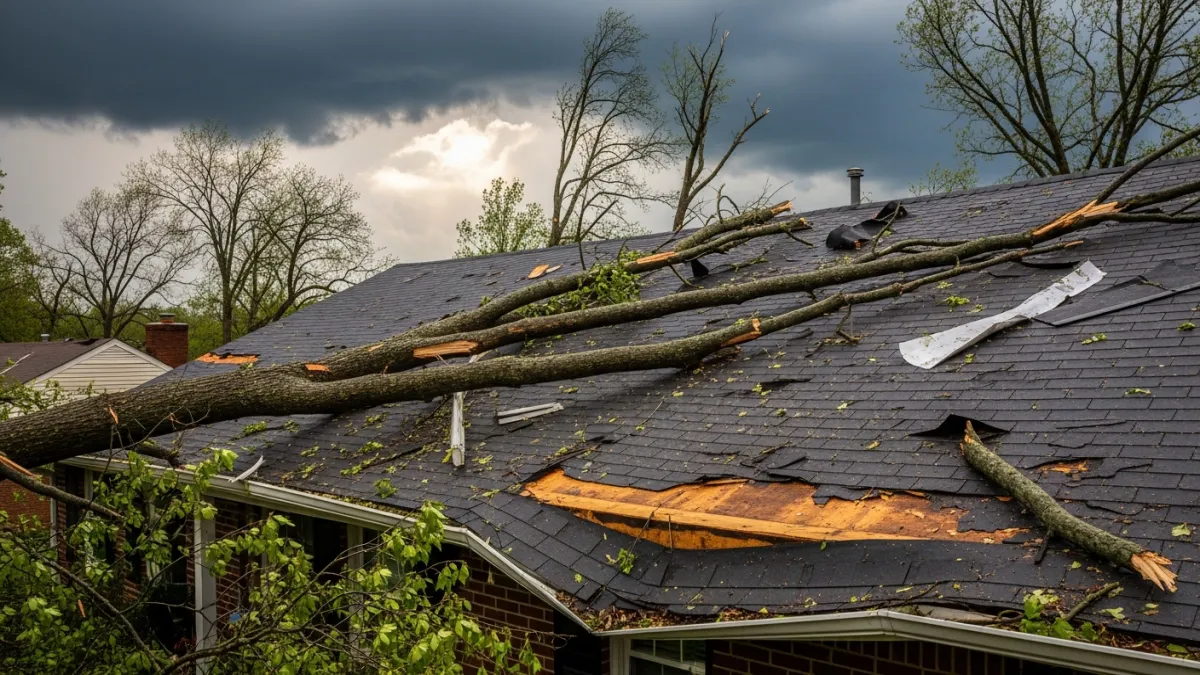
- Tree or large branch on the roof: The weight can cause structural damage and the impact has likely compromised shingles, flashing, or the deck beneath
- Holes or punctures in the roof surface: Flying debris during a storm has created an opening that admits water directly into the attic or living space
- Sagging roof sections: A visible sag in the roof line or ceiling indicates structural compromise — potentially waterlogged decking, broken rafters, or truss failure. This is the most dangerous scenario and may require evacuation
- Fire damage: Even a contained chimney fire or lightning strike can compromise the roof structure and create openings
Situations That Need Prompt Attention But Not Same-Day Emergency Service
- A few missing shingles with no active leak
- A slow drip from a pipe boot or minor flashing gap that only leaks during heavy, sustained rain
- Cosmetic damage — cracked or dislodged shingles that haven't yet led to water entry
- Gutter damage or detachment
- Minor granule loss visible in gutters after a storm
These situations should be addressed within days to weeks, not hours. Schedule a regular inspection and repair with your roofing contractor and monitor the areas for worsening during rain in the meantime.
What to Do Right Now: Step-by-Step Emergency Response
If you're dealing with a roof emergency at this moment, follow these steps in order. The goal is to minimize interior damage, protect your belongings, and document everything for your insurance claim.
Step 1: Contain the Water Inside Your Home
Place buckets, bins, or any available containers directly under active leaks. Spread towels or plastic sheeting on the floor around the leak area to protect flooring and prevent water from spreading. If water is entering near electrical fixtures, switches, or outlets, turn off the breaker for that circuit immediately — water and electricity is a life-threatening combination.
If your ceiling is bulging or sagging with trapped water, the safest approach is to place a large container beneath the bulge and carefully puncture the lowest point with a screwdriver or awl. This releases the water in a controlled stream rather than waiting for the ceiling to collapse under the weight and dump a large volume of water plus drywall debris onto your floor. A controlled release is messy but dramatically less damaging than a ceiling failure.
Step 2: Move Valuables and Furniture
Get furniture, electronics, documents, and personal items away from the affected area. Water damage compounds quickly — a soaked hardwood floor or saturated carpet can develop mold within 24 to 48 hours in Woodbridge's humid climate. The less material you expose to water, the lower your total damage and the simpler your insurance claim.
Step 3: Document Everything
Take photos and video of all damage — interior and exterior. Document the water entry point on the ceiling, any water staining or pooling on floors, damage to personal property, and any visible damage to the roof exterior that you can see safely from the ground. Timestamp your photos. This documentation becomes critical evidence for your insurance claim and establishes the timeline of damage.
Also note the date, time, and nature of the weather event that caused the damage. Insurance companies require this information, and having it ready when you call speeds up the claims process.
Step 4: Do NOT Go on the Roof
This is critical. Wet roof surfaces are extremely slippery. Storm conditions make heights even more dangerous. Fallen tree limbs may be unstable. And you can't safely assess or repair structural damage without professional equipment and training. Every year, homeowners are seriously injured attempting DIY roof repairs during or immediately after storms. Manage the situation from inside the home and let a professional handle the roof itself.
Step 5: Call a Local Roofing Contractor
Call a Woodbridge-based roofing company that offers emergency services. Describe the situation clearly: what happened, where the water is entering, and whether there's any visible structural damage. A local contractor can typically dispatch a crew for emergency tarping within 2 to 6 hours during business hours. After-hours and weekend calls may take 12 to 24 hours depending on demand, especially after major storms that affect many homes simultaneously.
When you call, ask these questions:
- Can you tarp my roof today?
- What is the emergency service fee?
- Do you handle insurance claims and can you be present for the adjuster inspection?
- What is your DPOR license number?
Step 6: File Your Insurance Claim
If the damage was caused by a storm, fallen tree, or other covered event, call your insurance company the same day to report the damage and open a claim. Most Virginia homeowner policies require "prompt" reporting of damage. Waiting days or weeks to file can complicate the process or give the insurer reason to question the timeline. For more guidance on navigating the insurance process, see our roofing insurance claims page.
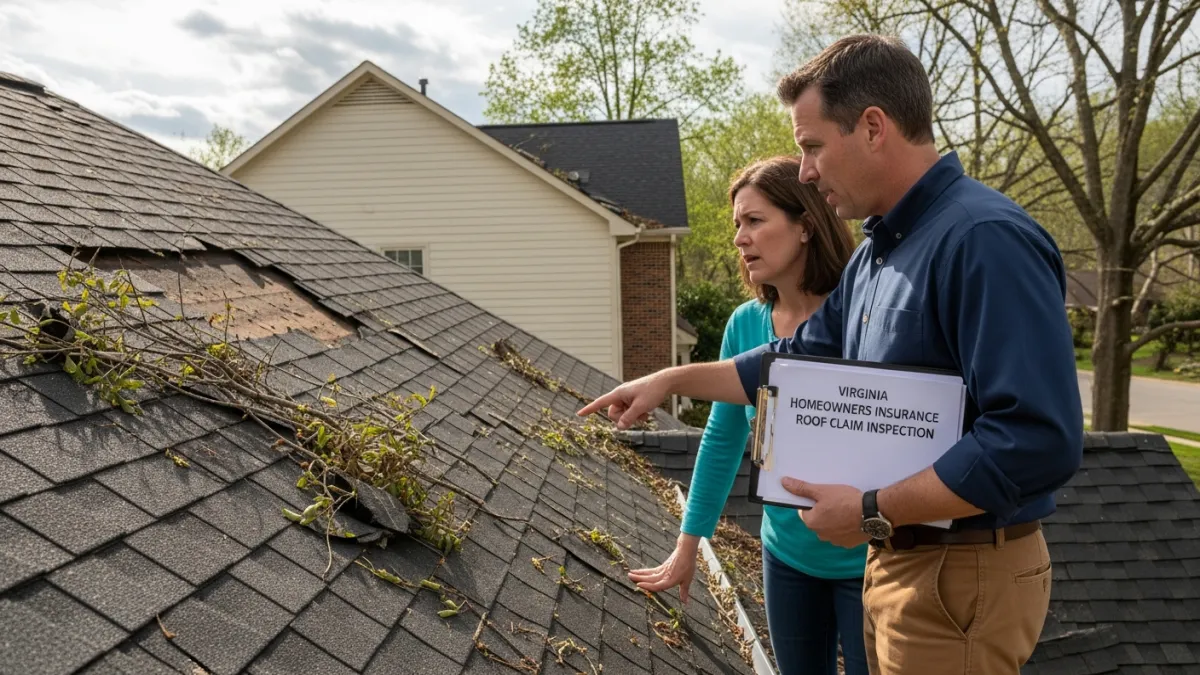
Your insurance company will schedule an adjuster to inspect the damage. Request that your roofing contractor be present during this inspection — they can identify all damage, including issues the adjuster might miss, and provide a professional scope of work that supports your claim.
Common Causes of Roof Emergencies in Woodbridge
Understanding what causes roof emergencies in the Woodbridge area helps you recognize risk factors on your own home and take preventive action before damage occurs.
Severe Thunderstorms and Wind Damage
Woodbridge sits in the Potomac corridor where summer thunderstorms develop rapidly and can produce wind gusts exceeding 60 mph. These gusts lift shingle tabs that have lost their adhesive seal — particularly on roofs over 15 years old where the asphalt binder has degraded from years of UV and heat exposure. Once a shingle is lifted, the next gust can rip it off entirely, exposing the underlayment or deck. A sustained windstorm can strip large sections of shingles from a roof, creating immediate water entry during the accompanying rain.
Homes along exposed ridgelines in communities like Montclair, Belmont Bay, and the neighborhoods along Gordon Boulevard are particularly vulnerable because they face wind without the buffer of surrounding structures or tree cover that lower-lying homes benefit from.
Fallen Trees and Heavy Branches
Prince William County is heavily wooded, and many Woodbridge neighborhoods — particularly Lake Ridge, Old Bridge Estates, and the areas near Leesylvania State Park — have mature trees within falling distance of homes. Ice storms, high winds, and the occasional microburst can bring entire trees or heavy limbs down onto roof surfaces. The impact creates immediate structural damage, punctures the roofing membrane, and often damages gutters, fascia, and siding simultaneously.
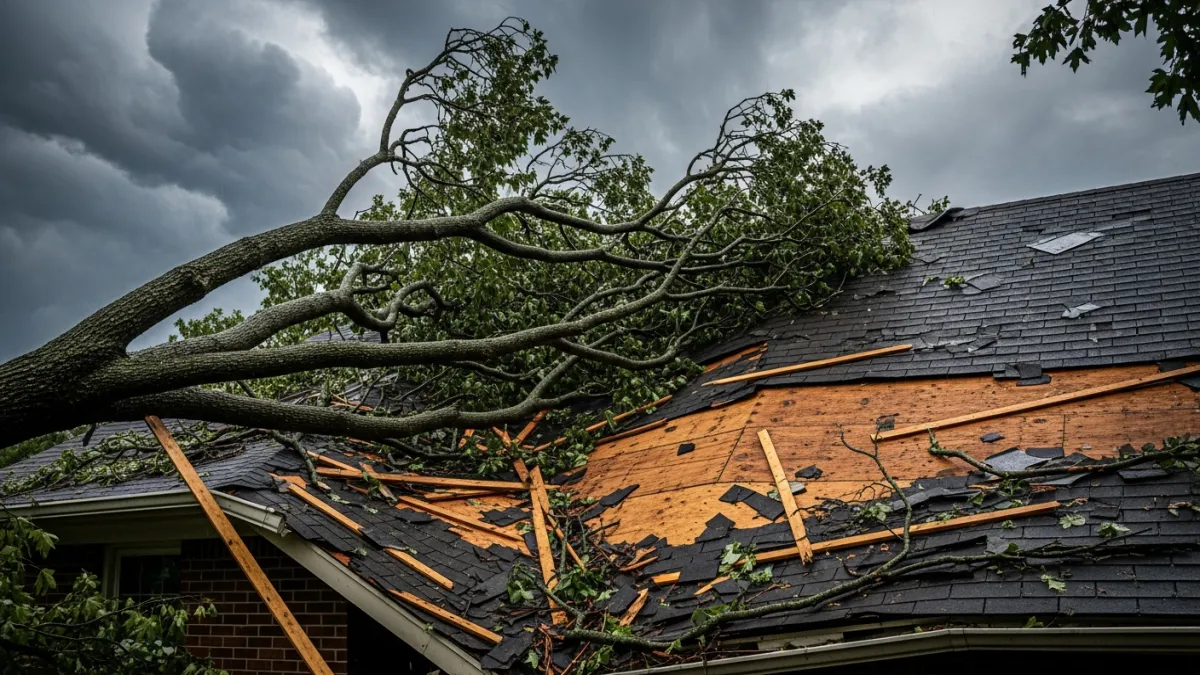
If a tree is on your roof, do not attempt to remove it yourself. The weight distribution may be the only thing preventing further collapse, and moving the tree incorrectly can worsen the structural damage. Call a roofing contractor and a tree service simultaneously — coordinating the tree removal and the roof stabilization requires professional judgment.
Hailstorms
While not as frequent in Woodbridge as in the Midwest, significant hailstorms do occur in Northern Virginia. Hail damages asphalt shingles by bruising the surface and dislodging granules, which compromises the shingle's waterproof barrier. The damage may not be immediately visible from the ground, but the affected shingles will fail prematurely — often developing leaks weeks or months after the storm. If a hailstorm passes through your area, schedule a professional inspection even if you don't see obvious damage from the ground.
Ice Dams in Winter
Northern Virginia winters produce the freeze-thaw cycles that create ice dams. When heat escaping from a poorly insulated attic melts snow on the upper portion of the roof, the meltwater flows down to the colder eaves where it refreezes into a ridge of ice. This ice dam traps subsequent meltwater, which pools behind it and works its way under shingles and into the attic. Homes in Woodbridge's older neighborhoods along Route 1 and in Dale City are especially prone to this problem because many were built before modern insulation and ventilation standards.
Ice dam emergencies require a professional approach — using a roof rake to remove snow from the eaves and applying calcium chloride ice melt to the dam. Never use a pickaxe or hammer to break ice off your roof. The permanent solution is improving attic insulation and ventilation so heat doesn't escape to melt snow on the roof surface in the first place.
Tropical Storm Remnants
Several times per decade, the remnants of a tropical system track through the Mid-Atlantic and deliver sustained heavy rain and wind to the Woodbridge area. These events test every weakness in a roofing system simultaneously — saturating underlayment, overloading gutters, driving wind-blown rain under shingles, and flooding low-slope sections. The combination of prolonged rain and moderate wind often causes more cumulative damage than a brief intense thunderstorm because the sustained assault finds every compromised seal, flashing joint, and degraded shingle.
What Happens When the Emergency Roofer Arrives
Understanding the emergency repair process helps you know what to expect and evaluate whether your contractor is handling the situation properly.
Phase 1: Assessment and Safety Check
The crew first evaluates the roof from the ground and from inside the attic to understand the scope of damage. They're checking for structural compromise, identifying the water entry point, and determining the safest approach to access and tarp the damaged area. If a tree is involved, they coordinate with a tree service if one isn't already on site.
Phase 2: Temporary Waterproofing
The immediate priority is stopping water entry. This typically involves applying a heavy-duty tarp over the damaged area, extending at least four feet beyond the damage on all sides, and securing it with 2x4 boards screwed through the tarp into the roof deck. For smaller areas, the crew may apply a temporary patch using roofing cement, modified bitumen membrane, or self-adhering ice-and-water shield directly over the breach. The goal is a weathertight seal that holds until a permanent repair can be made.
Phase 3: Damage Documentation
A professional contractor documents all visible damage with photos and notes during the emergency visit. This documentation serves dual purposes — it establishes the full scope of damage for your insurance claim, and it informs the permanent repair plan. The contractor should provide you with copies of all photos and a written description of what was found and what temporary measures were taken.
Phase 4: Permanent Repair Plan
Once the emergency is stabilized, the contractor assesses the full scope and provides an estimate for permanent repair. This may range from replacing a section of shingles and flashing to a full roof replacement if the damage is extensive. The repair is scheduled based on material availability, weather conditions, and the insurance claim timeline.
Cost of Emergency Roof Repair in Woodbridge VA
Emergency repairs carry higher costs than scheduled work because of the urgency, the after-hours availability, and the need to mobilize a crew quickly. Here's what to expect in the Northern Virginia market.
| Service / Item | Low End | High End | Notes |
|---|---|---|---|
| Emergency tarp installation | $200 | $600 | Temporary waterproofing over damaged area |
| After-hours/weekend service fee | $150 | $300 | Added to repair cost for non-business hours |
| Shingle repair (small section) | $350 | $800 | Replacing up to 1 roofing square |
| Flashing repair or replacement | $300 | $1,000 | Chimney, wall step, or valley flashing |
| Pipe boot replacement | $150 | $400 | Common leak source on aging roofs |
| Large section repair (multiple squares) | $800 | $2,500 | Includes matching shingles and underlayment |
| Decking repair (per sheet, 4x8) | $75 | $150 | Water-damaged or impact-damaged deck |
| Full roof replacement (if total loss) | $8,500 | $22,000 | See our cost guide |
Insurance Coverage for Emergency Repairs
Most Virginia homeowner insurance policies cover emergency roof repair when the damage is caused by a sudden, covered peril — wind, hail, falling trees, lightning, or fire. The policy typically covers both the emergency tarping and the permanent repair. You're responsible for your deductible, which is usually $1,000 to $2,500. Keep all receipts for emergency expenses including the tarping service, any supplies you purchased to contain water inside the home, and temporary housing if the damage makes your home uninhabitable.
Insurance does not cover damage resulting from normal wear and tear, deferred maintenance, or gradual deterioration. If your 25-year-old roof develops a leak during a rainstorm simply because the shingles are worn out, that's not a covered claim. But if a storm with documented wind speeds tears shingles off a roof that was otherwise functional, that's typically covered regardless of the roof's age.
Prices shown are typical ranges for Northern Virginia as of 2025 and vary based on damage scope, material requirements, and time of service. Contact us for a free assessment.
Preventing Roof Emergencies: Maintenance That Matters
The best emergency is the one that never happens. While you can't control the weather, you can control the condition of your roof going into storm season. These maintenance steps significantly reduce your risk of emergency damage.
Annual Professional Inspection
Schedule a professional roof inspection at least once per year, ideally in spring before storm season. The inspector checks every component — shingles, flashing, pipe boots, ridge vent, soffit vents, and gutters — and identifies small problems before they become emergency failures. A cracked pipe boot that's caught during an annual inspection costs $150 to $400 to replace. The same pipe boot that fails during a thunderstorm creates an interior water damage claim that can cost thousands.
Tree Management
Trim branches that overhang your roof or are within striking distance if the tree fails. Dead limbs, split trunks, and trees with root damage or fungal growth are the most likely to fall during storms. In the wooded neighborhoods of Lake Ridge, Old Bridge, and near Leesylvania State Park, proactive tree management is one of the most effective things you can do to prevent catastrophic roof damage.
Gutter Maintenance
Clogged gutters force water to back up under the roof edge, especially during heavy Woodbridge rainstorms. This water entry mimics an ice dam and can soak the fascia, soffit, and roof deck at the eave line. Clean your gutters at least twice per year — once in late fall after leaves have dropped and once in spring. Check that all downspouts are clear and directing water at least four feet from your foundation.
Attic Ventilation and Insulation
Proper attic ventilation extends shingle life and prevents ice dams in winter. A well-ventilated attic has balanced intake (soffit vents) and exhaust (ridge vent) that allow hot air to escape continuously. This prevents the attic temperature extremes that accelerate shingle aging from the underside. Adequate insulation on the attic floor prevents heat from escaping into the attic in winter, which eliminates the snowmelt pattern that creates ice dams.
Post-Storm Self-Inspection
After any significant storm, do a quick visual check from the ground. Walk around your home and look up at the roof from all sides. Look for missing or displaced shingles, damaged flashing visible at the edges, fallen debris, and bent or detached gutters. Check your attic for new water stains, damp insulation, or daylight visible through the roof boards. If you see anything concerning, schedule a professional inspection before the next rain event.
Choosing an Emergency Roofer in Woodbridge
When your roof is actively leaking, you're under pressure to act fast — but this is exactly when bad decisions get made. Storm chasers and unlicensed operators know that panicked homeowners are more likely to sign contracts without vetting the company. Protect yourself by following these guidelines even in an emergency.
Hire Local, Not Storm Chasers
After major storms, out-of-area contractors flood Woodbridge neighborhoods going door-to-door offering free inspections and immediate repairs. These companies often use high-pressure sales tactics, perform substandard work, and disappear before warranty issues surface. A local Woodbridge roofing company has a permanent presence in the community, relies on repeat business and referrals, and will be here in five years when you need warranty service.
Verify Credentials Even Under Pressure
A legitimate emergency roofer will provide their Virginia DPOR license number and proof of insurance without hesitation, even during an emergency call. It takes two minutes to verify a license on the DPOR website. An uninsured contractor who falls off your roof during an emergency repair can create a liability situation that dwarfs the cost of the roof damage itself.
Get a Written Scope Before Permanent Work Begins
Emergency tarping can be authorized verbally to stop immediate water entry. But permanent repairs should not begin until you have a written estimate with an itemized scope, price, and timeline. This protects both you and the contractor, and it's essential for insurance documentation.
The Repair-or-Replace Decision After Emergency Damage
After the emergency is stabilized, you'll face a decision: repair the damaged area or replace the entire roof. This decision depends on several factors.
When Repair Makes Sense
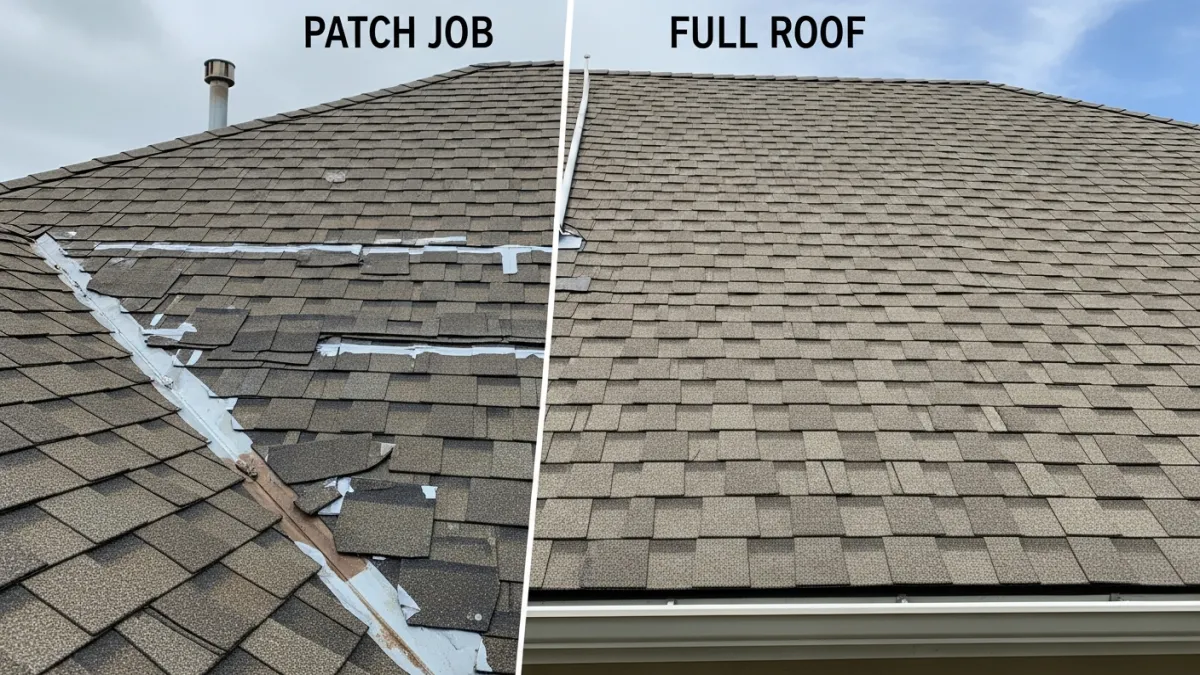
Repair is the right call when the damage is isolated to one area and the rest of the roof is in good condition with years of remaining life. A five-year-old roof with a tree branch impact to one section is a clear repair candidate. The undamaged portions still have 15 to 20 years of service, and a well-executed repair restores full function at a fraction of replacement cost.
When Replacement Is the Better Investment
Replacement becomes the smarter choice when the storm damage is widespread across the roof or when the roof was already nearing end of life. If a hailstorm has damaged shingles across every slope, patching isolated sections leaves compromised shingles everywhere you didn't patch. If your roof is 18 to 20 years old and a storm knocks off a section of shingles, the insurance claim may cover a full replacement — which gives you a new 25 to 30 year roof instead of a patch on an aging system. Your contractor can help you evaluate the economics and your insurance adjuster can determine what the policy covers. For a detailed look at the full replacement process, see our step-by-step guide.
The 30 Percent Rule
A useful guideline: if the cost of repairing the damage exceeds 30 percent of what a full replacement would cost, replacement is usually the better financial decision. For example, if a full replacement on your Woodbridge home would cost $12,000 and the repair estimate is $4,000 or more, you're spending a significant portion of replacement cost on a partial fix that leaves the rest of the aging roof in place. At that threshold, the incremental cost of replacement delivers dramatically more value per dollar spent.
Need Emergency Roof Repair Right Now?
Woodbridge Roofers responds to emergencies throughout Prince William County. Call us at (571) 570-7930 for immediate assistance or schedule a consultation online.
Schedule Free ConsultationFrequently Asked Questions
Conclusion
A roof emergency in Woodbridge demands quick, measured action. Contain the water inside your home, protect your belongings, document everything, and call a local roofing contractor — in that order. Do not attempt to climb on the roof during active weather. A professional crew can tarp the damaged area within hours and develop a permanent repair plan once conditions allow a thorough assessment. If the damage is storm-related, file your insurance claim immediately and have your contractor present when the adjuster inspects.
The best defense against roof emergencies is maintenance — annual inspections, tree management, clean gutters, and prompt repair of small issues before they become catastrophic failures. But when an emergency does happen, having a trusted local roofer who can respond quickly makes all the difference. Call Woodbridge Roofers at (571) 570-7930 or schedule a free consultation. We serve all of Woodbridge, Dale City, Lake Ridge, and communities throughout Prince William County.