Signs You Need a New Roof: Northern Virginia Homeowner Guide
Signs You Need a New Roof: Northern Virginia Homeowner Guide
Key Takeaways
- The most reliable signs you need a new roof in Northern Virginia include age over 20 years, widespread granule loss, curling or cracking shingles, recurring leaks, and sagging roof deck sections
- Northern Virginia's freeze-thaw cycles, summer humidity, and severe storms reduce roof lifespan to 20-25 years for standard asphalt shingles, shorter than manufacturer warranties suggest
- When cumulative repair costs reach 30 percent of full replacement cost, replacement becomes the smarter financial decision
- A professional roof inspection catches problems invisible from the ground, including compromised underlayment, deteriorated flashing, and soft decking
- Roof replacement in Northern Virginia costs $8,500 to $22,000 depending on material, and storm damage may be covered by homeowners insurance
If you own a home in Northern Virginia and you're wondering whether your roof needs replacement, the most telling signs you need a new roof are age beyond 20 years, shingle granules accumulating in your gutters after rain, curling or buckling shingles visible from the ground, recurring leaks in multiple locations, and any sagging or soft spots in the roof deck. Two or more of these appearing at the same time almost always means repair is no longer the cost-effective option.
Your roof is the single most important barrier between your home and the weather. In Northern Virginia, that means protecting against everything from intense summer heat and humidity in July and August, to ice storms and freeze-thaw cycles from December through March, to the severe thunderstorms and occasional tropical remnants that push through the Potomac River corridor. Every one of those conditions slowly degrades roofing materials, and the cumulative effect eventually reaches a point where patching and repairing no longer delivers reliable protection.
This guide walks through every major warning sign that your roof is approaching the end of its functional life, explains what each sign actually means in terms of structural integrity, helps you understand when repair still makes sense versus when replacement is the right call, and provides realistic cost expectations specific to the Northern Virginia market. Whether your home is in Woodbridge, Dale City, Lake Ridge, Manassas, or anywhere in Prince William County or the greater NoVA area, these indicators apply to the roofing systems installed on homes throughout the region.
Sign 1: Your Roof Is Over 20 Years Old
Age is the single most important factor in evaluating whether your roof needs replacement. Standard architectural asphalt shingles, which cover the vast majority of homes in Northern Virginia, carry manufacturer warranties of 25 to 30 years. However, real-world performance in this climate typically falls in the 20 to 25 year range. The gap between warranty length and actual lifespan exists because manufacturer warranties are based on ideal conditions, and Northern Virginia's weather is far from ideal for roofing materials.
The region experiences approximately 75 freeze-thaw cycles per winter season. Each cycle allows water to penetrate hairline cracks, expand as it freezes, and widen those cracks slightly. Over 20 winters, that cumulative damage weakens shingle integrity at a molecular level. Summer temperatures push attic spaces to 140 to 160 degrees when ventilation is inadequate, baking the asphalt binder that holds shingle granules in place. UV radiation degrades the surface continuously, even on overcast days. And the humidity that settles over the entire DMV corridor from May through September promotes algae and moss growth that holds moisture against the shingle surface.
If you don't know how old your roof is, check your home inspection report from when you purchased the property. You can also look for permit records through Prince William County, Fairfax County, or your local jurisdiction's building department. Another option is to ask a roofing contractor to estimate the age based on the shingle product line and its condition during an inspection.
The Age-Plus-Condition Rule
Age alone doesn't dictate replacement. A 22-year-old roof that has been well maintained, has proper ventilation, and shows minimal deterioration might have a few more years of reliable service. Conversely, a 15-year-old roof on a poorly ventilated home with deferred maintenance might already be failing. The practical rule is to start paying close attention once your roof passes the 15-year mark. Schedule a professional inspection every two to three years after that point so you have data on the rate of deterioration rather than being caught by surprise.
Sign 2: Shingle Granules in Your Gutters
Asphalt shingles are coated with ceramic granules that serve two essential purposes: they protect the asphalt layer from UV degradation, and they provide fire resistance. When shingles are new, some granule shedding is normal during the first few rain events. But on an aging roof, finding a consistent accumulation of granules in your gutters and at the bottom of your downspouts indicates that the protective surface layer is wearing away.
Check your gutters after any significant rainfall. A light dusting of granules is normal. A layer thick enough to feel gritty when you run your fingers along the gutter bottom is a warning sign. If you see bare spots on your shingles where the dark asphalt substrate is visible beneath where granules have worn away, the UV protection is compromised, and deterioration will accelerate rapidly from that point.
In Northern Virginia, heavy summer thunderstorms and the occasional hail event can strip granules from shingles in a single afternoon. After any storm that produces hail larger than a quarter or sustained winds above 60 mph, check your gutters for an unusual spike in granule accumulation. That volume of sudden loss from a single event can indicate storm damage that qualifies for an insurance claim, which is a different situation from gradual age-related wear.
Sign 3: Curling, Buckling, or Cracking Shingles
Shingle distortion is one of the most visible signs of roof failure, and you can often spot it from the ground with binoculars or even the naked eye from across the street. There are three common types of distortion, and each tells you something specific about what's happening:
- Cupping (edges curl upward): This happens when the bottom of the shingle dries and contracts faster than the top. It exposes the underlying surface to wind uplift and water infiltration. In Northern Virginia, cupping is often accelerated by heat radiating from poorly ventilated attics
- Clawing (center lifts, edges stay flat): This indicates the shingle is being stressed from below, typically by excessive attic heat or moisture. Clawing shingles lose their wind resistance and become increasingly vulnerable to blow-off during the thunderstorms common in this region from April through October
- Cracking: Thermal cycling causes shingles to expand and contract repeatedly. Over years, this repeated stress creates cracks that allow water to reach the underlayment and eventually the deck. Once cracking is widespread across multiple roof slopes, the shingle material has lost its structural flexibility permanently
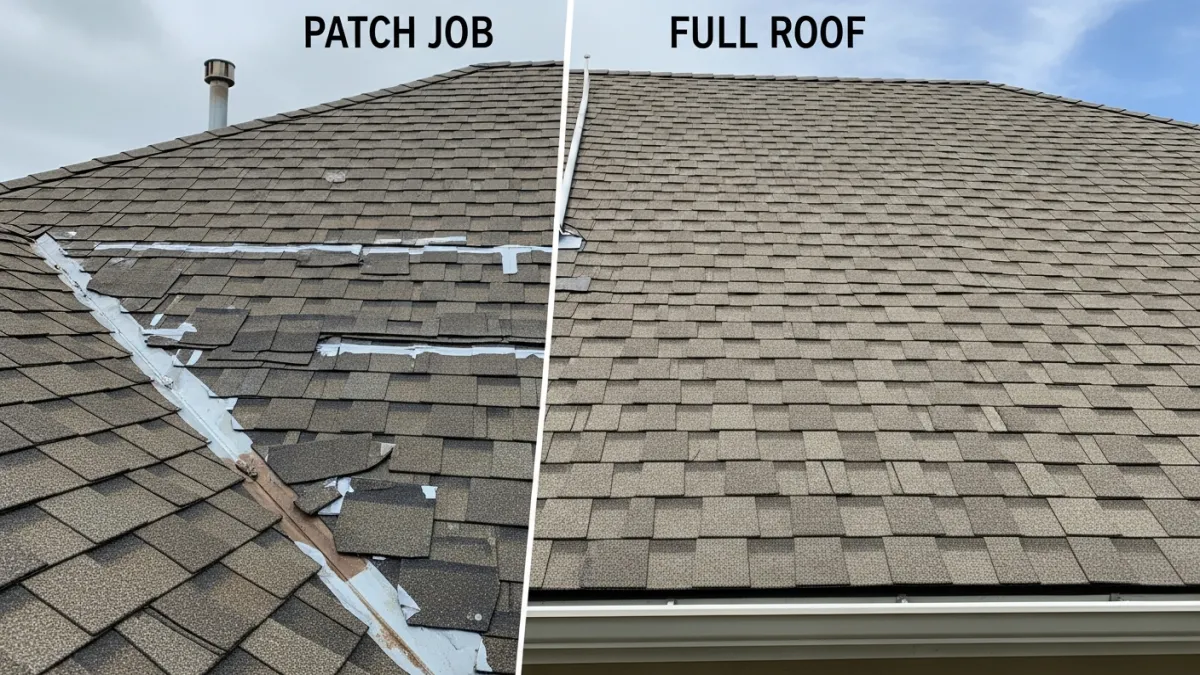
Isolated curling or cracking on a single slope, especially a south-facing one that takes the heaviest sun exposure, might be addressable with a targeted repair. But when you see distortion across multiple slopes on different sides of the house, the entire shingle field is deteriorating and replacement is the appropriate response.
Sign 4: Recurring or Multiple Leaks
A single leak in one location usually points to a specific failure: a cracked pipe boot, a separated flashing joint, or a few blown-off shingles. These are repair-worthy problems on an otherwise healthy roof. The situation changes fundamentally when you experience leaks in multiple locations or when the same area leaks repeatedly despite previous repairs.
Multiple leaks across different parts of the roof indicate systemic failure rather than isolated damage. The underlayment beneath the shingles may have deteriorated, the shingle adhesive seals may have failed across the entire field, or the cumulative effects of age and weather have compromised the system's ability to shed water reliably. Each new repair buys less time than the last because the underlying system is failing everywhere, not just in the spots where water happens to find its way inside first.
Water stains on your ceilings and upper-floor walls are the most obvious indicators. But leaks also reveal themselves through musty odors in the attic, damp insulation, dark streaks on rafters and sheathing, and in severe cases, mold growth on attic surfaces. If you notice any of these signs, get a professional inspection promptly. Water damage that goes unaddressed can compromise structural framing, ruin insulation, and create health hazards from mold exposure.
Sign 5: Sagging or Soft Spots in the Roof Deck
A sagging roofline is one of the most serious signs of roof failure because it indicates structural damage to the decking, and potentially to the rafters or trusses beneath. From the ground, sagging appears as a dip or wave in what should be a straight, even roofline. From inside the attic, it manifests as decking panels that feel soft or spongy when pressed, or areas where daylight is visible through gaps in the sheathing.
Sagging happens when water infiltration has been occurring for an extended period, slowly rotting the plywood or OSB decking panels. In Northern Virginia, ice dams along the eaves during winter are a common cause. When snow melts on the upper portion of a heated roof and refreezes at the colder eave edge, it creates a dam that backs water up under the shingles. That standing water saturates the decking repeatedly over the course of a winter, leading to delamination and rot that may not become visible until the following spring.
If you notice sagging, do not delay an inspection. The longer structural water damage goes unaddressed, the more extensive and expensive the repair becomes. What starts as a few rotted decking panels can progress to damaged rafters, compromised fascia boards, and even deterioration of the wall framing below the roofline.
Sign 6: Daylight Visible Through the Roof Boards
Go into your attic on a sunny afternoon with the lights off. If you can see pinpoints of daylight coming through the roof boards, water can follow those same paths during rain. Small gaps where daylight is visible typically indicate that decking has shifted, split, or deteriorated at the joints. In some cases, they signal that fasteners have pulled through the sheathing or that flashing has separated from the deck surface.
While you're in the attic, look at the underside of the roof deck for dark staining, which indicates past water infiltration. Check the insulation for dampness or compression. And look at the rafters and trusses for any signs of mold, mildew, or structural degradation. An attic inspection gives you information about your roof's condition that you simply cannot get from the ground or from the exterior surface alone.
Sign 7: Missing Shingles and Exposed Underlayment
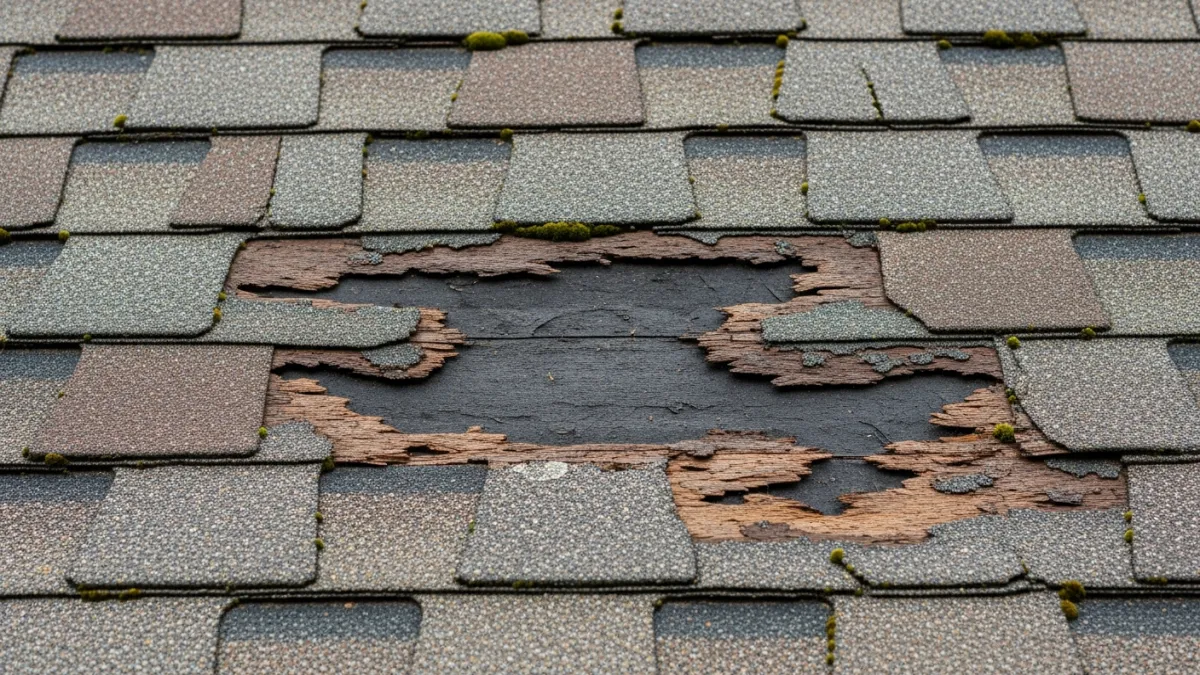
Missing shingles are the most visually obvious sign of roof damage, and they demand prompt attention. Every missing shingle leaves the underlayment, or in some cases the bare decking, exposed to direct weather. Synthetic underlayment provides temporary water resistance, but it was never designed to be the primary weather barrier. Direct UV exposure degrades underlayment rapidly, and once it fails, water reaches the decking with no remaining defense.
In Northern Virginia, shingles go missing for two primary reasons: wind damage from storms, and adhesive failure from age. New shingles have thermally activated adhesive strips that bond each shingle to the one below it, creating wind resistance rated to 110 to 130 mph on most architectural products. As shingles age, this adhesive weakens. Once the bond fails, even moderate winds of 40 to 50 mph can lift and tear shingles away.
If you lose a few shingles from a single storm event on an otherwise healthy roof, repair is straightforward. But if shingles are going missing during routine spring thunderstorms that don't produce extreme winds, the adhesive has failed across the entire shingle field, and more losses are inevitable. Replacement addresses the systemic adhesive failure that spot repairs cannot fix.
Sign 8: Moss, Algae, and Biological Growth
Dark streaks running down your roof are caused by Gloeocapsa magma, a type of blue-green algae that feeds on the limestone filler in asphalt shingles. While the algae itself is mostly cosmetic, it signals that moisture is being retained on the roof surface for extended periods, which accelerates granule loss and shingle deterioration. Algae growth is especially common on north-facing slopes and in areas shaded by trees, both of which are prevalent throughout Northern Virginia neighborhoods from Woodbridge to Fairfax to Manassas.
Moss is a more serious concern. Unlike algae, moss has a root structure that physically lifts shingle edges, creating gaps where water can penetrate. Moss also acts like a sponge, holding moisture against the shingle surface and preventing it from drying between rain events. Heavy moss growth on a roof that's already 15 or more years old compounds the existing age-related deterioration and can significantly shorten remaining lifespan.
On a younger roof, professional cleaning and the installation of zinc or copper strips along the ridge can control biological growth. On an older roof where moss has already lifted shingle tabs and compromised the surface, the damage is often too extensive for cleaning alone to restore reliable function.
Sign 9: Flashing Damage Around Chimneys, Vents, and Walls
Flashing is the metal material installed at transitions: where the roof meets a chimney, where a roof slope intersects a wall, around skylights, and at vent penetrations. Flashing is responsible for directing water away from these vulnerable joints, and when it fails, leaks follow quickly.
On older Northern Virginia homes, flashing was often installed using roofing cement rather than being properly stepped and counter-flashed. Roofing cement dries out and cracks within a few years, creating gaps that allow water to enter. Even properly installed metal flashing can separate from the chimney or wall surface over time as the structure expands and contracts with temperature changes.
If your leaks are concentrated around the chimney, skylights, or wall transitions, flashing repair or replacement might solve the problem without replacing the entire roof. But if flashing failure is occurring at multiple locations simultaneously on a roof that's already 18 or more years old, it's typically more cost-effective to replace the entire roofing system with new flashing installed as part of the project rather than piecemealing repairs to an aging system.
The Repair vs. Replacement Decision
Knowing when to repair and when to replace requires looking at the whole picture, not just the immediate problem. Here's a practical framework that Northern Virginia homeowners can use:
When Repair Makes Sense
- Your roof is under 15 years old
- The damage is limited to one area or slope
- You haven't had previous significant repairs
- The remaining shingle surface is in good condition with strong granule coverage
- The issue is a specific component failure (pipe boot, single flashing joint, localized wind damage)
When Replacement Is the Better Call
- Your roof is over 20 years old
- You've invested in two or more significant repairs in the past three years
- Problems are appearing on multiple slopes simultaneously
- Widespread granule loss, curling, or cracking is visible
- The roof deck has soft spots or structural concerns
- You're spending money on repairs to a system that's clearly approaching end of life
The 30 Percent Rule
A widely used guideline in the roofing industry is the 30 percent threshold. When the cumulative cost of repairs over a three to five year period reaches 30 percent of what a full replacement would cost, replacement becomes the better financial decision. Here's how that works in practice for a Northern Virginia home:
If a full roof replacement for your home would cost approximately $12,000, the 30 percent threshold is $3,600. If you've already spent $1,500 on a chimney flashing repair and $1,200 on patching a leak near a dormer, you've invested $2,700. One more $900 or higher repair puts you at or beyond the threshold. At that point, each additional dollar spent on the old roof is money that could have gone toward a new system with a 25 to 30 year lifespan and a full warranty.
This rule isn't absolute, but it provides a useful quantitative framework for a decision that often feels overwhelming when you're looking at it without structure. Track your repair expenditures and compare them to replacement estimates from local contractors.
What a Professional Roof Inspection Reveals
Many of the signs described in this guide are visible from the ground or from inside the attic. But a professional inspection reveals additional details that affect the repair-versus-replacement decision significantly. A qualified inspector examines:
- Shingle adhesion: Are the adhesive strips still bonded, or can shingles be lifted easily by hand? Failed adhesion is invisible from the ground but dramatically reduces wind resistance
- Underlayment condition: The layer beneath the shingles may have deteriorated even if the shingles themselves look acceptable from a distance
- Flashing integrity: Close inspection of every chimney joint, wall transition, and penetration reveals separations and sealant failures that are not visible from the ground
- Ventilation performance: Insufficient ventilation shortens roof life. An inspector evaluates whether the ridge vent, soffit vents, and attic space are providing adequate airflow to control temperature and moisture
- Decking condition from above: Walking the roof surface reveals soft spots that indicate decking deterioration beneath seemingly intact shingles
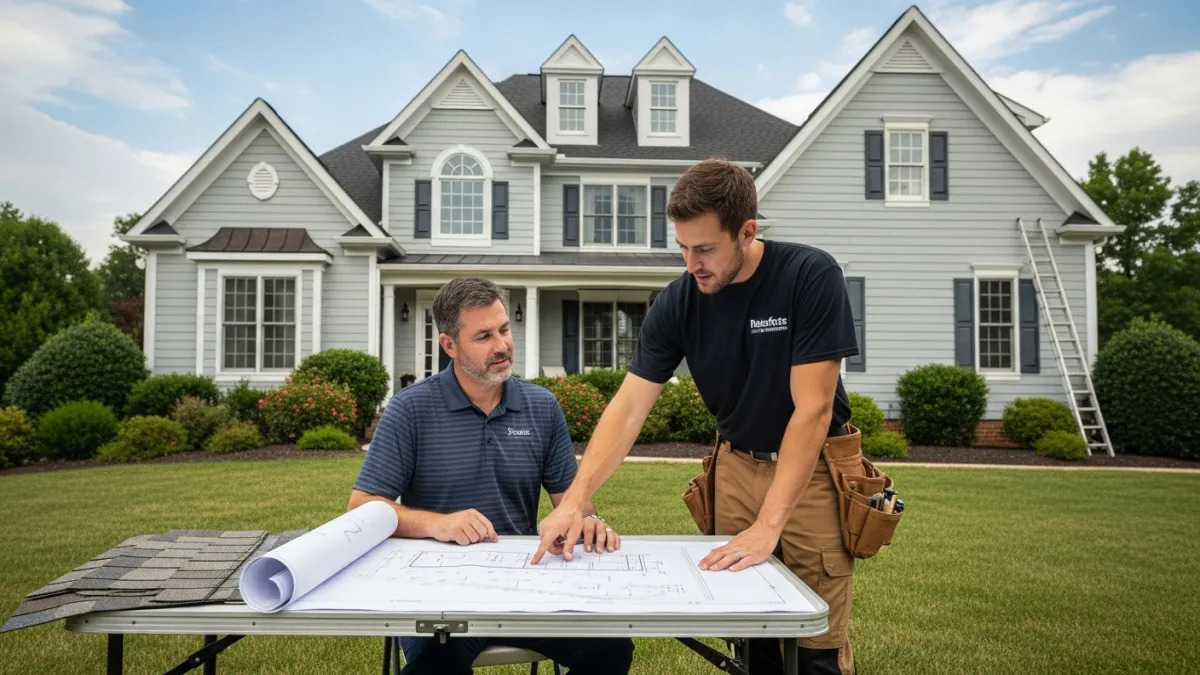
We provide free roof inspections throughout Northern Virginia. Having data from a professional assessment gives you the information needed to make a confident decision rather than guessing based on what you can see from the driveway.
How Northern Virginia Weather Affects Your Roof
Understanding the specific climate stresses that Northern Virginia imposes on roofing systems helps explain why roofs in this region age differently than roofs in other parts of the country.
Summer Heat and UV Exposure
Northern Virginia summers routinely bring temperatures into the 90s, with heat index values exceeding 100 degrees for days at a time. Attic temperatures in poorly ventilated homes can reach 150 to 160 degrees. This extreme heat bakes shingles from both sides, causing the asphalt binder to dry, become brittle, and lose its ability to retain granules. South-facing and west-facing slopes take the heaviest UV exposure and consistently deteriorate faster than north-facing slopes on the same home.
Freeze-Thaw Cycles and Ice Dams
Northern Virginia experiences an average of 75 to 90 freeze-thaw cycles per winter. Each cycle allows water to penetrate microscopic cracks, expand by roughly nine percent as it freezes, and widen those cracks. Over time, this process degrades shingle integrity and weakens the bond between shingles and the deck. Homes in areas with inconsistent snow cover, such as the neighborhoods along Route 1 in Woodbridge and Dale City, experience this cycling most intensely because the ground thaws and refreezes repeatedly rather than maintaining a stable snow pack.
Ice dams form when heat escaping through an insufficiently insulated attic melts snow on the upper roof, and the meltwater refreezes at the colder eave. The resulting ice dam blocks drainage, backing water under the shingles and saturating the decking. Homes with complex rooflines and multiple dormers are especially susceptible.
Severe Storms and Wind
The greater Woodbridge and Prince William County area experiences 30 to 40 thunderstorm days per year, many of them producing damaging wind gusts. Microbursts, which are localized columns of rapidly descending air, can produce gusts exceeding 80 mph without any tornado being present. These events strip shingles, break flashing seals, and can cause immediate catastrophic damage to roofs that were already weakened by age. If your roof has weathered 20 years of these storms, the cumulative stress on every fastener, adhesive strip, and flashing joint is substantial.
Cost of Roof Replacement in Northern Virginia
Once you've determined that your roof needs replacement, the next question is cost. Northern Virginia prices run 15 to 25 percent above national averages due to higher labor rates, stricter permit requirements, and material logistics costs. The following ranges are based on a standard 2,000 square foot home and represent total installed costs including materials, labor, tear-off, and disposal.
| Service / Item | Low End | High End | Notes |
|---|---|---|---|
| Architectural asphalt shingles (2,000 sq ft) | $8,500 | $15,000 | Material + labor, NoVA market |
| Premium designer shingles (2,000 sq ft) | $12,000 | $18,000 | Adds 5-10 years lifespan |
| Standing seam metal roof (2,000 sq ft) | $16,000 | $22,000 | 40-60 year lifespan |
| Tear-off and disposal (single layer) | $1,000 | $2,500 | Often included in total price |
| Decking replacement (per 4x8 sheet) | $75 | $150 | Quantity found during tear-off |
| Permit fees (Prince William County) | $75 | $250 | Required for full replacement |
| Professional roof inspection | $0 | $350 | Many contractors offer free inspections |
Prices shown are typical ranges for Northern Virginia as of 2025 and vary based on home size, material grade, site access, and current material costs. Contact us for a free on-site estimate.
Factors That Affect Your Price
- Roof size: Cost scales roughly proportionally with square footage, though larger roofs sometimes benefit from slightly lower per-square pricing
- Pitch: Steeper roofs require more safety equipment, slower installation, and more material per square foot of floor plan. A 12:12 pitch costs noticeably more than a 4:12
- Complexity: Dormers, valleys, skylights, chimneys, and intersecting planes all add labor and material
- Material grade: Standard architectural shingles versus premium lines with enhanced wind and impact ratings
- Number of existing layers: Removing two layers costs more than one
- Decking condition: Rotted decking is replaced per sheet and can add $500 to $2,000+ to the project
- Season: Off-season work (November through February) may be priced lower, though weather limitations apply
For a detailed breakdown of replacement costs specific to Woodbridge, see our guide on how much a new roof costs in Woodbridge VA. And to understand the step-by-step process once you decide to move forward, our roof replacement process guide covers every phase from inspection through final walkthrough.
What to Do When You Spot Warning Signs
Recognizing the signs is the first step. Acting on them promptly is what protects your home and your wallet. Here's a practical action plan:
- Document what you see. Take photos of visible damage from the ground and any interior signs like water stains or attic moisture. Note the dates and conditions when you first noticed each issue
- Schedule a professional inspection. A thorough on-site inspection provides the data you need to make a confident repair-versus-replacement decision. It also gives you documentation for insurance purposes if storm damage is a factor
- Get multiple estimates. If the inspection indicates replacement is needed, get two to three written estimates from licensed contractors. Compare them on an itemized basis, not just the bottom line
- Check your insurance. If the damage may be storm-related, file a claim before starting work. Your contractor should be present during the adjuster's inspection to ensure all damage is documented. Visit our roofing insurance claims page for details on the process
- Explore financing. If the replacement isn't covered by insurance and the cost is a concern, roofing financing options are available that allow you to pay monthly while getting the roof your home needs now
The worst option is to ignore warning signs and hope for the best. A failing roof doesn't improve on its own. Delaying replacement allows water damage to compound, structural components to deteriorate, and the eventual project cost to increase significantly. Addressing the problem when the first clear signs appear almost always costs less than waiting until an emergency forces your hand.
Not Sure If Your Roof Needs Replacement?
Schedule a free inspection with Woodbridge Roofers. We'll assess your roof's condition, show you exactly what we find, and give you an honest recommendation. Call us at (571) 570-7930 or book online.
Schedule Free ConsultationFrequently Asked Questions
Conclusion
Your roof communicates its condition through the signs covered in this guide: age, granule loss, curling and cracking, recurring leaks, sagging, missing shingles, biological growth, and flashing failure. The challenge for most Northern Virginia homeowners is not recognizing these signs but deciding how to respond. The 30 percent rule provides a financial framework, and a professional inspection provides the objective data you need to make that decision with confidence.
Northern Virginia's climate demands more from roofing systems than many other regions. If your roof is showing multiple warning signs, delaying action only increases the eventual cost and risk of interior damage. Call Woodbridge Roofers at (571) 570-7930 or schedule a free consultation to get a clear assessment of your roof's condition and an honest recommendation on the best path forward.