Storm Damage Roof Repair in Woodbridge VA: Your Complete Guide
Storm Damage Roof Repair in Woodbridge VA: Your Complete Guide
Key Takeaways
- After storm damage, your first steps are to stay safe, document damage from the ground with photos, prevent further water intrusion, and call your insurance company and a licensed storm damage roof repair contractor
- Homeowners insurance covers roof damage from sudden events like wind, hail, and fallen trees — but not wear and tear or deferred maintenance
- Storm damage repair costs in Woodbridge VA range from $350 to $1,500 for localized fixes, while full storm-related replacements run $8,500 to $22,000
- Having your roofing contractor present during the insurance adjuster inspection significantly increases the likelihood of full claim coverage
- Avoid storm chasers — out-of-town contractors who knock on doors after storms often deliver subpar work and disappear before warranty issues surface
When a storm damages your roof in Woodbridge, VA, the most important thing you can do is act quickly and methodically: document the damage, contact your insurance company, and call a licensed local roofing contractor who can provide emergency protection and guide you through the storm damage roof repair process from inspection through final restoration. Delays allow water intrusion to compound, turning a roofing repair into a structural problem that costs significantly more to fix.
Woodbridge sits in the I-95 corridor of Prince William County, where severe weather is not a matter of if but when. Summer thunderstorms regularly produce wind gusts exceeding 60 mph, driving rain, and occasional hail. Remnants of tropical systems push up from the south, dumping several inches of rain in hours. Winter brings ice storms and freeze-thaw cycles that exploit every weakness in a roofing system. And while tornadoes are rare in Northern Virginia, the region has experienced EF-0 and EF-1 events that caused significant localized damage in Prince William County. Hail damage is another common concern after severe storms in the area.
This guide walks you through exactly what to do after storm damage to your Woodbridge roof — from the immediate steps that prevent further damage through the insurance claims process, contractor selection, and the repair or replacement work itself. Whether you're dealing with a few missing shingles or an entire section of roof peeled back by wind, you'll know exactly how to handle it.
What to Do Immediately After Storm Damage
The first hours after discovering storm damage to your roof set the tone for everything that follows. Acting quickly and correctly protects your home from further damage, strengthens your insurance claim, and gets the repair process moving. Here's the step-by-step sequence.
Step 1: Stay Safe
Do not climb on your roof. After a storm, the roof surface may be slippery, structurally compromised, or covered in debris that creates fall hazards. Damaged areas may not support your weight. Leave the roof inspection to professionals who have the equipment, training, and insurance to work safely at height. If you see downed power lines near your home, stay away from them entirely and call your utility company immediately.
Step 2: Document Everything
Before anything gets moved, cleaned up, or repaired, document the damage thoroughly. Use your phone to take photos and video from multiple angles around the entire perimeter of your home. Capture:
- Missing, displaced, or damaged shingles visible from the ground
- Shingle pieces, granules, or debris in your yard and gutters
- Dented, bent, or detached gutters and downspouts
- Damaged flashing around chimneys, walls, and vents
- Fallen tree limbs on or near the roof
- Broken or cracked ridge cap shingles
- Any damage to siding, windows, or fencing caused by the same storm
- Water stains, dripping, or wet spots on ceilings, walls, and in the attic
Make sure your photos are date-stamped. This documentation becomes critical evidence for your insurance claim, especially if there's any question about when the damage occurred or what caused it.
Step 3: Prevent Further Damage
Your insurance policy requires you to take reasonable steps to prevent further damage after a covered event. This is called the "duty to mitigate," and failure to do so can reduce your claim payout. If water is entering your home, move furniture and belongings away from the affected area and place containers to catch water. If a section of roof is exposed, call your roofing contractor for emergency tarping. Do not attempt to tarp the roof yourself — it's dangerous, and an improperly secured tarp can cause additional damage in subsequent wind events.
Step 4: Contact Your Insurance Company
File your claim as soon as possible after the storm. Have your policy number ready, describe the damage you've documented, and note the date and time of the storm. The insurance company will assign a claim number and schedule an adjuster to inspect the damage, typically within one to two weeks after a localized storm. After a widespread storm event affecting many homes in Prince William County, the wait for an adjuster can stretch to three to six weeks due to high volume.
Step 5: Call a Licensed Local Roofing Contractor
Contact a licensed Woodbridge roofing company to schedule a professional inspection and emergency repairs. A qualified contractor will inspect the roof from ladder access points and the attic, identify all storm-related damage including less obvious issues like hail bruising and compromised underlayment, provide emergency tarping if needed, and prepare a detailed scope of work and estimate that aligns with how insurance companies evaluate claims. This inspection and scope become the foundation of your claim.
Types of Storm Damage to Woodbridge Roofs
Different storm events cause different types of roof damage, and understanding what to look for helps you communicate effectively with both your insurance company and your contractor.
Wind Damage
Wind is the most common cause of storm damage to Woodbridge roofs. Summer thunderstorms routinely produce gusts of 50 to 70 mph, and severe events can exceed 80 mph. Wind damage typically shows up as:
- Lifted or missing shingle tabs: Wind gets under the edge of shingles that have lost their adhesive seal and peels them up or tears them off entirely. Ridge caps and edge shingles along rakes are the most vulnerable
- Creased shingles: Wind can crease shingles without removing them, creating a fold line where the shingle will eventually crack and fail. Creased shingles often look intact from the ground but are functionally damaged
- Exposed underlayment: When multiple shingles are torn off a section, the synthetic underlayment beneath is exposed. While underlayment provides temporary water protection, it's not designed for prolonged UV exposure and must be covered with new shingles promptly
- Displaced flashing: Strong gusts can shift step flashing along walls and chimneys, opening gaps that allow wind-driven rain to enter
Wind damage is often uneven across a single roof. The side of your home facing the prevailing wind direction takes the worst beating, while sheltered slopes may show little or no damage. Your contractor will inspect every slope independently to document the full extent.
Hail Damage
Hail events in Prince William County tend to be localized — one neighborhood can get hit hard while a community two miles away sees nothing. Hail damage to asphalt shingles takes two forms:
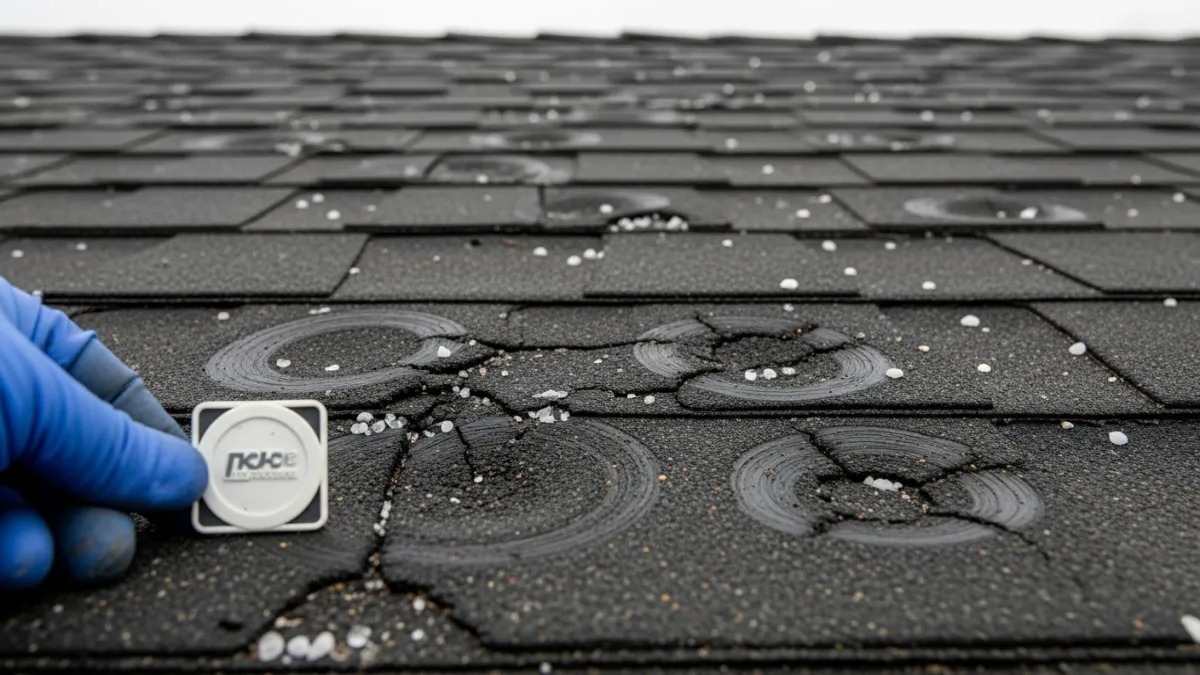
- Visible impact marks: Larger hail (one inch or greater) can crack shingles, dislodge granules in a circular pattern, or dent the shingle surface. These marks are often visible from the roof surface but not from the ground
- Bruising: Smaller hail may not crack the shingle surface but can bruise the underlying mat, compromising the shingle's structural integrity. Bruised shingles feel soft or spongy when pressed, compared to the firm surface of an undamaged shingle. This type of damage is invisible from the ground and requires hands-on inspection to detect
Hail also damages metal components — look for dents in gutters, downspouts, vent caps, and flashing. These dents serve as supporting evidence for your insurance claim, corroborating that hail of damaging size hit your property. Metal components like mailboxes, air conditioning condensers, and car hoods can also show hail impact marks.
Fallen Tree and Debris Damage
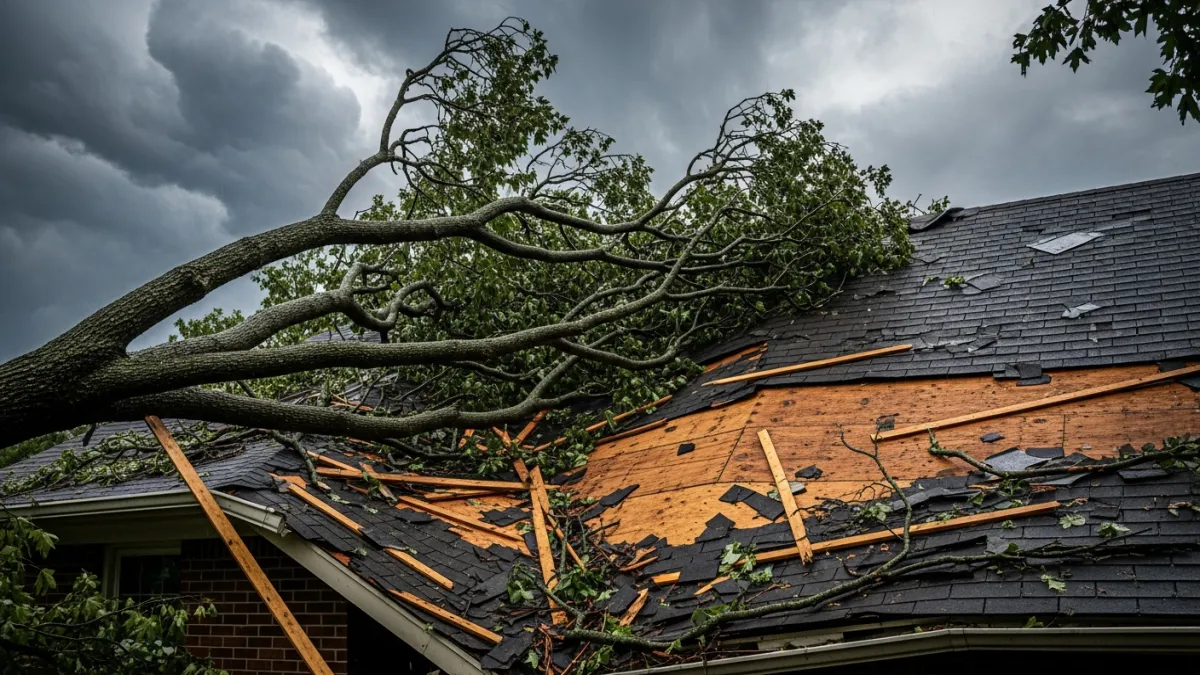
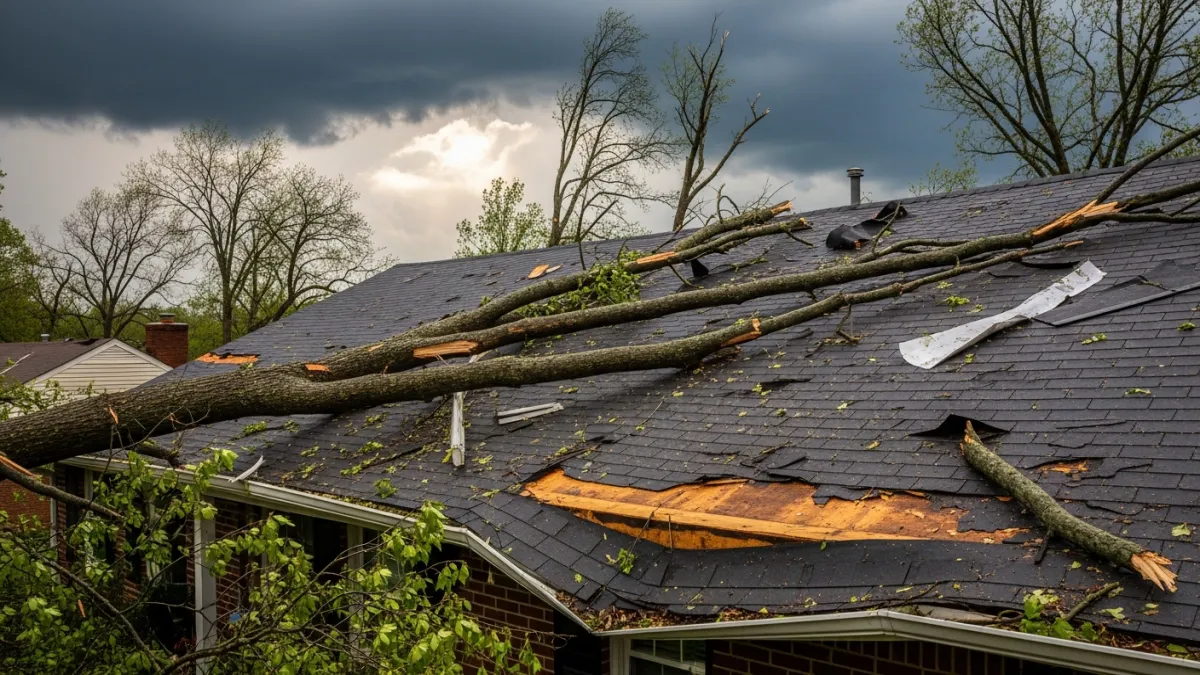
Woodbridge and its surrounding communities — Dale City, Lake Ridge, Montclair — have extensive mature tree coverage. High winds bring down limbs and occasionally entire trees onto roofs. Even a moderate-sized limb falling from 30 feet can crack shingles, break decking, damage ridge vents, and bend flashing. Large trees can cause structural damage to rafters and trusses that goes far beyond roofing.
If a tree or large limb is resting on your roof, do not attempt to remove it yourself. The weight may be holding damaged sections in place, and removing it without proper support can cause further collapse. Call a tree service and your roofing contractor — they'll coordinate the removal and immediate waterproofing of the exposed area.
Heavy Rain and Water Intrusion
Intense rainfall alone doesn't damage a healthy roof. But when rain combines with wind, it drives water horizontally under shingle laps and into gaps around flashing that would remain dry during a normal rain event. Heavy rain also overwhelms gutters, causing water to back up under the drip edge. The result is water intrusion that appears as stains on interior ceilings and walls, wet insulation in the attic, and — over time — mold growth in enclosed spaces.
If you notice water stains or dripping after a storm, the leak may not be directly above the stain. Water can travel along rafters and decking before dripping down at a point far from the actual penetration. A professional inspection from inside the attic is essential to trace the entry point accurately.
The Insurance Claims Process for Storm Damage
Navigating an insurance claim for storm damage roof repair in Woodbridge VA can feel overwhelming, but the process is straightforward when you understand each step. Here's how it works and what you can do to maximize your coverage.
Filing the Claim
Contact your insurance company as soon as possible after the storm. Most Virginia homeowner policies require timely notification, and delays can complicate your claim. Provide your policy number, the date of the storm, and a description of the damage you've observed. The insurer assigns a claim number and schedules an adjuster visit.
Keep records of every communication with your insurance company — dates, times, names of representatives, and what was discussed. This documentation protects you if disputes arise later in the process.
The Adjuster Inspection
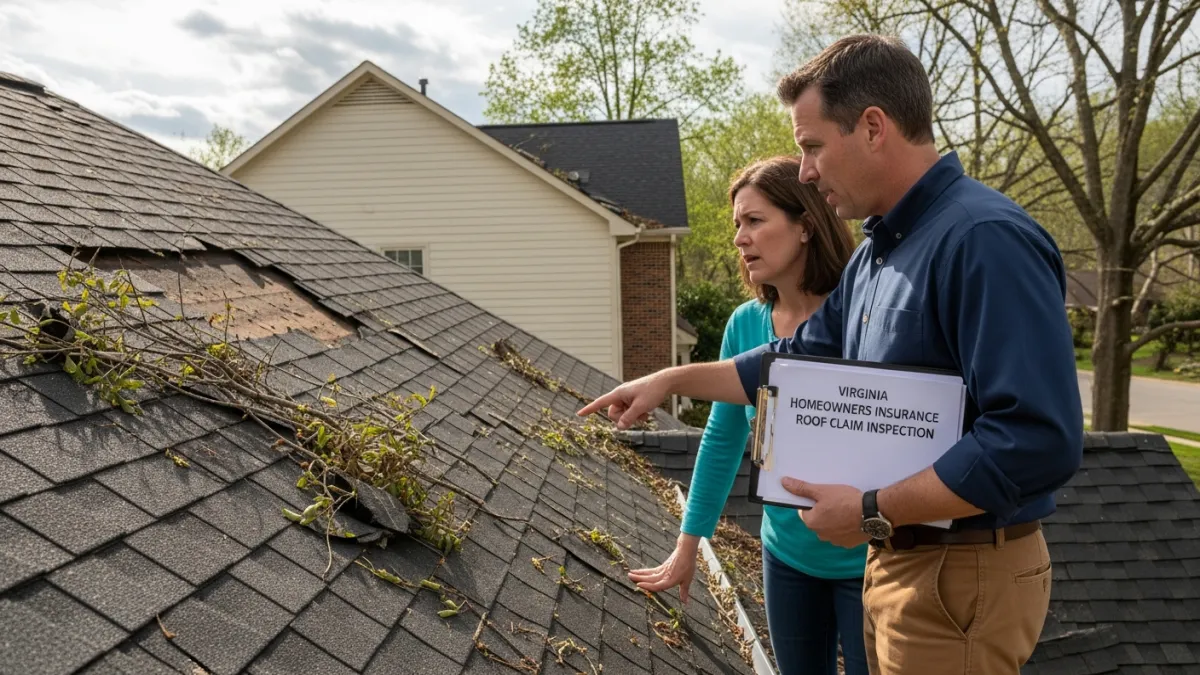
The insurance adjuster inspects your property to assess the damage and determine what the policy covers. This is the most critical step in the claims process, and having your roofing contractor present during the adjuster's visit significantly improves outcomes. Your contractor can:
- Point out damage the adjuster might miss, including hail bruising, compromised underlayment, and cracked flashing seals
- Explain the scope of repairs needed using industry-standard terminology that the adjuster's estimating software recognizes
- Ensure the adjuster documents the full extent of damage on every slope, not just the most visible areas
- Identify code-upgrade requirements that the policy may cover (ice-and-water shield, ventilation improvements)
Adjusters are professionals, but they're also working under time pressure and may be inspecting dozens of homes per day after a major storm. Having an experienced contractor on site ensures nothing gets overlooked. Learn more about how we help with insurance claims.
Claim Approval and Supplements
After the inspection, the adjuster generates an estimate based on their findings. This initial estimate may not cover the full scope of necessary work — and that's normal. Common items that get missed or undervalued in initial estimates include:
- Decking replacement discovered during tear-off
- Additional damaged areas not visible from the initial inspection angle
- Code-required upgrades like ice-and-water shield installation in valleys and at eaves
- Proper waste disposal and dump fees
- Overhead and profit margins for the contractor (some adjusters initially exclude these)
When additional damage or costs are identified, your contractor submits a supplement to the insurance company with detailed documentation. The supplement process is standard and not adversarial — it's how the claim gets adjusted to reflect the actual scope of work. A contractor experienced with insurance restoration in Woodbridge knows how to document supplements effectively and communicate with adjusters in the language they understand.
Your Deductible
You're responsible for your deductible regardless of how the claim is processed. Most Virginia homeowner policies carry deductibles of $1,000 to $2,500, though some policies have percentage-based deductibles (typically 1 to 2 percent of the home's insured value) specifically for wind and hail claims. Check your policy declarations page to know your deductible amount before filing. Any contractor who offers to "cover" or "waive" your deductible is engaging in insurance fraud — avoid them.
Cost of Storm Damage Roof Repair in Woodbridge VA
The cost of storm damage repair varies widely depending on the type and extent of damage. Here are typical ranges for Woodbridge and Northern Virginia, where prices run 15 to 25 percent above national averages.
| Service / Item | Low End | High End | Notes |
|---|---|---|---|
| Emergency tarp and temporary waterproofing | $250 | $800 | Prevents further damage after storm |
| Localized shingle repair (small area) | $350 | $1,000 | Replacing blown-off or damaged shingles |
| Flashing repair or replacement | $200 | $800 | Per location (chimney, wall, vent) |
| Ridge cap replacement | $300 | $800 | Common wind damage area |
| Pipe boot replacement | $150 | $350 | Per penetration |
| Full roof replacement (storm damage, 2,000 sq ft) | $8,500 | $22,000 | Usually covered by insurance minus deductible |
| Decking replacement (per sheet, 4x8) | $75 | $150 | Found during tear-off, covered by claim |
| Gutter repair or replacement (per linear foot) | $8 | $25 | Often damaged alongside roof |
The Repair vs. Replacement Calculation
Not every storm-damaged roof needs full replacement. The decision depends on the extent and distribution of the damage, the age of the existing roof, and the economics of repair versus replacement. A useful rule of thumb: if storm damage affects more than 30 percent of the total roof area, or if the roof was already nearing the end of its useful life (18 to 20+ years for asphalt shingles), replacement is usually the better financial decision. Repairing scattered damage across an aging roof delivers diminishing returns because the unrepaired areas continue to deteriorate.
For a five-year-old roof with storm damage localized to one slope, targeted repair makes sense — the rest of the roof has years of service life remaining. For a 22-year-old roof with damage across multiple slopes, the storm event may be the catalyst for a replacement that was needed soon anyway, and your insurance claim can cover most of the cost.
Prices shown are typical ranges for Northern Virginia as of 2025 and vary based on damage extent, material grade, site access, and current material costs. Contact us for a free inspection and estimate.
Avoiding Storm Chasers in Woodbridge
After every major storm that hits Prince William County, out-of-town roofing crews descend on affected neighborhoods. They knock on doors, hand out business cards, and offer to inspect your roof for free. Some are legitimate contractors from neighboring regions trying to help with surge demand. Many are not. Here's how to identify and avoid storm chasers who can cost you money and headaches.
Red Flags to Watch For
- Door-to-door canvassing immediately after a storm: Legitimate local contractors are busy responding to calls from existing customers and referrals — they don't need to walk neighborhoods soliciting business
- Out-of-state license plates on the work truck: While not automatically disqualifying, this is a flag that warrants additional verification of their Virginia DPOR license
- Pressure to sign a contract immediately: "This price is only good today" is a sales tactic, not a business practice. A legitimate contractor gives you time to make an informed decision
- Offering to cover your deductible: This is insurance fraud. Any contractor who proposes this arrangement is not someone you want working on your home
- No verifiable local address: Ask for their office address and verify it. A P.O. box or "we work out of our trucks" is not reassuring when you need warranty service two years from now
- Requesting large upfront deposits: A reasonable deposit for a roof replacement is 10 to 30 percent. Anyone asking for 50 percent or more before starting work is a risk
Why Local Contractors Are the Better Choice
A roofing company based in Woodbridge or Prince William County has a permanent presence in your community. They have a physical office, a local phone number that gets answered, and a reputation built over years of serving your neighbors. When a warranty issue surfaces 18 months after the job, they're still here. When you need a repair five years from now, they answer the phone. Storm chasers, by definition, move on to the next disaster zone — and their warranty promises go with them.
Local contractors also understand the specific permit requirements in Prince William County, the HOA dynamics in Dale City and Woodbridge neighborhoods, and the climate factors that affect material selection and installation practices here. That local knowledge produces better outcomes on every project.
Storm Damage Prevention for Woodbridge Homes
While you can't control the weather, you can take steps to minimize the damage storms cause to your roof. These preventive measures reduce your risk and can lower the severity of damage when storms do hit.
Annual Roof Inspections
Schedule a professional roof inspection at least once a year, ideally in spring before storm season begins. The inspector checks for loose or deteriorating shingles, compromised flashing, degraded pipe boots, and any vulnerabilities that a storm could exploit. Addressing these issues proactively costs a fraction of what emergency repairs cost after a storm. Regular inspections also establish a documented baseline condition of your roof, which strengthens any future insurance claim by proving the damage is storm-related rather than pre-existing.
Tree Maintenance
Woodbridge neighborhoods are heavily treed, and overhanging branches are a major source of storm damage. Trim any branches that extend within six feet of your roof surface. Remove dead or dying trees that could fall on your home in high winds. The cost of proactive tree maintenance — typically $200 to $1,500 depending on the tree size and location — is far less than the cost of removing a tree from your roof and repairing the damage it caused.
Gutter Maintenance
Clean gutters handle storm runoff effectively. Clogged gutters cause water to back up under the drip edge and behind the fascia, creating water intrusion that mimics roof damage. Clean your gutters at least twice a year — once after the leaves fall in November and once in spring. Consider gutter guards if your home is surrounded by mature trees that clog gutters frequently.
Impact-Resistant Shingles
If you're replacing your roof, consider upgrading to impact-resistant shingles rated Class 3 or Class 4 under the UL 2218 standard. These shingles are designed to withstand hail impact without cracking or losing granules. They cost approximately 10 to 20 percent more than standard architectural shingles, but some insurance companies offer premium discounts of 5 to 28 percent for homes with Class 4 impact-resistant roofing. Over the lifespan of the roof, the insurance savings can offset the higher material cost. Visit our materials page for more information on shingle options.
The Storm Damage Repair Process
Once your insurance claim is approved and your contractor is selected, the repair or replacement follows a structured process. Here's what to expect.
For Localized Repairs
If the storm damage is limited to a specific area — a section of missing shingles, a displaced ridge cap, or damaged flashing — the repair is typically completed in a few hours to one day. The crew removes the damaged materials, inspects the underlayment and decking beneath, replaces any compromised components, and installs new shingles or flashing that match the existing roof as closely as possible. Color matching can be challenging on older roofs because shingles fade with UV exposure, but an experienced contractor will source the closest available match and install it where the color difference is least visible.
For Full Replacement
When storm damage warrants full replacement, the process mirrors a standard roof replacement: complete tear-off, deck inspection and repair, and installation of a new roofing system. The timeline is typically one to three days on site. The primary difference is the coordination with your insurance company — your contractor handles the claim documentation, supplement submissions, and adjuster communications so you can focus on your daily life rather than paperwork.
Full replacement after storm damage is an opportunity to upgrade your roofing system. You may be able to upgrade from three-tab to architectural shingles, add ice-and-water shield in valleys and at eaves (now required by code in Virginia), improve attic ventilation, and select impact-resistant shingles — all within the scope of the insurance claim when these items are code-required or when you pay the price difference for elective upgrades.
Seasonal Storm Patterns in Woodbridge VA
Understanding when storms are most likely helps you prepare proactively. Woodbridge experiences distinct seasonal storm patterns that affect your roof differently throughout the year.
Spring (March through May)
Strong frontal systems move through Northern Virginia as winter transitions to spring, bringing high winds, heavy rain, and occasional hail. These transitional storms can be particularly damaging to roofs weakened by winter freeze-thaw cycles. Spring is the ideal time for a post-winter inspection to catch any damage before the more severe summer storm season begins.
Summer (June through August)
This is peak storm damage season in Woodbridge. Afternoon and evening thunderstorms develop rapidly, producing wind gusts that frequently exceed 60 mph, brief but intense downpours, and occasional hail. The combination of extreme heat during the day and sudden severe storms creates the most demanding conditions for roofing materials. Late summer also brings the potential for tropical storm remnants that can dump four to eight inches of rain in 24 hours.
Fall (September through November)
Hurricane season extends through November, and remnants of Atlantic hurricanes can affect Northern Virginia with heavy rain and sustained winds. Fall also brings the transition storms that precede winter, along with the first freeze-thaw cycles. Fallen leaves clog gutters, causing water backup that can damage fascia boards and create ice dams later in the season if not cleared.
Winter (December through February)
Ice storms and heavy snow loads are the primary winter threats to Woodbridge roofs. Ice dams form when heat escaping through an inadequately insulated attic melts snow on the upper roof surface. The meltwater flows down to the colder eaves, refreezes, and creates a dam that traps water behind it. That trapped water backs up under shingles and into the home. Proper attic insulation and ventilation are the primary defenses against ice dams.
Storm Damage? Call Us Now
If your Woodbridge roof has storm damage, don't wait. We provide emergency tarping, thorough damage assessments, and full insurance claim support. Call us at (571) 570-7930 or schedule an inspection online.
Schedule Free ConsultationFrequently Asked Questions
Conclusion
Storm damage roof repair in Woodbridge VA doesn't have to be a stressful ordeal when you follow the right steps: stay safe, document everything, file your insurance claim promptly, and work with a licensed local roofing contractor who knows how to navigate the claims process and deliver quality repairs. The combination of prompt action and professional guidance protects your home from further damage and ensures you receive the full insurance coverage you're entitled to.
Whether your roof has a few missing shingles or an entire section torn back by wind, Woodbridge Roofers is here to help. We provide emergency tarping, thorough damage assessments, detailed insurance documentation, and expert repairs and replacements. Call us at (571) 570-7930 or book a free consultation to get your roof inspected and your claim started.