What Is TPO Roofing and Should Your Virginia Business Use It?
What Is TPO Roofing and Should Your Virginia Business Use It?
Key Takeaways
- TPO (Thermoplastic Polyolefin) roofing is a single-ply membrane system that has become the most popular flat roofing material for commercial buildings in Northern Virginia over the past 15 years
- TPO costs $5.50 to $9.00 per square foot installed in Northern Virginia, making it one of the most cost-effective commercial roofing systems available
- A properly installed TPO roof lasts 20 to 30 years with appropriate maintenance, and its heat-welded seams create the strongest joint in single-ply roofing
- TPO's white reflective surface reduces cooling costs by 10 to 25 percent compared to dark EPDM or built-up roofing, a significant advantage in Virginia's hot summers
- Installation quality is critical with TPO — the heat-welded seams require precise temperature control and operator skill, making contractor selection the most important decision in a TPO project
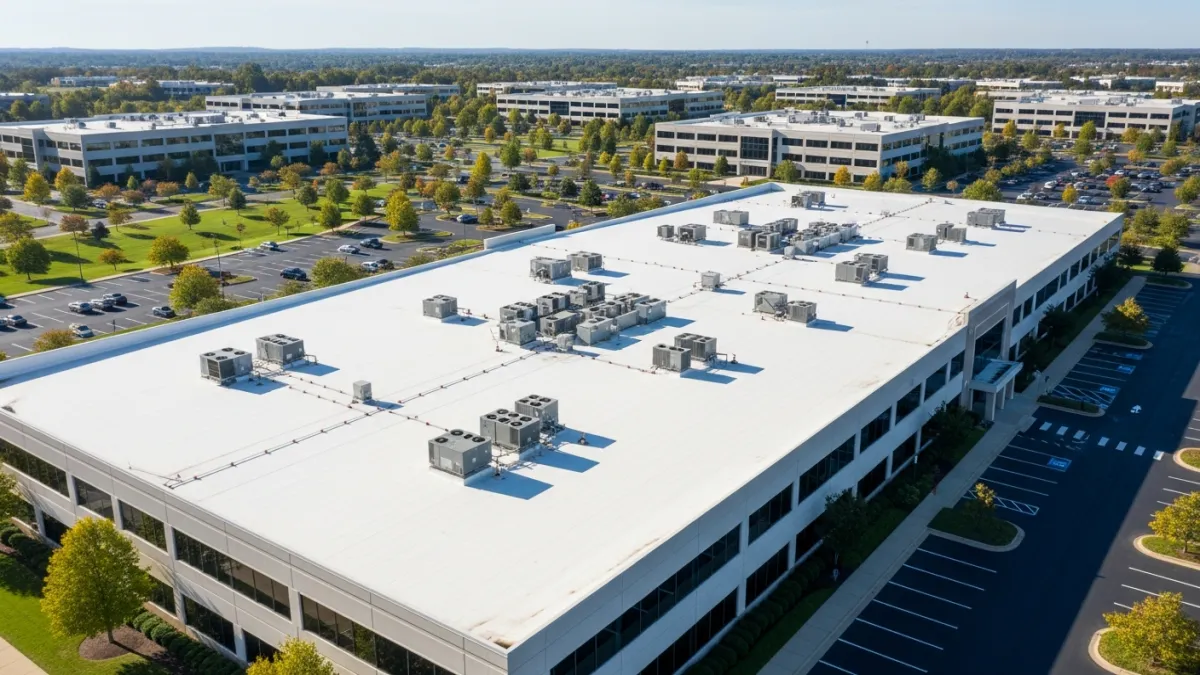
If you own or manage a commercial building in Northern Virginia with a flat or low-slope roof, you've almost certainly been told about TPO roofing. It's the most widely installed commercial roofing membrane in the United States, and for good reason — it offers an effective combination of performance, energy efficiency, and cost that has made it the default choice for commercial flat roofs from strip malls along Route 1 to office buildings in the Dulles corridor. But "most popular" doesn't automatically mean "best for every building," and understanding what TPO is, where it excels, and where it has limitations will help you make a better decision for your specific property.
This guide covers what TPO roofing actually is, how it compares to the alternatives (EPDM and PVC), what it costs in Northern Virginia, how long it lasts, what can go wrong, and how to find a qualified installer. Whether you're planning a new construction project, re-roofing an existing building, or trying to extend the life of a current flat roof, this information will help you evaluate TPO as an option.
What Is TPO Roofing?
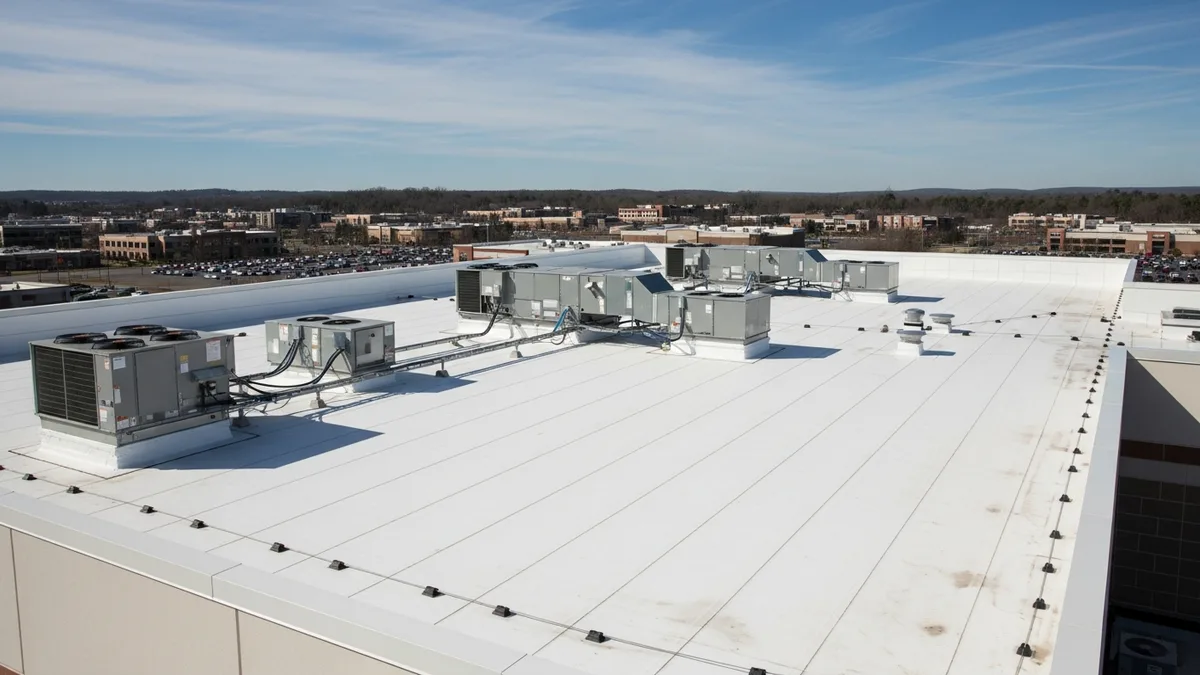
TPO stands for Thermoplastic Polyolefin. It's a single-ply roofing membrane manufactured in large sheets (typically 10 to 12 feet wide) that are rolled out across the roof surface and joined together using hot-air welding. The membrane is composed of a blend of polypropylene and ethylene-propylene rubber, reinforced with a polyester fabric scrim for strength. It's available in white, gray, and tan, with white being the most common choice for its energy-reflective properties.
The key technical advantage of TPO is its heat-welded seams. Unlike EPDM (which uses adhesive or tape to join sheets) or built-up roofing (which relies on multiple layers of asphalt and felt), TPO seams are fused together by a hot-air welding machine that melts the membrane edges and bonds them into a single continuous sheet. When done correctly, the welded seam is actually stronger than the membrane itself — meaning the seam is the last place a TPO roof will fail.
Advantages of TPO Roofing for Northern Virginia Buildings
Energy Efficiency in Virginia's Hot Summers
Northern Virginia summers push temperatures into the 90s regularly from June through September, and attic/plenum spaces above flat roofs can reach 150 to 170 degrees under a dark roof surface. TPO's white reflective surface reflects up to 80 percent of solar energy rather than absorbing it, reducing the heat load on the building's cooling system. Commercial building owners in the Woodbridge and Prince William County area report cooling cost reductions of 10 to 25 percent after switching from dark EPDM or built-up roofing to white TPO. On a 10,000 square foot commercial building with $3,000 to $5,000 in annual cooling costs, that's a meaningful operational savings that compounds every summer for the life of the roof.
Heat-Welded Seam Strength
The heat-welded seams are TPO's strongest feature. When properly welded at the correct temperature (typically 900 to 1,100 degrees Fahrenheit depending on ambient conditions), the seam bond exceeds the strength of the membrane sheet itself. This means wind uplift, thermal cycling, and building movement are more likely to stress the membrane in the field than at the seams — the opposite of what happens with adhesive-bonded EPDM systems, where seams are the most common failure point.
Chemical and UV Resistance
TPO resists damage from grease, oils, and common chemicals that can degrade EPDM rubber. This makes it suitable for restaurant buildings, automotive service facilities, and any commercial property where rooftop HVAC equipment may leak refrigerant or lubricants. It also has good UV resistance, though the membrane's UV stabilizers do degrade over time — this is the primary factor that determines TPO's end-of-life timeline.
Cost-Effectiveness
TPO provides commercial-grade performance at a lower installed cost than PVC and comparable cost to EPDM. When you factor in the energy savings from the reflective surface, TPO's total cost of ownership over 20 years is typically the lowest of any single-ply system for Northern Virginia commercial buildings.
TPO vs EPDM vs PVC: How They Compare
| Feature | TPO | EPDM | PVC |
|---|---|---|---|
| Cost per sq ft (installed) | $5.50 - $9.00 | $5.00 - $8.00 | $7.00 - $12.00 |
| Lifespan | 20 - 30 years | 20 - 30 years | 25 - 35 years |
| Seam method | Heat-welded | Adhesive/tape | Heat-welded |
| Energy efficiency | High (white) | Low (black) | High (white) |
| Chemical resistance | Good | Moderate | Excellent |
| Wind resistance | Good to excellent | Good | Good to excellent |
Cost of TPO Roofing in Northern Virginia
TPO roofing costs in Northern Virginia reflect the region's higher labor rates and material logistics costs compared to national averages:
| Building Size | Low End | High End | Notes |
|---|---|---|---|
| 2,500 sq ft (small commercial) | $13,750 | $22,500 | 60 mil membrane |
| 5,000 sq ft (medium) | $27,500 | $45,000 | 60-80 mil membrane |
| 10,000 sq ft (large) | $55,000 | $90,000 | Per-sqft cost decreases at scale |
| TPO repair (localized) | $300 | $1,500 | Patch, re-weld, or seal |
Prices shown are typical ranges for Northern Virginia as of 2025. Factors affecting price include membrane thickness (60 mil vs 80 mil), insulation requirements, existing roof tear-off, parapet and penetration count, and access logistics. Contact us for a detailed estimate specific to your building.
Understanding TPO Membrane Thickness
TPO membrane comes in three standard thicknesses: 45 mil, 60 mil, and 80 mil. Each has its place:
- 45 mil: The thinnest option, suitable for budget-driven projects on buildings with minimal rooftop traffic. We generally don't recommend 45 mil for Northern Virginia commercial buildings because the thinner membrane has less resistance to puncture, UV degradation, and thermal cycling stress
- 60 mil: The standard commercial specification. Provides a good balance of performance, longevity, and cost for most Northern Virginia commercial applications. This is what we install on the majority of our TPO projects
- 80 mil: The premium option, recommended for buildings with regular rooftop maintenance access (HVAC servicing), exposure to foot traffic, or where maximum longevity is the priority. The additional thickness adds 3 to 5 years of expected service life and better puncture resistance
Choosing a TPO Roofing Contractor in Northern Virginia
TPO installation quality depends almost entirely on the skill of the installer. The heat-welding process requires precise temperature control based on ambient conditions — too hot and the membrane is damaged, too cool and the seam doesn't achieve full bond strength. An experienced TPO contractor adjusts welding parameters throughout the day as temperatures and humidity change. Here's what to look for:
- Manufacturer certification: Major TPO manufacturers (GAF, Carlisle, Firestone, Johns Manville) certify installers who have completed their training programs. Ask which manufacturer's certification the contractor holds
- Commercial roofing experience: A residential roofing contractor who "also does flat roofs" may not have the equipment or expertise for quality TPO installation. Look for a contractor whose portfolio includes documented commercial TPO projects
- Virginia DPOR licensing: Commercial roofing may require a Class A or Class B contractor license depending on the project value
- Warranty options: Ask about both the manufacturer's system warranty (which typically requires certified installation) and the contractor's workmanship warranty
- Seam testing documentation: A quality TPO contractor tests seam welds during installation using a probe test to verify full bond. Ask if they document seam testing and provide it as part of the project close-out package
TPO Maintenance for Northern Virginia Buildings
- Biannual inspections: Inspect the membrane in spring and fall, checking seams, flashings, penetration seals, and drainage. Virginia's freeze-thaw cycles can stress membrane adhesion and flashing details
- Keep the surface clean: Remove debris, leaves, and standing water. TPO's white surface shows dirt more than EPDM, but accumulated debris can trap moisture and accelerate localized deterioration
- Address ponding water: Any area where water stands for more than 48 hours after rain indicates a drainage problem that will shorten membrane life. Add tapered insulation or improve drains as needed
- Protect from punctures: Use walk pads in areas with regular foot traffic (HVAC access routes, antenna maintenance areas). TPO is more puncture-resistant than EPDM but not puncture-proof
- Document everything: Maintain a maintenance log with dates, findings, and any repairs. This documentation supports warranty claims if they become necessary
TPO Roofing and Energy Code Compliance in Virginia
Virginia's commercial energy code requires minimum insulation R-values for roof assemblies on new construction and major re-roofing projects. When you install a new TPO system, the project typically includes polyiso insulation board between the structural deck and the membrane. Current code requires a minimum of R-25 continuous insulation for commercial buildings in Northern Virginia's climate zone, though many building owners specify R-30 or higher to maximize energy savings. The white reflective surface of TPO works together with this insulation to significantly reduce cooling loads — commercial buildings in the Woodbridge and Manassas area commonly see 15 to 25 percent reductions in summer cooling costs after upgrading from a dark EPDM roof to a white TPO system with code-compliant insulation.
For buildings with existing insulation that meets code, a TPO recover installation — where the new membrane is installed over the existing roof system — can save 30 to 40 percent compared to a full tear-off and replacement. However, this option is only appropriate when the existing insulation is dry, the deck is structurally sound, and local code allows an additional layer. Your contractor should perform core cuts to evaluate the existing assembly before recommending a recover versus a full replacement. For more on how roofing materials compare on energy performance, see our guide on energy-efficient roofing options.
Conclusion
TPO roofing has earned its position as the most popular commercial flat roofing system in Northern Virginia because it delivers the right combination of energy efficiency, seam strength, chemical resistance, and cost-effectiveness for this market's conditions. The key to a successful TPO installation is contractor selection — the heat-welding process requires skill and experience that not every roofing company possesses. Choose a manufacturer-certified contractor with documented commercial TPO experience, specify 60 mil or 80 mil membrane for Northern Virginia's demanding conditions, and commit to a biannual maintenance program to protect your investment.
Call us at (571) 570-7930 or book a consultation for your commercial roofing project in Northern Virginia.