Metal Roofing in Gainesville, VA
Can I put a metal roof on a townhouse in Gainesville, VA?
Usually, with two checks. Prince William County says re-roofing needs no permit, but replacing decking that forms a fire-rated townhouse wall termination does. Your homeowners association must also approve the material, profile and color, because county guidance tells owners to check covenants before roofing work.
Key facts for Gainesville
- Gainesville is unincorporated Prince William County, so its building permits come from the county's Building Development Division at 703-792-6930.
- The county's permit guidance lists re-roofing and replacement of 256 square feet or less of roof decking as work that needs no permit.
- That guidance adds that a permit is required where decking was built as fire-retardant treated or protected to form a fire-rated wall termination, which it says mostly applies to townhouses.
- The county tells owners to check with their homeowners association about restrictive covenants that require approval of roofing before work begins.
- Gainesville's first townhome community, Crossroads, broke ground in 1994, and townhouses have been central to its housing ever since.
- Haymarket handles its own zoning but the county issues building permits there, so the town line matters more for zoning and association questions than for the building permit.
A townhouse suburb with a few rules that matter
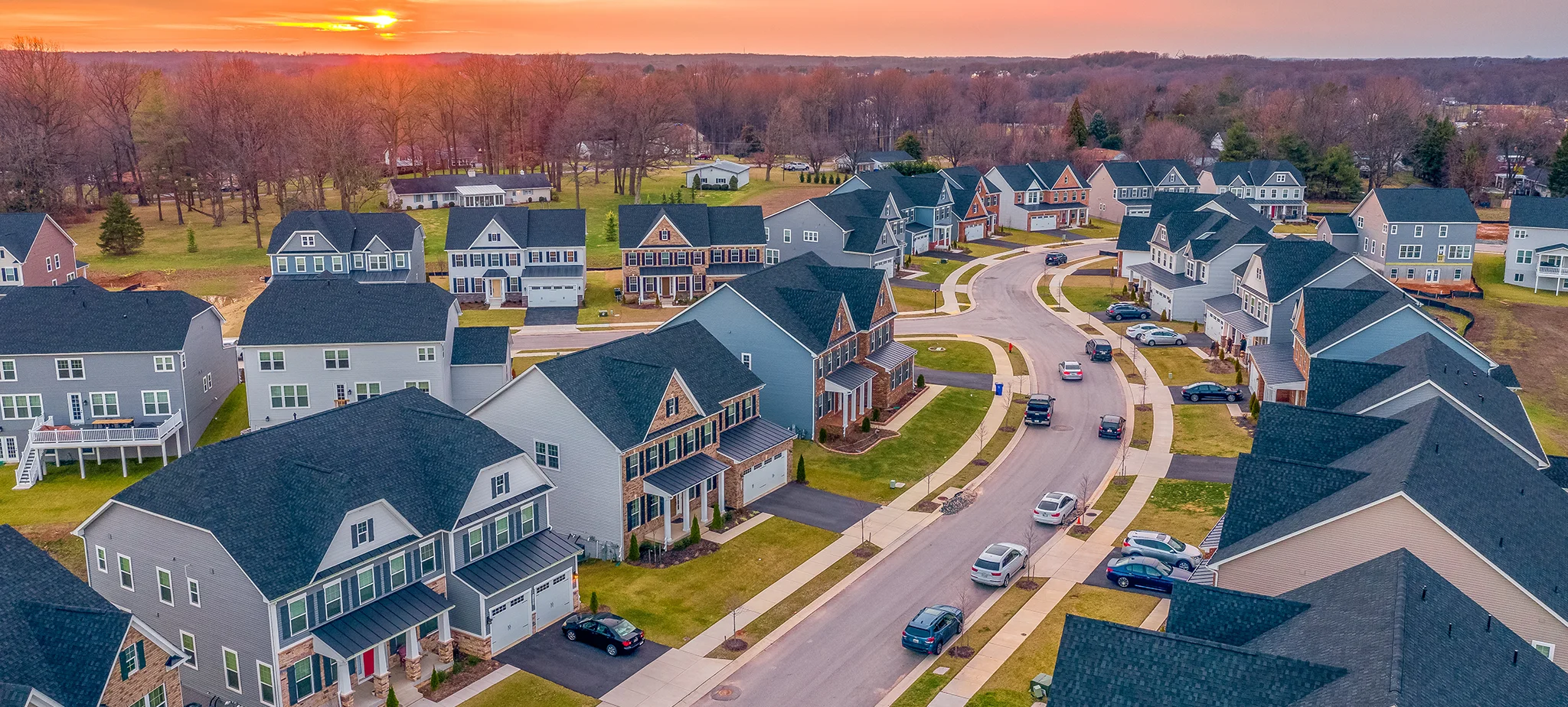
Gainesville grew from a crossroads into a suburb of townhouses and single family homes starting in the 1990s. That history gives its metal roofing questions a specific shape: shared walls, fire separation at the roof deck and associations that control exterior appearance.
The roofs here are mostly asphalt shingle on houses less than thirty years old, so the decks are generally sound and the common reason for metal is not rot. Owners ask about metal because of storm exposure, interest in a longer service life, or a replacement cycle they would prefer to end.
The decision usually turns on the association before the county. A townhome community may allow only certain panel profiles and colors, or none. Call (571) 570-7930 for the 15 minute phone consultation, and bring the covenant language if you have it.
What does a metal roof mean for a Gainesville townhouse?
It means paying attention to the party wall. In a townhouse row the roof deck at the wall between units can be part of a fire-rated assembly, and Prince William County says a permit is required where decking was built to be fire-retardant treated or protected to form a fire-rated wall termination. Swapping shingles for metal over untouched deck is a different matter from replacing that decking.
Metal can also make sense on the long straight rows townhouses have. Flashing at the party wall and end units can be detailed once and repeated. The hard parts are coordinating with neighbors on a shared roofline and getting association approval for a roof that must match the row.
Who approves it: the county, the HOA or both?
Both can be involved, and the HOA usually comes first. Prince William County's building division lists re-roofing as work that needs no permit, along with decking replacement of 256 square feet or less, except where the decking forms the fire-rated wall termination. The county also warns owners that covenants may require association approval for roofing.
Ask your association for the rule in writing: allowed materials, panel profile, color range, and whether a metal roof needs architectural review. Ask the county's Building Development Division about decking at party walls before anything is torn off, and ask the association who signs the approval letter. Near the Haymarket line, use the county's address lookup, because the town handles its own zoning even though the county issues the building permit.
What gets installed differently in Gainesville?
Underlayment and decking come first. Sound plywood or OSB decking with a synthetic underlayment keeps a metal roof dry and quiet, and the ice barrier detail still matters at eaves where water backs up. Panel profile follows pitch: standing seam for roofs around 3 in 12 and steeper, and exposed fastener panels only on simple low roofs like porches and garages.
Snow and ice need a plan. Gainesville gets about 36 inches of precipitation a year, with winter freezes that send ice sliding off smooth panels. Put snow guards above front doors, garages and walks. Flash chimneys with a saddle and counterflashing, keep dissimilar metals apart at gutters, and use clips that let long panels expand and contract. On townhouse rows, line up panel seams and trim across units so the roofline reads as one.
When is metal not the right call in Gainesville?
It is not right when the association bars it, when the roof is too low for the profile, or when a townhouse row would end up with mismatched roofs.
It is also a poor fit on a short horizon: metal costs more up front, and the payback comes over decades. Noise is a weak reason to avoid it, because solid decking quiets rain. Hail can dent lighter gauge, and ice sliding is a safety issue to engineer around rather than a reason to skip metal. If cost shapes the decision, the owner offers financing, described on the roof financing page.
METAL ROOF OPTIONS FOR GAINESVILLE HOMES
STANDING SEAM
Fits Gainesville single family homes with simple gables and hips at about 3 in 12 or steeper. Concealed fasteners suit the clean exteriors common here, if the association approves the profile and color.
EXPOSED FASTENER PANEL
Suits detached garages, porches and sheds in Gainesville subdivisions that allow it. Surface screws rely on gaskets and need checking, so this lower cost panel belongs on simple roofs rather than townhome rows.

STONE COATED STEEL
Closest to the asphalt look that many Gainesville townhome associations expect. The stone granule surface keeps the shingle appearance on steel, though panel weight and color matching across a row need attention.

METAL SHINGLE AND SLATE PANEL
Interlocking panels that mimic slate or shake suit single family houses with dormers and valleys. They bring more flashing joints, so they suit owners who want the look and accept slower installation.