ACV vs RCV Roof Insurance in Virginia: What's the Difference?
ACV vs RCV Roof Insurance in Virginia: What's the Difference?

Key Takeaways
- ACV (actual cash value) pays your roof's replacement cost minus depreciation, and that depreciation is not recoverable — it's a permanent reduction to your payout
- RCV (replacement cost value) pays the full cost to replace your roof with materials of similar kind and quality, with the depreciation portion held back and released after the work is documented as complete
- On a 15-year-old architectural shingle roof in Northern Virginia, the gap between ACV and RCV payouts is typically $5,000 to $10,000+ on the same claim
- Carriers calculate depreciation at roughly 4% per year on a standard 25-year shingle — a 10-year roof loses ~40%, a 20-year roof loses ~80%
- Upgrading from ACV to RCV typically costs $80–$250 per year in extra premium and almost always pays for itself the first time you file a covered storm claim
If you've ever read a Virginia homeowners policy and felt your eyes glaze over at acronyms like ACV and RCV, you're not alone — and the distinction between these two terms is the single most expensive line in your policy when storm damage hits. The short answer: ACV pays your roof's replacement cost minus depreciation; RCV pays the full replacement cost, with depreciation held back and released after the work is done. On a typical 15-year-old roof in Woodbridge, Lake Ridge, or Dale City, the difference can be $5,000 to $15,000 in out-of-pocket cost on the same claim. Knowing which type of policy you carry — and why it matters — should be a 10-minute homework assignment for every Virginia homeowner long before the next storm hits.
Northern Virginia roofs face wind, hail, ice, and the back-end of tropical systems coming up I-95 every year. The Potomac corridor between Quantico and Tysons is one of the more storm-active stretches of the mid-Atlantic, and the region's mix of mature trees and tightly packed suburban subdivisions in places like Lake Ridge, Montclair, and Lorton means a single afternoon thunderstorm can put dozens of roofs into the claims pipeline at once. When you call your insurer, the type of coverage on your declarations page — ACV or RCV — quietly decides whether your check covers the new roof or just a fraction of it.
This guide walks through exactly how each policy type pays out, how depreciation is calculated on Virginia roofs, real-world payout examples for a Woodbridge home, when to upgrade from ACV to RCV (and when carriers won't let you), how the recoverable depreciation holdback works in practice, and how to read your own declarations page so you know what you have before a storm forces the issue. If you've already filed a claim and the payout looks low, the same framework will help you figure out whether the math is right or whether your contractor needs to file a supplement.
What ACV and RCV Actually Mean on a Roof Claim
Both ACV and RCV are valuation methods — different ways of converting "your roof was damaged" into "here is the dollar amount we will pay." Neither one changes whether your damage is covered (that's determined by the cause of loss), and neither one changes your deductible. They only change how much money lands in your bank account when the claim is approved.
Actual Cash Value (ACV)
An ACV settlement pays you the cost to replace your roof minus depreciation. Depreciation reflects the wear and reduced remaining useful life of your existing roof. The older your roof, the more depreciation comes off the top — and on an ACV policy, that depreciated amount is gone. You will never see it. If your insurer determines your roof has lost 60 percent of its value to age and weathering, your ACV payout starts at 40 percent of the replacement cost before your deductible is even subtracted.
ACV is the default valuation method for older roofs and for homeowners who didn't specifically buy a replacement-cost endorsement. It's also the only option many carriers will offer once a roof crosses an age threshold — commonly 15 or 20 years in Virginia. Some carriers automatically convert an RCV roof endorsement to ACV at renewal once the roof reaches that age, and the conversion notice is often buried in renewal paperwork that homeowners skim or skip.
Replacement Cost Value (RCV)
An RCV settlement pays the full cost to replace your damaged roof with materials of similar kind and quality at today's prices, with no permanent reduction for depreciation. The catch: the payout comes in two checks. The first check, the ACV portion, is the replacement cost minus depreciation minus your deductible, and is mailed soon after the claim is approved. The second check, the recoverable depreciation (also called the depreciation holdback), is released only after you complete the roof replacement and submit a final invoice plus photos of the finished work.
RCV protects you against the financial cliff that older roofs fall off when depreciation eats most of the value. It's the coverage type you want, and on most Northern Virginia homes with roofs under 15 years old, it's available for a modest premium increase.
Why Depreciation Exists at All
Insurance, at its core, is meant to put you back in the position you were in just before the loss — not to upgrade you. If your 15-year-old roof had ten years of useful life left and a storm wiped it out, the carrier's argument is that paying for a brand-new 25-year roof gives you a windfall of fifteen extra years of useful life that you didn't have a moment before the storm. Depreciation is the math the industry uses to remove that windfall.
RCV doesn't deny that logic — it shifts the cost. On an RCV policy, you pay a slightly higher premium every year in exchange for the carrier eating the depreciation when a covered loss happens. Over a long enough timeframe, the math tends to favor the carrier. Over the lifetime of one bad storm, it can save a Northern Virginia homeowner the cost of a used car.
How Depreciation Is Calculated on a Virginia Roof Claim
Most carriers in Virginia use straight-line depreciation tied to the material's expected useful life, and the expected-life numbers used in the major claims software platforms are well-established. A 3-tab asphalt shingle is depreciated against a 20-year expected life (roughly 5 percent per year), and architectural or dimensional asphalt — the dominant Northern Virginia material — is depreciated against a 25-to-30 year life (roughly 3.3 to 4 percent per year). Premium and designer asphalt products carry a longer 30-to-40 year expected life that depreciates at 2.5 to 3.3 percent per year, while standing seam metal roofing is depreciated against a 40-to-50 year horizon (2 to 2.5 percent per year). For the low-slope additions and porch roofs that show up on a meaningful share of NoVA homes, TPO and EPDM membranes are depreciated against a 20-to-25 year life at roughly 4 to 5 percent per year.
The math is straightforward. Take the replacement cost, multiply by the depreciation percentage, and subtract. A 12-year-old architectural shingle roof at 4% per year is depreciated by 48 percent. On a $14,000 replacement, that's $6,720 of depreciation right off the top. On an ACV policy, you only ever see the remaining $7,280 minus your deductible. On an RCV policy, you see that same $7,280 first, then the $6,720 holdback after the work is done.
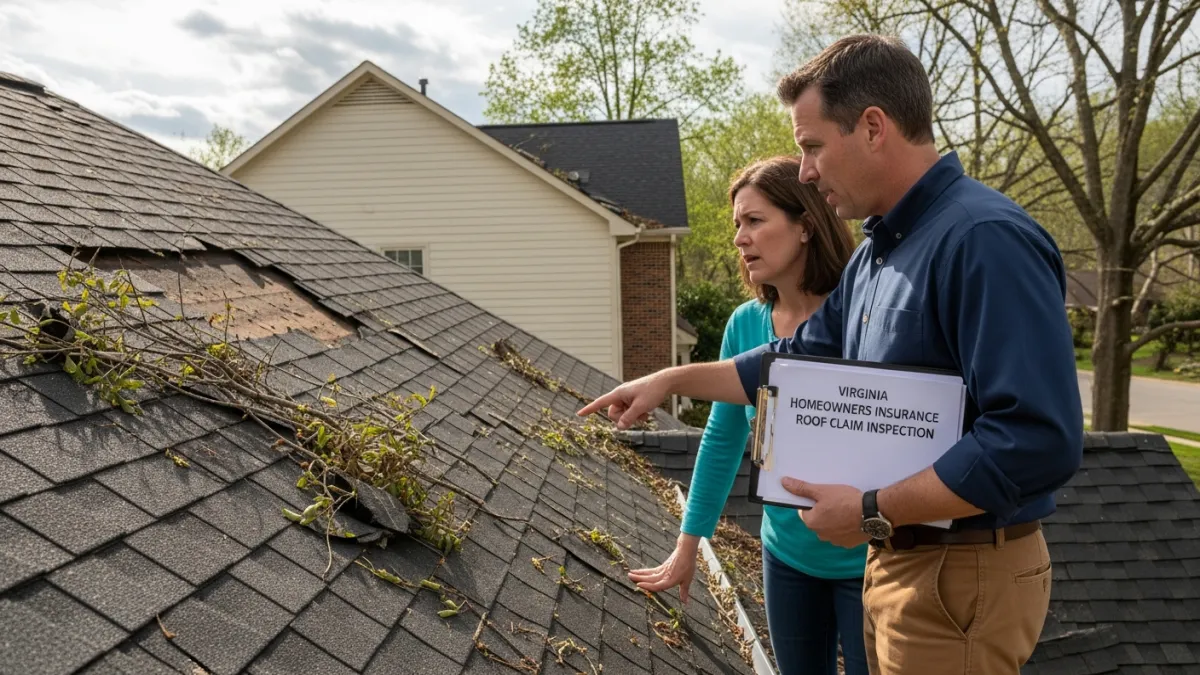
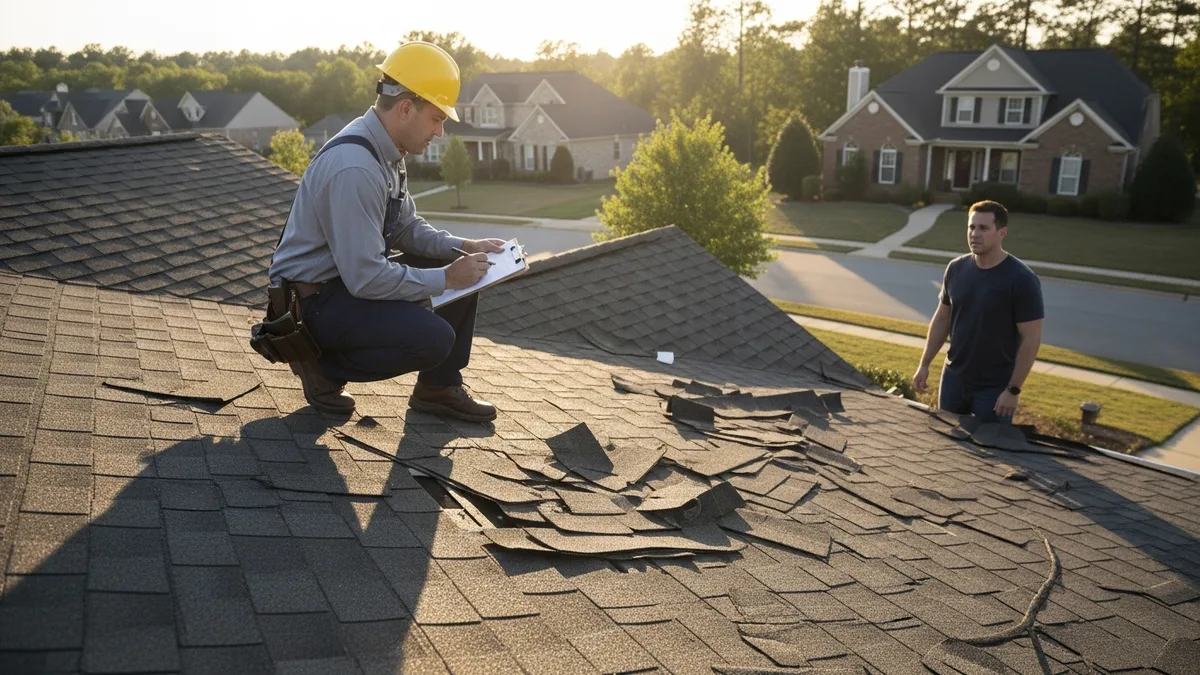
Adjusters can apply condition adjustments on top of the straight-line calculation. If the roof shows above-average wear for its age — heavy granule loss, multiple prior repairs, blistering — the adjuster may apply additional "condition" depreciation that pushes the percentage higher. If the roof is in better-than-average condition for its age (well-maintained, no prior repairs, original installation by a reputable contractor), you can ask for a condition modifier in your favor. This is where having your roofing contractor present during the inspection matters — they can document the favorable condition with photos that support a smaller depreciation deduction.
Real Northern Virginia Payout Examples: ACV vs RCV Side-by-Side
Numbers make this concrete. The table below uses a baseline of $14,000 replacement cost for a 2,200 sq ft Northern Virginia home with architectural asphalt shingles — a typical mid-range cost in the Woodbridge / Lake Ridge / Dale City market as of 2026 — and a $1,500 deductible. The depreciation rates assume an architectural shingle on a 25-year schedule.
| Roof Age | Depreciation | ACV Net Payout | RCV Net Payout | Out-of-Pocket Difference |
|---|---|---|---|---|
| 5 years | 20% ($2,800) | $9,700 | $12,500 | $2,800 |
| 10 years | 40% ($5,600) | $6,900 | $12,500 | $5,600 |
| 15 years | 60% ($8,400) | $4,100 | $12,500 | $8,400 |
| 20 years | 80% ($11,200) | $1,300 | $12,500 | $11,200 |
| 22 years | 88% ($12,320) | $180 | $12,500 | $12,320 |
Replacement cost shown is a typical 2026 range for a 2,200 sq ft Northern Virginia home with architectural asphalt shingles. Your actual cost varies with roof pitch, complexity, material grade, and current market conditions. Deductible assumed at $1,500; if your policy uses a percentage-based wind/hail deductible the math shifts accordingly.
Read that table carefully. At five years old, the difference between ACV and RCV is $2,800 — annoying, but not financially catastrophic for most homeowners. At fifteen years, the gap is $8,400, which is more than the down payment on a car. At twenty years and beyond, the ACV check is essentially symbolic, and the homeowner is paying for the entire roof replacement out of pocket while the carrier writes a check for less than the cost of a new dishwasher.
This is why the question "Is it worth upgrading to RCV?" is almost always answered yes — but it has to be answered before the storm. Once damage occurs, the policy in force at the time of loss is the policy that pays.
How the Recoverable Depreciation Holdback Works
If you carry RCV coverage, expect two checks, not one. The timeline on a typical Northern Virginia claim runs as follows: damage occurs (storm, hail, fallen tree) and you file the claim within 30 days, ideally within a week. The carrier's adjuster inspects within 7 to 14 days, and your roofing contractor should be on the roof during that inspection to verify scope. Once the scope and pricing are finalized, the carrier approves the claim and issues the first check, the ACV portion — replacement cost minus depreciation minus your deductible. You then hire a contractor and complete the work, typically within 30 to 90 days of approval, and your contractor submits the final invoice plus photos as proof of completion (some carriers also require a sworn statement in proof of loss). The carrier releases the second check, the recoverable depreciation, within 14 to 30 days of receiving documentation, usually closer to 14.
A few important rules govern the holdback. You generally have 180 to 365 days from the date of loss to complete the work and claim the recoverable depreciation, with each carrier setting its own deadline — check your policy or ask the adjuster directly. If you choose not to do the work (you sell the home and pocket the ACV check, for example), the recoverable depreciation is forfeited; the carrier will not pay it. If your final invoice is lower than the approved scope because you found a cheaper contractor, the carrier only releases depreciation up to what you actually spent, never the difference as profit. And if your final invoice is higher due to legitimate scope additions discovered during the work — rotted decking, code-required upgrades, hidden flashing failures — your contractor can file a supplement to capture the additional cost, which is one of the most important reasons to hire a contractor experienced with insurance work.
Many homeowners get confused at step 3 and assume the first check is the entire payout. If you carry RCV and you only see the depreciated amount on the first check, that's normal — but keep the depreciation total visible in the claim file and track the deadline. Talk to a contractor experienced with filing a roof insurance claim in Virginia if you are unsure whether your settlement reflects ACV or RCV terms.
How to Find Out Which Coverage You Actually Have
Almost every Virginia homeowner we work with assumes they have RCV coverage. About a third of them don't. Here's how to confirm in under ten minutes:
1. Read the Declarations Page
Your declarations page (the "dec page") is the summary document attached to your policy at every renewal, and it lists your dwelling coverage, deductibles, endorsements, and named perils. Under either Coverage A (Dwelling) or under the Endorsements section, look for one of three specific phrases. "Replacement Cost Loss Settlement" or "RCC" means RCV is in force. "Actual Cash Value Loss Settlement" or "ACV roof endorsement" means ACV is in force on the roof. And "Roof Surfaces Payment Schedule" or "Roof Settlement Schedule" indicates a tiered payout that depreciates the roof on its own schedule and is often functionally similar to ACV once the roof reaches a certain age.
If the language is ambiguous (as it often is on State Farm and Allstate dec pages in Virginia), call your agent and ask one specific question: "On a wind or hail claim against the roof, will the settlement include recoverable depreciation, or is depreciation a permanent deduction?" If the answer mentions recoverable depreciation, you have RCV. If the answer mentions a depreciation schedule or roof age table, you likely have ACV or a hybrid roof endorsement.
2. Check for Roof-Specific Endorsements
In the past decade, many Virginia carriers have added cosmetic damage exclusions, roof age depreciation schedules, and composition shingle endorsements that quietly shift roof coverage from RCV to ACV once the roof passes a certain age. These typically appear under "Endorsements" or "Optional Coverages" on the declarations page. Read them. If you see anything referencing roof age, payment schedule by age, or "matching" limitations, those are the clauses that change your effective coverage.
3. Confirm in Writing
After your call with the agent, ask for the answer in writing — email is fine. Save it in the same folder as your policy documents. If you ever file a claim and the adjuster's interpretation differs from what your agent told you, the written confirmation is your evidence to escalate to a supervisor or, if needed, the Virginia State Corporation Commission Bureau of Insurance.
When (and How) to Switch From ACV to RCV in Virginia
If you confirm you have ACV coverage and you want to switch to RCV, the practical playbook for Virginia homeowners runs through five steps over roughly 60 days. Start by getting a current roof inspection report, since most carriers require an inspection within the past 12 months before they'll endorse RCV onto an existing roof — a licensed Virginia roofing contractor can do this for $0 to $200 and many will inspect free as part of a sales call. Next, document the install date with receipts, a building permit record (Prince William County records are searchable online), or your prior closing disclosure if the roof was installed before you bought the home; carriers want to know how old the roof actually is, not your guess. Then have your contractor photograph every slope and every penetration with a drone — the 15-minute drone walk-around dramatically reduces back-and-forth with the underwriter.
With the inspection report, install date documentation, and drone photos in hand, call your agent and request the RCV endorsement at least 60 days before renewal — most carriers process endorsements at renewal rather than mid-term to avoid pro-rated billing complications. Before agreeing to anything, get the new premium and the new declarations page in writing and confirm the new dec page explicitly shows RCV settlement on the dwelling. If any of those documents come back ambiguous, escalate to the underwriter directly rather than accepting an oral assurance from the agent.
Carriers will refuse the endorsement if your roof is over a certain age (typically 15 or 20 years), in poor condition, or has had multiple prior claims. If your roof is borderline, fix the smaller issues first — replace a few cracked shingles, clear moss from the north slope, repoint the chimney flashing — and re-apply.
When ACV Might Actually Make Sense
There's a small set of cases where ACV is the rational choice, even with the downside math, and they're worth knowing because the wrong policy on the wrong roof costs real money in either direction. If your roof is over 20 years old and you plan to replace it within one to two years anyway, the premium savings on ACV may be a few hundred dollars and any storm payout would be small under either valuation at that age — the math approaches a wash. If your home sits on a particularly high-risk lot with heavy tree cover or a history of repeated claims, the carrier may offer RCV only at a steep premium, and sometimes the ACV premium is sustainable while RCV isn't.
A premium metal or designer roof with a 50-year material warranty has slow depreciation under either valuation, so the premium difference between ACV and RCV may not be worth carrying for the first 10 to 15 years of the roof's life — though by year 20 the math typically flips. And if you deliberately self-insure with a high deductible, robust cash reserves, and a homeowners policy treated as catastrophic-only coverage, ACV may be consistent with your overall insurance strategy. For the typical Northern Virginia homeowner with a 5- to 15-year-old asphalt shingle roof on a $400,000–$700,000 house, RCV is the default recommendation. The premium increase is small, the downside risk on ACV is large, and storms are not optional in this region.
Cost of Roof Replacement in Northern Virginia (and How It Interacts with ACV/RCV)
Understanding the underlying replacement cost helps you read your settlement realistically. Northern Virginia roof replacement runs 15–25% above national averages because of higher labor costs, county permit fees, and waste disposal pricing in the DMV.
| Roof Type / Scope | Low End | High End | Notes (NoVA Market, 2026) |
|---|---|---|---|
| Architectural asphalt, 1,800 sq ft home | $8,500 | $14,000 | Tear-off + new install, 30-yr shingle |
| Architectural asphalt, 2,400 sq ft home | $11,500 | $18,500 | Most common scope in Woodbridge / Lake Ridge |
| Class 4 impact-resistant upgrade | +$1,800 | +$3,500 | Often qualifies for 5–25% insurance premium discount |
| Standing seam metal, 2,200 sq ft home | $22,000 | $38,000 | 50-year material life, much slower depreciation |
| Decking replacement (per 4×8 sheet) | $85 | $160 | Often discovered after tear-off; supplement-eligible |
| Permit (Prince William County) | $110 | $280 | Required for full replacement, billed pass-through |
Prices shown are typical ranges for Northern Virginia as of 2026 and vary based on home size, material grade, site access, pitch, and current material costs. Contact us for a free on-site estimate.
Note how these numbers feed back into the ACV/RCV math. A higher replacement cost magnifies the dollar gap between ACV and RCV for any given depreciation percentage. On a $25,000 metal roof at 30% depreciation, the gap is $7,500 — even though the percentage is moderate. On a $9,500 asphalt roof at 60% depreciation, the gap is $5,700. Either way, the absolute dollars at stake are large enough that the small RCV premium is almost always justified.
Common ACV/RCV Mistakes Northern Virginia Homeowners Make
Across hundreds of insurance restoration projects in Woodbridge, Dale City, Lake Ridge, Lorton, Manassas, and Stafford, the same handful of mistakes show up over and over, and avoiding them alone tends to add thousands of dollars to the typical claim outcome. The single most common mistake is assuming RCV without checking — read your dec page or call the agent and confirm in writing rather than guessing. A close second is cashing the first ACV check and not doing the work; if you have RCV and skip the replacement you forfeit the recoverable depreciation, and even if you plan to sell, the cleaner move is usually to do the work, claim the holdback, and then list because the appraised value typically more than covers the difference. Letting the deadline expire on the holdback is the third recurring failure — most carriers give 180 to 365 days to complete the work, and storm-season delays plus contractor backlogs can eat that window quickly if you don't track it in writing.
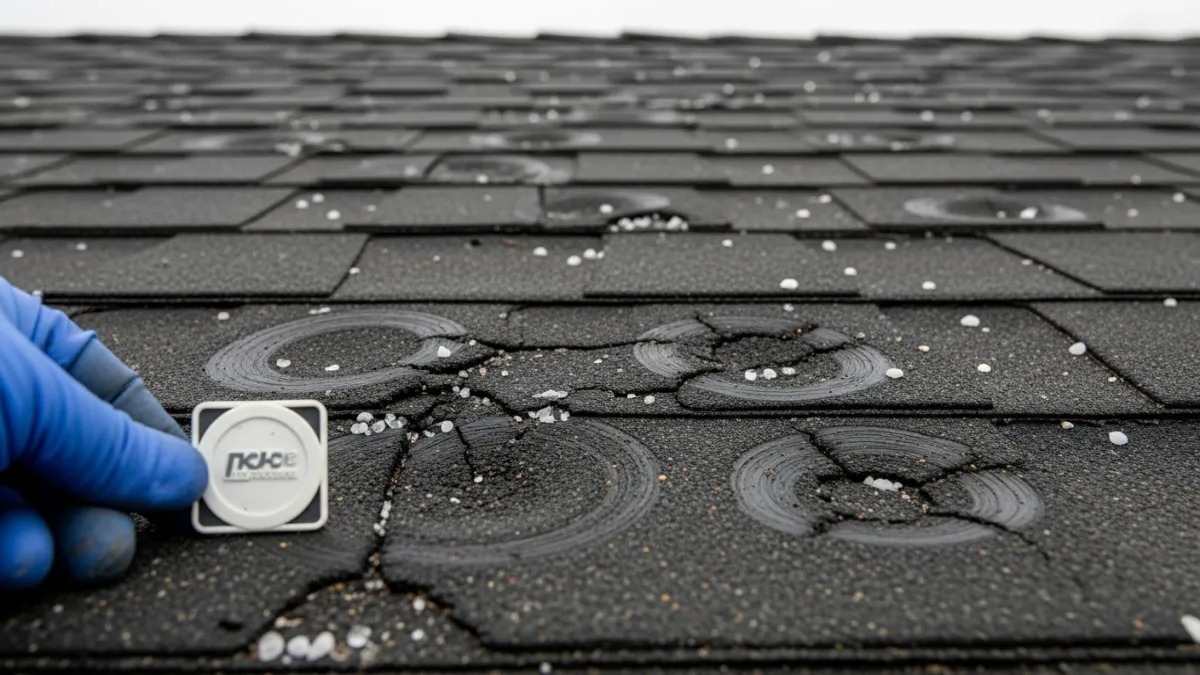
The remaining mistakes cluster around the inspection itself and the scope of the claim. Hiring a contractor who isn't familiar with the supplement process is a quiet but expensive one — when decking damage or other hidden issues are discovered after tear-off, those costs need to be supplemented to the carrier, and a contractor unfamiliar with the process either eats the cost or passes it to you, while the right contractor files the supplement and gets it approved. Accepting the first scope without a contractor present at the inspection is closely related; adjusters work fast and miss things, and a contractor on the roof during the inspection ensures bruised shingles, cracked pipe boots, and compromised flashing all get into the scope on the first pass rather than appearing as supplement requests later. Finally, if you have a metal roof or impact-resistant shingles, ignoring the cosmetic damage exclusion is a trap — check whether your policy excludes cosmetic-only damage, because that one clause changes hail claim outcomes substantially and is one of the most common reasons a metal-roof hail claim comes back at zero.
If you are mid-claim and any of these scenarios sounds familiar, having a licensed roofing claims contractor review the paperwork before you sign anything is usually worth the half-hour conversation. The cost is zero and the upside is a properly scoped claim.
Decision Framework: Should You Have ACV or RCV?
Use this quick rule of thumb. The answer is RCV unless every condition in the ACV column applies:
| Factor | Choose RCV if… | ACV is reasonable if… |
|---|---|---|
| Roof age | Under 15 years | Over 18 years and being replaced soon |
| Premium difference | Under $300/year | Carrier-quoted premium gap is over $400/year |
| Cash reserves | Less than 6 months' emergency fund | Comfortable self-insuring up to $15,000 |
| Storm exposure | Open lot, mature trees, prior claims in zip code | Minimal exposure, no claim history |
| Material lifespan | Standard 25-year asphalt | Premium 50-year metal roof, first 10 years |
For the vast majority of Northern Virginia homeowners with asphalt shingle roofs under 15 years old, RCV is the right call. The annual premium delta is small enough that one moderate storm anywhere in your policy lifetime makes the math work, and Northern Virginia produces moderate storms reliably.
Not Sure Which Coverage You Have? We'll Help You Read It.
Woodbridge Roofers helps Northern Virginia homeowners understand their roof coverage before they file a claim — and we represent your interests during the adjuster inspection if storm damage hits. Free roof inspection, free policy review, no pressure. Call (571) 570-7930 or book online.
Schedule Free ConsultationFrequently Asked Questions
Related Articles
- Does Homeowners Insurance Cover Roof Replacement in VA?
- How to File a Roof Insurance Claim in Virginia
- Roof Insurance Supplement Contractor in Virginia
- Hail Damage Roofing in Northern Virginia
Conclusion
The difference between ACV and RCV roof insurance in Virginia is the single most important line in your policy when storm damage hits. ACV pays your roof's replacement cost minus depreciation, and that depreciation is gone forever. RCV pays the full replacement cost, with the depreciation portion held back and released after the work is completed. On a typical 15-year-old roof in Woodbridge, Dale City, or Lake Ridge, the gap between the two valuation methods is often $5,000 to $10,000 — sometimes more. The annual premium difference is usually $80–$250, which means the RCV upgrade typically pays for itself the first time you file a covered claim.
If you don't know which coverage you have right now, take ten minutes today: pull out your declarations page, look for the loss settlement clause under Coverage A, and confirm whether the roof is on RCV or ACV terms. If you find ACV and your roof is under 15 years old, call your agent and ask about converting at the next renewal. If your roof is older than that and you're carrying ACV, start budgeting for the next replacement now — the carrier likely won't be carrying most of the cost.
If you've already filed a claim and the math doesn't look right, or you simply want a professional read on your policy and your roof's condition before the next storm hits, call Woodbridge Roofers at (571) 570-7930 or book a free phone consultation. We serve Woodbridge, Dale City, Lake Ridge, Lorton, Manassas, Stafford, and surrounding Prince William and Stafford County communities, and we handle insurance restoration work end-to-end.