DIY Roof Repair vs Hiring a Contractor in Virginia: Honest Trade-Offs
DIY Roof Repair vs Hiring a Contractor in Virginia: Honest Trade-Offs
Key Takeaways
- Virginia does not legally bar homeowners from working on their own roof, but shingle warranties, insurance coverage, and local permit rules almost always make DIY a worse value than it appears
- Truly safe DIY tasks are limited to gutter cleaning, ground-level inspections, attic checks, and minor caulking from a ladder — not walking on the roof
- Most Northern Virginia minor repairs run $250–$1,200 from a licensed contractor; the labor margin over DIY material cost is usually less than the value of the warranty and insurance backstop
- Common DIY mistakes (wrong sealant, lifted shingles, exposed nails, overdriven fasteners) create larger leaks than the original problem within 6–18 months
- Always hire a pro for: steep roofs (6/12+), 2+ story homes, flashing repairs, valleys, anything under active warranty, or any work you'll need to file with insurance
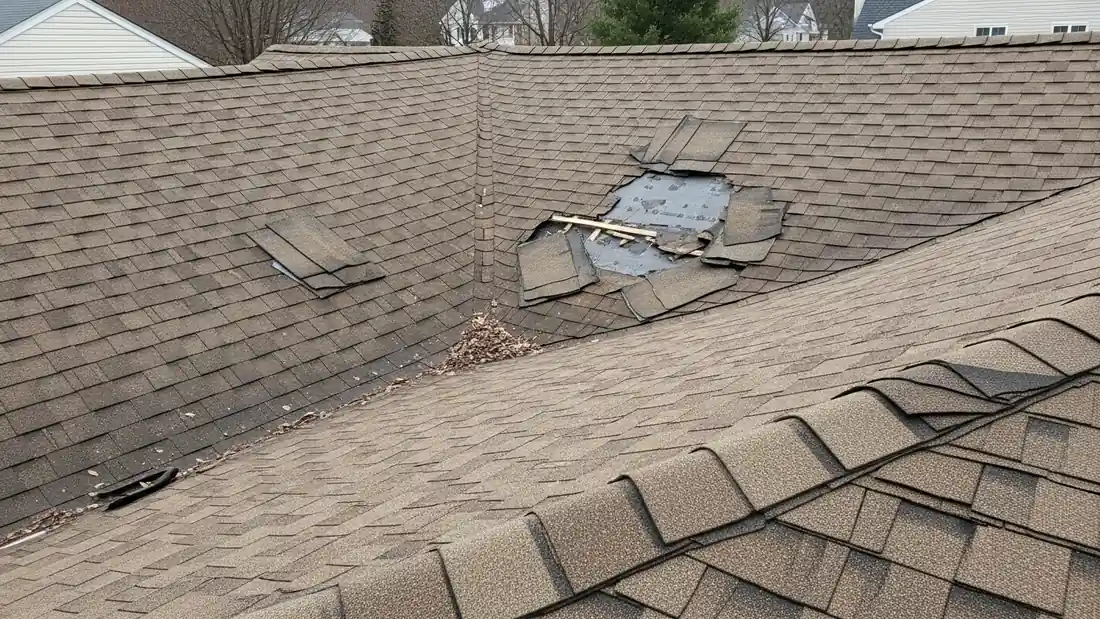
Northern Virginia homeowners face a familiar scenario several times during the life of a roof: a small leak appears, a few shingles blow off in a Bristow windstorm, or a rubber boot around a vent pipe cracks and lets water through. The repair sounds straightforward, the parts are cheap, and there's a strong temptation to climb up and fix it yourself rather than wait for a contractor and pay for what feels like an afternoon's work. This guide gives Virginia homeowners an honest read on which repairs are reasonable to do yourself, which absolutely are not, and what the real cost difference looks like when you account for warranty, insurance, safety equipment, and the rather high probability that a botched repair will cost more than just calling someone in the first place.
The article doesn't argue that you should never touch your roof. It argues that the calculus is different than most homeowners think. The professional cost premium is smaller than it looks, and the downside risks (warranty voiding, insurance denial, falls, larger water damage) are much larger than they look.
What's Legal vs What's Smart
Virginia state law does not require a licensed contractor for repair work performed by the homeowner on a single-family residence the homeowner occupies. The Virginia DPOR contractor licensing requirements apply when work is performed for compensation, not when a homeowner does the work on their own property. So legally, a Woodbridge or Manassas homeowner can replace their own shingles, repair their own flashing, and even reroof their own home if they are willing.
Practical and contractual constraints, however, are stricter than the law itself. Local building permits are the first hurdle: Prince William County, Fairfax County, and the City of Manassas all require a building permit for roof replacement and for repairs that exceed a small square-footage threshold, and permit applications generally require a licensed contractor or, for owner-occupied work, a homeowner affidavit acknowledging code compliance responsibility. Manufacturer shingle warranties are the second hurdle, since almost every major warranty requires installation by the manufacturer or a licensed roofing contractor — self-installed shingles or repairs typically void the workmanship and accessory warranty portion even when the materials warranty technically remains. Homeowners insurance is the third constraint: carriers exclude damage caused by defective workmanship or improper maintenance, so a DIY repair that leaks later may result in a denied claim and in some cases creates a paper trail that makes future related claims harder.
Two further constraints catch most NoVA homeowners off guard. HOA or community covenants in Lake Ridge, Stonebridge at Potomac Town Center, Westridge, and most newer Prince William and Loudoun communities require pre-approval for any visible exterior modification and frequently require a licensed contractor — even a single-shingle repair can trigger an architectural review submission. And Virginia residential real estate disclosure law requires sellers to disclose known defects, so DIY repair history is often a question buyers ask at closing, and some self-installed repairs are visually obvious to a home inspector. For most Northern Virginia homeowners, the combination of warranty, insurance, HOA, and permit constraints makes DIY roof repair a worse practical choice than the legal framework alone would suggest.
What's Reasonable for a Homeowner to DIY
A short, honest list of roof-related tasks that most homeowners can safely perform themselves with basic tools starts with gutter cleaning, done from a stable ladder with a spotter on the ground. Gutter cleaning is critical in Northern Virginia where oak, maple, and tulip poplar leaves clog gutters every fall and directly contribute to ice dam formation in January and February. Downspout extension placement is similarly straightforward — adding splash blocks or extension hoses to direct water four to six feet from the foundation prevents the kind of grading-related water intrusion that often gets misdiagnosed as a roof leak. Visual inspection from the ground with binoculars, especially after a Northern Virginia thunderstorm or hail event, is one of the most valuable habits a homeowner can develop; look for missing shingles, lifted edges, displaced flashing, and granule accumulation in gutters as the early warning signs.
Three more tasks are reasonable inside the home or from a ladder. Attic inspection for daylight at penetrations, water staining on rafters or insulation, and signs of inadequate ventilation (frost in winter, extreme heat in summer) costs nothing and frequently catches problems before they show up as ceiling stains. Trimming branches that overhang or touch the roof prevents abrasion damage and reduces leaf loading on the roof and gutters. And minor caulking from a ladder — sealing exposed nails on metal flashing, touching up siding caulk where it meets the roofline, or applying a small bead around a vent pipe boot reachable from a ladder without standing on the roof — is acceptable as long as you use a roofing-specific sealant (NP1, Through the Roof!, or similar polyurethane) rather than generic silicone. None of these tasks require walking on the roof or removing roofing materials, which is why they remain on the safe-DIY list.
What You Should Not DIY
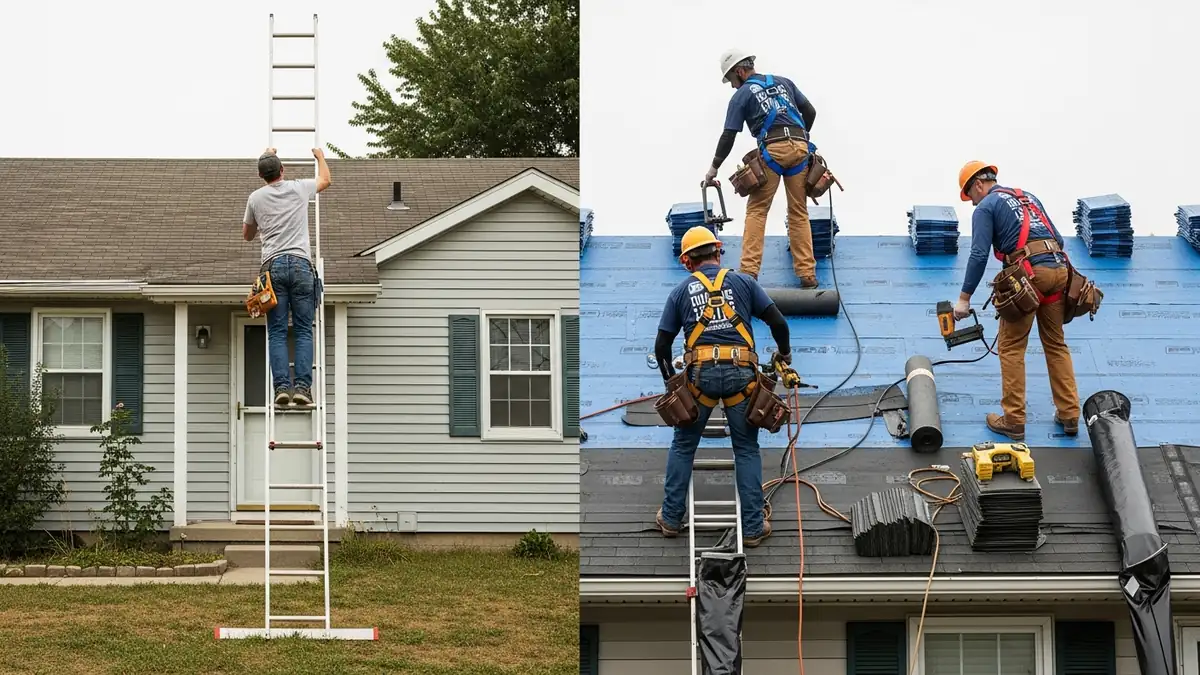
A second list — the work that should always go to a licensed Northern Virginia roofing contractor — is longer and more important. Walking on the roof for more than a brief inspection is the first item, since most NoVA homes have 6/12, 8/12, or steeper pitches that require fall protection equipment and the technique to use it safely; falls from 1.5- and 2-story residential roofs are routinely fatal in Northern Virginia. Replacing shingles looks easy but isn't — improper nail placement, wrong nail length, mis-aligned tabs, and damaged adjacent shingles during removal are common DIY failures, and the new shingle often leaks within a few months because the underlying tar seal was disturbed during the work. Flashing repair around a chimney, skylight, dormer, or wall intersection is the next must-hire category; almost all roof leaks originate at flashing, and flashing requires step-flashing technique, counter-flashing integration with siding, and proper sequence under the shingle layer that DIY flashing repairs almost always get wrong within a year.
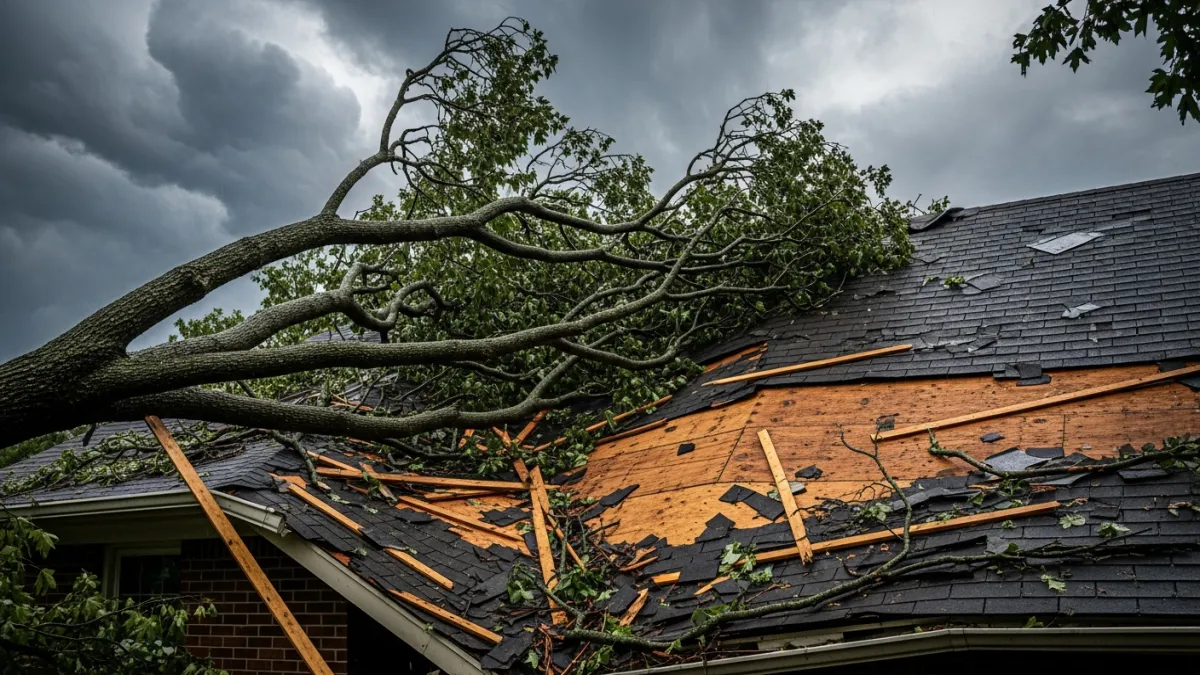
The remaining no-DIY categories cover valleys, penetrations, deck work, and storm damage. Valley repair or replacement should always go to a contractor because valleys carry concentrated water flow and require specific underlayment, ice and water shield, and either woven shingle or metal valley installation — DIY valley work is one of the most leak-prone repairs in the entire roof. Vent boot replacement from the roof requires lifting and resealing existing shingles because the boot installs under the upper shingle and over the lower shingle, and that lift-and-reseal is almost always done wrong by DIY. Roof deck repair (replacing rotted decking) requires structural carpentry, proper underlayment overlap, and shingle reinstallation, and code requires inspection in most NoVA jurisdictions. Storm damage assessment and repair must wait for the licensed contractor and the insurance adjuster to inspect, because touching the damage beforehand can compromise the claim — the only exception is emergency tarping to prevent further water entry, ideally also performed by a contractor. And anything on a roof that is wet, frosty, mossy, or has any algae growth is off-limits regardless of skill, because slip risk increases dramatically and the upside of doing the work that day rarely justifies the risk.
Real Cost Comparison: Northern Virginia 2026
| Repair | DIY Materials | Pro Repair Cost | Hidden DIY Costs |
|---|---|---|---|
| Replace 4–6 wind-blown shingles | $45–$80 | $250–$550 | Ladder rental, harness, color match, warranty void |
| Replace cracked vent pipe boot | $15–$45 | $275–$475 | Lifting/resealing shingles, on-roof safety |
| Chimney flashing repair | $60–$150 | $450–$1,200 | Step-flashing technique, counter-flashing, almost always leaks if DIY |
| Skylight reseal | $25–$60 | $400–$900 | Skylight warranty void, leak risk if not fixed at flashing layer |
| Valley repair (small section) | $80–$200 | $650–$1,800 | High-flow water area, hardest to get right |
| Gutter cleaning (typical NoVA home) | $0–$25 | $150–$300 | Reasonable DIY task with safety precautions |
| Emergency tarp after storm | $60–$140 | $350–$750 | Storm conditions; safer to call pro |
Pro repair costs are typical 2026 ranges for Woodbridge, Manassas, Lake Ridge, and surrounding Northern Virginia communities. Storm damage repairs may be covered by insurance — see our claims guide before paying out of pocket.
The Hidden Costs of DIY That Don't Show Up in the Material Receipt
A $45 bundle of shingles looks like a much better deal than a $400 service call until you factor in the costs that don't show up on the material receipt. Safety equipment is the first one — a proper roof harness, anchor, and lanyard kit runs $180 to $320, and an extension ladder rated for the height of a 2-story NoVA home runs $200 to $450 to buy or $40 to $70 per day to rent. Color match is the second hidden cost: replacement shingles from a different lot rarely match the existing roof exactly, and pros keep extras from the original install or know how to source a closer match, while DIY repairs are visually obvious from the curb for the next five to ten years until the patch weathers in. Warranty void is the third — if your roof is under a 25-year manufacturer warranty with 18 years left, voiding that warranty for a $45 repair is a poor exchange, since the avoided pro repair fee is much less than the value of the remaining warranty coverage.
The remaining hidden costs tend to be the largest. Insurance exposure means a leak caused by a botched DIY repair that damages your ceiling, drywall, hardwood floor, and furniture downstream may not be covered — you are trading a $400 repair for $4,000 to $15,000 of potential interior damage with no carrier backstop. Time matters too: a pro completes a typical small repair in one to three hours including travel and cleanup, while the same repair takes a homeowner most of a Saturday including ladder setup, trips to the store, and the inevitable second trip for the part you didn't realize you needed. And the repair-of-repair cost is the most predictable hidden expense — the most common DIY outcome on flashing and shingle repairs is that the work leaks within 12 to 18 months and a pro then has to remove and redo it, with the total cost ending up higher than just calling a pro the first time.
For a fuller perspective on choosing between repair and replacement, see when to repair vs replace your Virginia roof.
The Five Most Common DIY Roof Repair Mistakes
A handful of mistakes account for the vast majority of failed DIY roof repairs in Northern Virginia, and each one is essentially a category of error rather than a single misstep. Wrong sealant is the most common — generic silicone caulk is the wrong choice for almost every roof application because silicone does not bond to asphalt, breaks down under UV, and fails within two to four years; the correct material is a roofing-grade polyurethane or modified bitumen sealant such as NP1, Through the Roof!, or Henry 208R. The caulk-only "fix" mistake follows closely: a bead of sealant over a leaking flashing is not a repair but a six-to-twelve month delay, and the correct fix is to remove the failed flashing and reinstall it properly under and over the surrounding shingle and siding rather than smearing sealant on top.
The remaining three failure categories involve handling the shingles themselves. Lifting an asphalt shingle to slip a new one underneath, or to access a flashing or boot, almost always breaks the tar seal between shingles, and the lifted shingle then catches wind and tears off during the next windstorm regardless of how careful the original lift was. Wrong nail placement or length voids the wind warranty even when the rest of the install looks clean — asphalt shingles have a strict nail line, nails above the line don't catch the shingle below, nails below the line are exposed and create leak points, and the wrong nail length leads to either overdriven nails that puncture the shingle or underdriven nails that hold the shingle off the deck. And walking on the roof in unsuitable conditions (wet shingles, frosty shingles, mossy or algae-covered shingles, or very hot shingles that become soft and granule-shedding) is the leading cause of falls — pros work in the right conditions with proper safety equipment, while homeowners often work whenever they happen to have the time.
When DIY Genuinely Makes Sense
There are narrow scenarios where homeowner repair is reasonable, and they are worth knowing because the article isn't a blanket prohibition. If the roof is at end of life and you are planning to replace within 12 months, a temporary patch to stop a leak before a scheduled replacement doesn't carry the same warranty and insurance concerns because the entire roof is coming off shortly anyway. If the repair is very minor, very accessible, and on a single-story home with a low-pitch roof of 4/12 or lower, the safety calculus shifts meaningfully — most NoVA homes don't qualify but some 1960s ranch homes in the Dale City and Lake Ridge areas do. Professional roofing experience or a trade construction background also changes the calculus, since a retired contractor or working tradesperson brings the technique and judgment a typical homeowner doesn't. And if you have consulted with your insurance carrier and shingle manufacturer in advance and confirmed the planned work won't void the warranty or affect coverage, the contractual constraints are off the table. Outside these specific cases, hiring a licensed Northern Virginia contractor is the better economic and risk decision for almost every homeowner.
Have a Repair You're Considering DIY? Get a Pro Quote First.
Woodbridge Roofers offers free repair estimates throughout Prince William, Fairfax, and Loudoun Counties. Many minor repairs cost less than homeowners assume, and we'll give you an honest read on what's actually wrong before you invest in materials and risk a fall. Call (571) 570-7930.
Book a Free Phone ConsultationFrequently Asked Questions
Related Articles
- Should You Repair or Replace Your Virginia Roof?
- How to File a Roof Insurance Claim in Virginia
- Roof Leak Repair in Woodbridge, VA
- Emergency Roof Repair in Woodbridge
Conclusion
The honest take on DIY roof repair vs hiring a contractor in Virginia: a small set of maintenance tasks (gutter cleaning, ground-level inspections, attic checks, branch trimming) are reasonable and valuable for homeowners to do themselves. Almost everything else — shingle replacement, flashing work, valley repair, vent boot replacement, anything involving walking on the roof — is better and cheaper to hire out once you account for the actual cost of doing it right, the value of the warranty and insurance protection at risk, and the high probability that a DIY repair will need to be redone professionally within 18 months.
If you're staring up at your roof from the driveway debating whether to climb up or call someone, calling someone is almost always the right answer for Northern Virginia homeowners. Get a free estimate, get a professional read on what's actually wrong, and make the decision with full information.
Call Woodbridge Roofers at (571) 570-7930 or book a free phone consultation. We'll tell you honestly whether the repair is small enough to handle without a site visit or warrants a closer look in person.