How to Find a Licensed Roofing Contractor in Prince William County
How to Find a Licensed Roofing Contractor in Prince William County
Key Takeaways
- Every roofing contractor in Prince William County must hold a valid license from the Virginia Department of Professional and Occupational Regulation (DPOR) — no exceptions
- You can verify any contractor's license status in minutes through the DPOR online lookup at dpor.virginia.gov — check before you sign anything
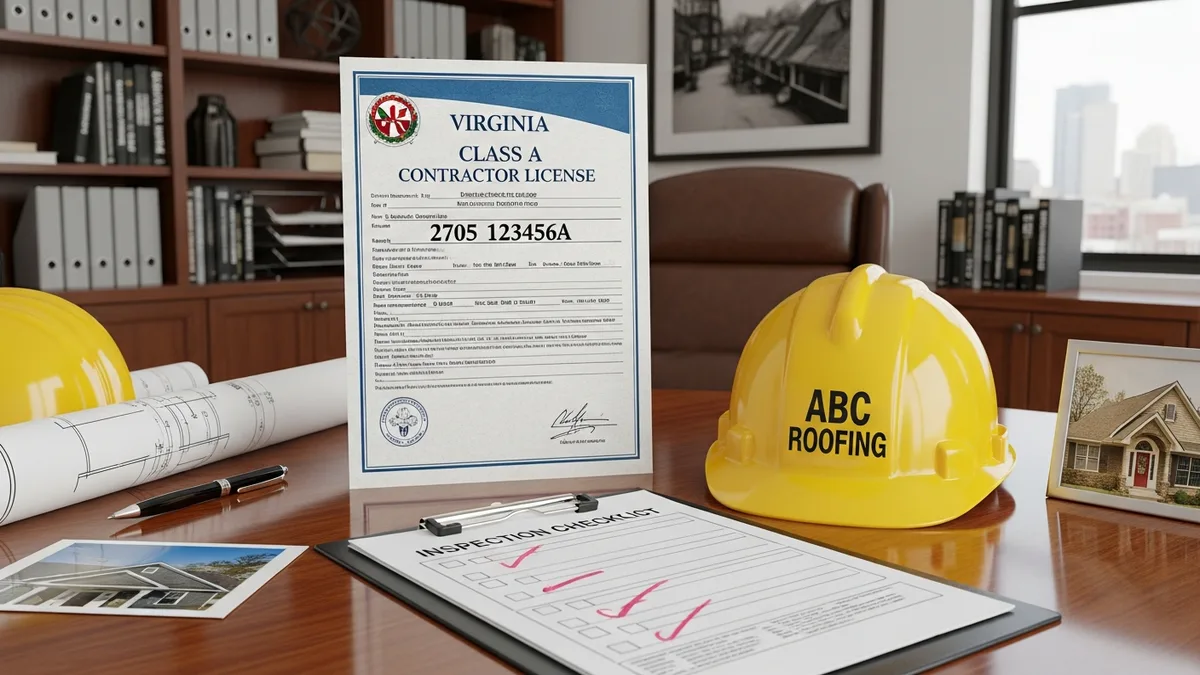
- Virginia requires three license classes based on project value: Class C (up to $10,000), Class B ($10,001 to $120,000), and Class A (over $120,000). Most residential roof replacements require at least a Class B license
- In addition to licensing, your contractor must carry both general liability insurance and workers compensation insurance — and you should verify these directly with the insurance carrier, not just accept a photocopy
- Hiring an unlicensed contractor puts you at risk: no permit compliance, no recourse for poor work, potential personal liability for worker injuries, and problems when selling your home
Finding a licensed roofing contractor in Prince William County should be the first filter in your selection process — before you compare prices, review portfolios, or read online reviews. A valid Virginia contractor license is not just a formality. It confirms that the contractor has met minimum competency requirements, has registered with the state, and is subject to the regulatory authority of the Department of Professional and Occupational Regulation (DPOR). An unlicensed contractor has no such accountability, and hiring one exposes you to risks that range from substandard work to personal liability for worker injuries on your property.
This guide walks Prince William County homeowners through the licensing verification process step by step, explains the insurance requirements you should verify, identifies the red flags that indicate an unlicensed or underqualified contractor, and provides a practical checklist for evaluating roofing contractors before signing a contract.
Virginia Contractor License Classes Explained
Virginia categorizes contractor licenses into three classes based on the total value of a single project or contract:
| License Class | Project Value Limit | Typical Roofing Projects |
|---|---|---|
| Class C | Up to $10,000 | Small repairs only |
| Class B | $10,001 to $120,000 | Most residential replacements |
| Class A | Over $120,000 | Large commercial, multi-unit |
Since most residential roof replacements in Prince William County cost $8,500 to $20,000, the majority require at least a Class B license. A contractor with only a Class C license cannot legally perform a roof replacement that exceeds $10,000 in total contract value. Verify that your contractor's license class covers the scope and value of your specific project.
How to Verify a Contractor's License
The verification process takes about two minutes online:
- Go to the DPOR website: Visit dpor.virginia.gov and navigate to the license lookup tool
- Search by company name or license number: Enter the exact company name as it appears on the estimate. If they provided a license number, search by that for the most accurate result
- Review the results: Check that the license is "Active" (not expired, suspended, or revoked), that the license class covers your project value, that the specialty classifications include "Roofing" or "Building," and that the company name matches what appears on your estimate
- Note the license number: Record it for your records. The license number should also appear on your written estimate and contract
What the DPOR lookup does NOT tell you: The license confirms legal standing to operate but does not guarantee quality, financial stability, or customer satisfaction. Think of it as a minimum threshold — necessary but not sufficient. You still need to evaluate insurance coverage, references, reviews, and the quality of the contractor's proposal.
Insurance Requirements You Must Verify
General Liability Insurance
General liability insurance protects your property if the contractor causes damage during the project — a dropped tool that cracks a window, a dumpster that damages your driveway, or debris that harms a neighboring property. Without this coverage, you would need to pursue the contractor directly for damages, which may be unrecoverable if the contractor is a small operation with limited assets. Look for a minimum of $1 million in general liability coverage, which is industry standard for residential roofing contractors.
Workers Compensation Insurance
This is the one that most homeowners don't think about until it matters. Workers compensation covers medical bills and lost wages for workers injured on the job. If a contractor without workers comp sends a crew to your home and a worker falls from the roof and is injured, you as the property owner may be held liable for that worker's medical bills and lost income. This is not a theoretical risk — it happens regularly, and the financial exposure can be devastating. Virginia law requires employers with three or more employees to carry workers compensation. Some contractors try to circumvent this by classifying workers as independent subcontractors, which may not provide you with the same protection.
How to Actually Verify Insurance
Do not simply accept a photocopy of an insurance certificate from the contractor. Insurance policies can be cancelled after the certificate is issued, and some less scrupulous operators carry insurance just long enough to obtain the certificate, then cancel for the premium refund. Instead:
- Request the certificate of insurance with your name listed as the certificate holder
- Call the insurance carrier directly (the number on the certificate) and confirm the policy is active and covers the named contractor
- Verify the policy period covers your project dates
- Confirm the coverage amounts meet minimum thresholds ($1M general liability, statutory workers comp)
Red Flags That Indicate Unlicensed or Unqualified Contractors
- "We don't need a license for this": False. Virginia requires a contractor license for roofing work above the handyman exemption threshold ($1,000)
- No written estimate: A legitimate contractor provides a detailed, written estimate with their license number, company address, and scope of work
- "We're working under another company's license": This is generally not how Virginia licensing works. The licensed company must be the contracting entity
- "You pull the permit": The contractor should handle the permit. Asking you to pull it may indicate they can't because they're unlicensed
- Door-to-door solicitation after a storm: While not always a scam, storm-chasing contractors who appear at your door after severe weather are often out-of-state operations without Virginia licenses. They do the work, collect the insurance check, and disappear before quality issues surface
- Cash-only, no contract: A contractor who insists on cash payment and won't provide a written contract is avoiding the documentation trail that legitimate businesses maintain
- Unusually low price: If one estimate is 40 to 50 percent below others for the same scope, the contractor may be unlicensed, uninsured, or planning to cut corners on materials or labor
Complete Contractor Evaluation Checklist
Use this checklist when evaluating any roofing contractor for a Prince William County project:
- DPOR license verified: Active status, correct class for project value, roofing classification
- General liability insurance verified: Called the carrier directly, confirmed active policy with adequate coverage
- Workers comp insurance verified: Same verification process as general liability
- Written estimate provided: Itemized by material, labor, tear-off, disposal, permit, underlayment, flashing, ventilation
- Local references checked: Spoke with previous Prince William County customers. Projects similar in scope to yours
- Online reviews reviewed: Google Business Profile, with attention to review patterns, response to complaints, and mentions of your specific community or area
- Warranty terms in writing: Manufacturer material warranty details and contractor workmanship warranty duration clearly stated
- Payment terms reasonable: No more than 10 to 20 percent deposit required before work begins. Final payment due after completion and satisfaction
- Permit handling confirmed: Contractor procures the permit, includes it in their scope, and schedules the inspection
- Timeline provided: Clear start date, estimated duration, and contingency plan for weather delays
Prince William County Permit Requirements and Inspections
A building permit is required for roof replacements in Prince William County, and only a licensed contractor can pull one on your behalf. The permit ensures that the work is performed to current Virginia building code standards, including proper underlayment installation, ice and water shield placement in valleys and at eave edges, adequate ventilation, and correct flashing at all penetrations. After the work is completed, the county schedules an inspection to verify code compliance. If the work fails inspection, the contractor must correct the deficiencies and schedule a re-inspection at no additional cost to you.
An unlicensed contractor cannot pull a permit, which means either the work proceeds without one — leaving you with unpermitted modifications to your home — or they ask you to pull the permit yourself, which is a major red flag. Unpermitted roofing work creates problems when you sell your home because the buyer's inspector or lender may flag the missing permit. It also means no county inspection was performed, so there's no independent verification that the installation meets code. Communities with HOA oversight, like Stonebridge at Potomac Club or Lake Ridge, often require proof of permit as part of their architectural review process.
Manufacturer Certifications as an Additional Quality Signal
Beyond the DPOR license, look for manufacturer certifications from major shingle producers like GAF, Owens Corning, and CertainTeed. These programs require contractors to meet installation training standards, maintain active licensing and insurance, and demonstrate a track record of quality work. The practical benefit to you as a homeowner is access to enhanced warranty options — a GAF Master Elite contractor, for example, can offer the Golden Pledge warranty with 25 years of workmanship coverage, while a non-certified installer can only offer the standard material warranty. Manufacturer certification is not a substitute for DPOR licensing, but it provides an additional layer of quality assurance on top of the regulatory minimum. When comparing contractors, ask whether they hold any manufacturer certifications and what specific warranty options those certifications unlock for your project.
Conclusion
Finding a licensed roofing contractor in Prince William County is the non-negotiable first step in any roofing project. The DPOR lookup takes two minutes and immediately eliminates unlicensed operators from consideration. Insurance verification takes another five minutes and protects you from potentially catastrophic liability. These checks are not optional best practices — they are essential safeguards that separate legitimate contractors from operators who put your investment, your home, and your legal exposure at risk. Do these checks before you compare prices, before you read reviews, and before you schedule estimates.
Call us at (571) 570-7930 or book a free consultation. We're fully licensed, insured, and happy to provide verification documentation upfront.