Townhome Roofing in Woodbridge VA: Shared Walls, Unique Challenges
Townhome Roofing in Woodbridge VA: Shared Walls, Unique Challenges
Key Takeaways
- Townhome roofing involves critical details at the party wall (shared wall) junction where your roof meets your neighbor's — improper flashing here causes leaks affecting both homes
- Coordinating with adjacent homeowners for simultaneous replacement creates better transitions, reduces per-unit costs, and avoids the aesthetic mismatch of different-age roofs on attached units
- Most Woodbridge townhome communities are HOA-governed with ARC requirements for roofing — check your community's guidelines before selecting materials
- Townhome roof replacement in Woodbridge typically costs $7,000 to $14,000 depending on unit size, end-unit vs interior-unit configurations, and material grade
- End units have one additional exposed wall with its own roofing and flashing requirements, making them slightly more expensive to roof than interior units
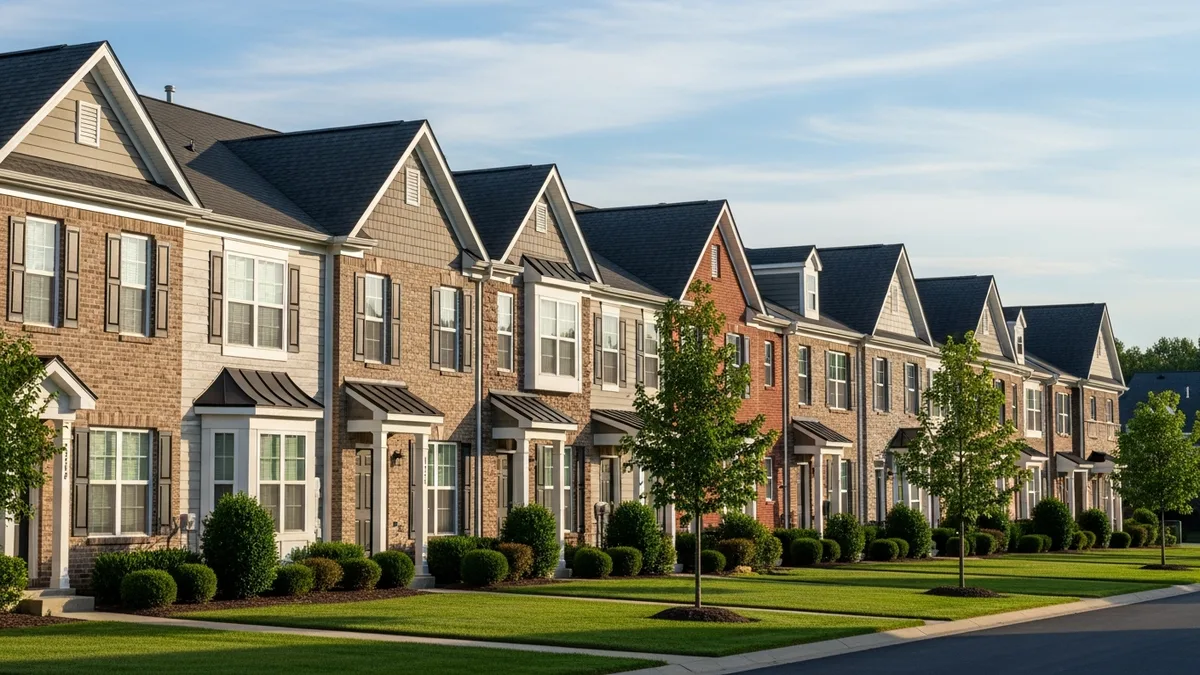
Woodbridge and the surrounding Prince William County area have thousands of townhomes — attached row houses that share party walls with adjacent units. Communities like Stonebridge at Potomac Club, sections of Lake Ridge, Dale City, Montclair, and numerous other neighborhoods include townhome sections where roofing presents unique challenges that don't exist on detached single-family homes.
The central challenge in townhome roofing is the party wall — the shared wall between adjacent units. The roof-to-party-wall junction is a critical flashing point that, if not properly detailed, allows water to penetrate into both homes. When only one unit in a row replaces its roof, the junction between the new roof and the adjacent unit's older roof must be carefully managed to maintain weather integrity. This is where the quality of your contractor matters most.
The Party Wall Challenge
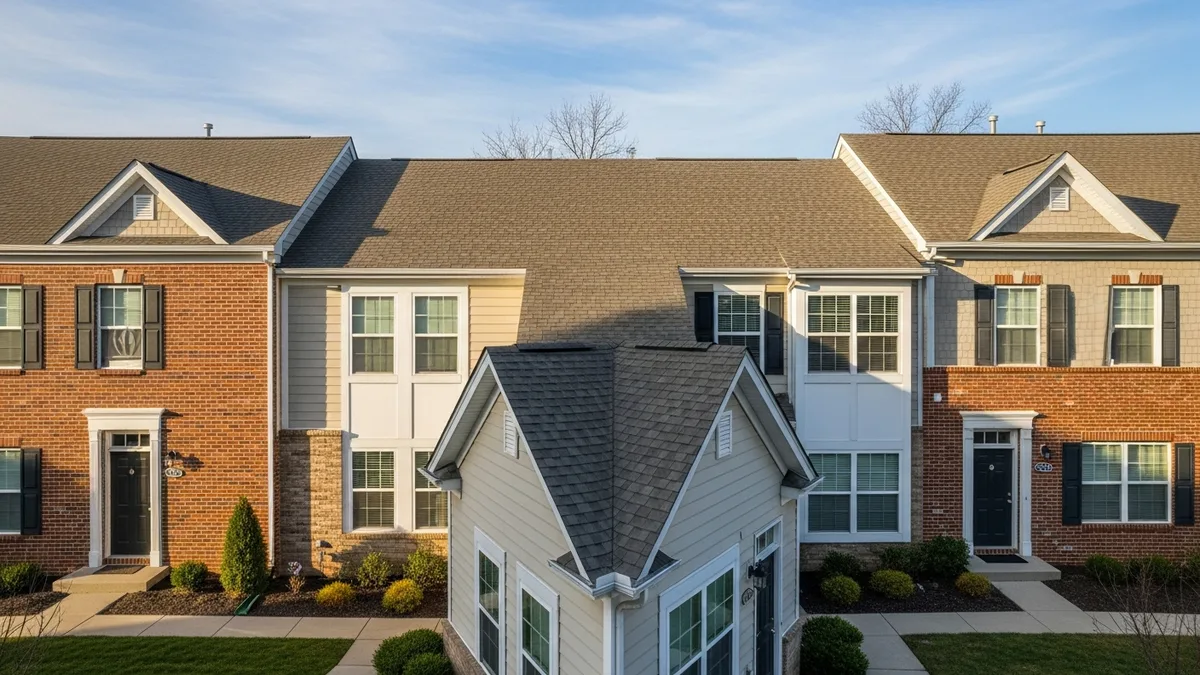
The party wall (also called a fire wall or demising wall) is the structural wall shared between adjacent townhome units. This wall typically extends above the roof line (a parapet or fire wall) or terminates at the roof surface. In either configuration, the junction where the roof meets this wall requires step flashing, counter flashing, and proper sealant to prevent water intrusion.
When both adjacent units have the same-age roof, the flashing at the party wall is a continuous, unified system. When one unit replaces its roof independently, the contractor must tie the new flashing into the existing flashing on the adjacent unit without disturbing the neighbor's roof — a detail that requires experience and careful execution. Improperly handled party wall transitions are the most common source of post-replacement leaks on townhome roofing projects.
Benefits of Coordinated Replacement
The ideal approach for townhome roofing is coordinating with adjacent owners to replace simultaneously. This creates several advantages:
- Better party wall transitions: When both roofs are replaced at the same time, the flashing at the party wall can be installed as a unified system rather than a splice between old and new
- Cost savings: Contractors may offer per-unit discounts when replacing multiple attached units simultaneously because of setup efficiencies, shared dumpster costs, and reduced material waste
- Consistent appearance: Matching material and color across attached units maintains a uniform appearance that benefits all owners' property values
- Fewer disruptions: One mobilization event rather than two means less total disruption to the row
If you can't coordinate with your neighbors, a single-unit replacement is still perfectly viable — it just requires a contractor experienced with the party wall transition detail.
End Units vs Interior Units
Townhome position in the row affects the roofing scope and cost:
- Interior units: Have party walls on both sides. The roof is typically a simple gable or shed design with minimal complexity. Interior units have the smallest roof area and the lowest replacement cost in the row
- End units: Have a party wall on one side and a fully exposed exterior wall on the other. The end wall often has its own roof-to-wall flashing requirements, additional fascia and soffit coverage, and sometimes additional gable-end or hip-end roofing. End units typically cost 10 to 20 percent more than interior units to roof
Cost of Townhome Roofing in Woodbridge
| Unit Type | Low End | High End | Notes |
|---|---|---|---|
| Interior unit (arch shingles) | $7,000 | $12,000 | Smallest roof area |
| End unit (arch shingles) | $8,000 | $14,000 | Additional exposed wall |
| Multi-unit discount (per unit) | 5% | 15% | When neighbors coordinate |
| Repair (party wall flashing) | $400 | $1,200 | Common leak source |
HOA Considerations for Townhome Roofing
Nearly all Woodbridge townhome communities have HOA governance with ARC requirements. Some additional townhome-specific HOA considerations include: some HOAs require that replacement colors match adjacent units, not just the community palette; some communities coordinate group replacement programs where multiple units replace simultaneously at a negotiated group rate; and some HOA governing documents specify that certain roofing maintenance tasks are the association's responsibility rather than the individual owner's — check your documents to understand what you're responsible for versus what the HOA handles. For the full ARC process, see our HOA roof replacement guide.
Townhome Roof Maintenance
Townhome maintenance follows the same principles as single-family home maintenance, with some additional considerations related to the attached nature of the building:
- Gutter coordination: In many townhome rows, the gutter system is interconnected. One unit's clogged gutter can back up water into adjacent units. Coordinate gutter cleaning with your neighbors, or advocate for the HOA to handle gutter maintenance as a community-wide service
- Party wall monitoring: Check the interior walls along the party line for water stains, especially near the ceiling. Leaks at the party wall transition often show up on interior surfaces before they're visible on the exterior. Early detection prevents extensive damage to both units
- Shared ventilation awareness: Some townhome designs share attic spaces across multiple units or have minimal fire-stops between attic sections. When replacing your roof, verify that ventilation modifications don't negatively affect adjacent units' attic conditions
- Annual professional inspection: Schedule annually each spring. The inspector should pay particular attention to the party wall flashing condition, which is the most vulnerable point on any townhome roof
Materials for Townhome Roofing
Material selection for townhome roofing in Woodbridge must balance HOA requirements, neighbor coordination, and performance needs. Most Woodbridge townhome communities require architectural asphalt shingles within a specific color palette. Within those constraints, prioritize algae-resistant formulations with strong wind ratings. Products like GAF Timberline HDZ, Owens Corning Duration, and CertainTeed Landmark Pro are commonly approved options that provide the combination of appearance, durability, and warranty coverage that makes sense for townhome applications. When coordinating with neighbors, selecting the same product and color creates the most aesthetically unified result and simplifies the ARC submission process for all parties.
Choosing a Contractor for Townhome Roofing
Choosing a Contractor for Townhome Roofing
- Townhome-specific experience: Ask for references from townhome projects, specifically about party wall transitions. This is the detail that separates experienced townhome roofers from contractors who primarily work on detached homes
- Neighbor coordination willingness: A good townhome contractor proactively discusses coordinating with adjacent owners and can provide multi-unit pricing
- HOA familiarity: Experience with your community's ARC process and approved materials streamlines the approval timeline
- Liability awareness: The contractor should carry adequate insurance for townhome work, where the risk of affecting an adjacent property is higher than on a detached home
Storm Damage on Townhome Roofs
Storm damage on townhome roofs introduces additional complexity compared to detached homes. When wind or impact damage occurs at or near the party wall, both units may be affected even though the damage is only visible on one side. Your insurance claim may need to document damage that extends to the junction with the adjacent unit, and the repair may need to address flashing on both sides of the party wall to properly restore weather integrity. Coordinate with your neighbor and both insurance companies when party wall area damage is involved. An experienced townhome roofing contractor can assess damage on both sides and provide documentation that supports both homeowners' claims.
Insurance Claims on Townhome Roofs
Filing an insurance claim on a townhome roof introduces complexity that doesn't exist with detached homes. When storm damage affects one unit in a row, the adjuster needs to determine the boundary of the damaged area relative to the party walls. If the damage extends across the party wall junction, both homeowners may need to file separate claims with their respective insurance companies — even if the physical damage appears to be on a single unit's roof surface. The party wall flashing system connects both roofs, and restoring weather integrity at that junction often requires work on both sides.
Complications also arise when the insurance company approves replacement for one unit but the adjacent unit's roof — while not storm-damaged — is in poor condition. Tying new materials into a deteriorated neighboring roof creates a compromise at the party wall that may not hold up long-term. In these situations, the most practical approach is to coordinate with the neighbor to replace both roofs simultaneously, even if only one is covered by insurance. The neighbor benefits from a new roof at a potentially discounted rate through the multi-unit coordination, and you get a proper party wall transition rather than a splice between new and failing materials. Your contractor should document the situation thoroughly so the insurance company understands why the party wall work on both sides is necessary for a complete repair.
Ventilation Challenges in Attached Townhomes
Townhome ventilation is inherently more constrained than on detached homes. Interior units have soffit access on only the front and rear of the building — the side walls are shared party walls with no ventilation opportunity. This limits the number of intake points and can create dead zones in the attic where airflow stagnates. When replacing a townhome roof, the contractor should maximize the intake capacity at the available soffits, install continuous ridge vent along the full length of the ridge, and verify that insulation baffles are in place at every rafter bay to keep the airflow path clear from soffit to ridge.
Some older Woodbridge townhome designs from the 1980s and early 1990s were built with minimal attic ventilation — often just a pair of gable vents or a few individual soffit vents that provide far less airflow than modern code requires. These homes are prone to moisture buildup in the attic, which leads to premature decking deterioration and shingle failure from the underside. Upgrading to a balanced soffit-to-ridge ventilation system during roof replacement is a code requirement on most projects and delivers measurable improvements in both roof longevity and energy performance. The cost of the ventilation upgrade is minimal when done during the replacement compared to the expense of a standalone retrofit.
Conclusion
Townhome roofing in Woodbridge VA requires attention to details that don't apply to detached homes — particularly the party wall transitions and neighbor coordination that make the difference between a leak-free result and a chronic moisture problem. Choose a contractor with documented townhome experience, explore coordinating with your neighbors for simultaneous replacement, and ensure the ARC process is handled smoothly. The investment in a quality townhome roof protects not just your unit but contributes to the structural integrity and appearance of the entire row.
Call us at (571) 570-7930 or book a consultation for your Woodbridge townhome roofing project.