Flat Roof vs Low-Slope Roof in Northern Virginia: System Choice and Cost
Flat Roof vs Low-Slope Roof in Northern Virginia: System Choice and Cost
Key Takeaways
- "Flat roof" is colloquial — true flat doesn't exist; the industry term is low-slope (under 2/12 pitch)
- Low-slope roofs require membrane systems (TPO, EPDM, PVC, mod-bit, BUR) because shingles can't shed water at slopes below 2/12
- Typical NoVA installed cost: $7–$14.50 per sq ft depending on membrane and insulation; service life 18–35 years
- TPO is the default recommendation for most NoVA residential additions and small commercial roofs in 2026
- Ponding water more than 48 hours after rain is a code issue and the leading cause of premature membrane failure
Many Northern Virginia property owners use "flat roof" and "low-slope roof" interchangeably, and contractors often follow the customer's lead. Technically though, the two terms have specific meanings that affect membrane selection, drainage design, code compliance, and cost. There's actually no such thing as a truly flat roof in code-compliant construction; every "flat" roof has at least 1/4 inch per foot of slope toward drains. This guide explains what the terms mean, what membrane systems work for each, what they cost in 2026 Northern Virginia, and how to choose the right system for residential additions, mid-century modern homes, and small commercial properties throughout Prince William, Fairfax, and Loudoun Counties.
The Definitions That Actually Matter
The Virginia Construction Code (which adopts the IBC and IRC) categorizes roof slope into three ranges, and understanding which one your project sits in determines which materials are even legal to install. Low-slope roofs are anything less than 2/12 — less than 9.5 degrees — and require a membrane roofing system such as TPO, EPDM, PVC, modified bitumen, or built-up; asphalt shingles, wood shake, slate, and tile are not code-compliant on these slopes regardless of the manufacturer's claims. Conventional pitched roofs sit in the 2/12 to 4/12 range and allow asphalt shingles with additional underlayment, while membrane systems remain code-compliant as well. Steep-slope roofs at 4/12 and above are standard shingle, tile, slate, or metal panel territory and follow the manufacturer's normal installation specs.
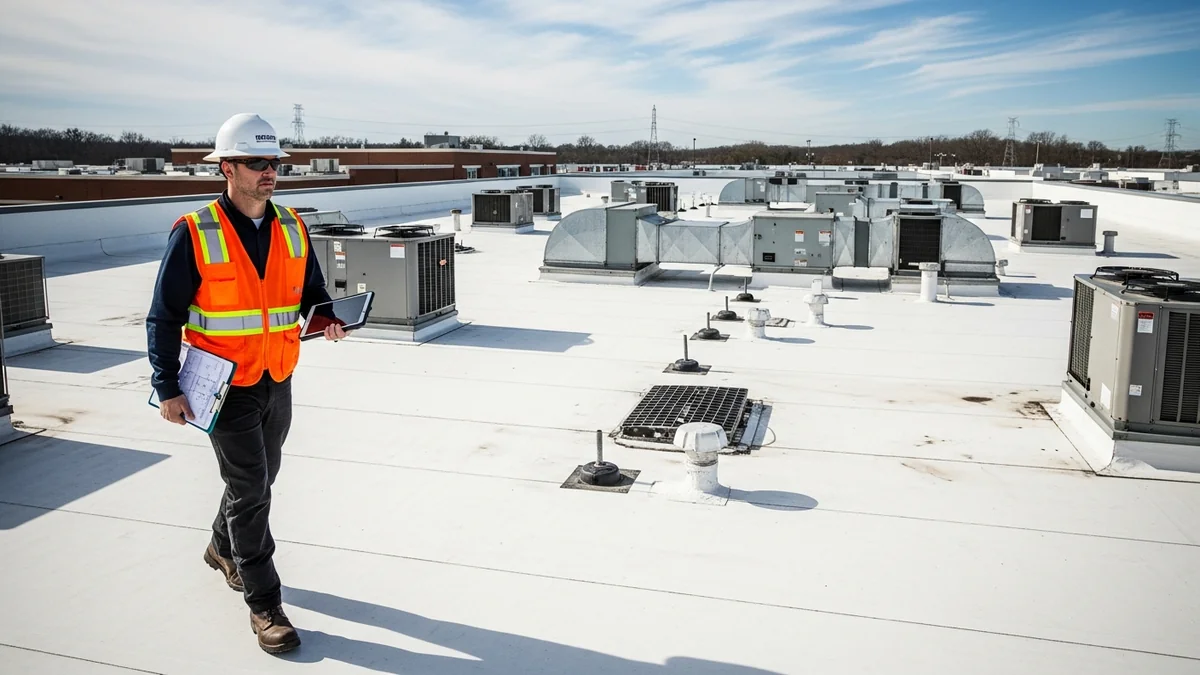
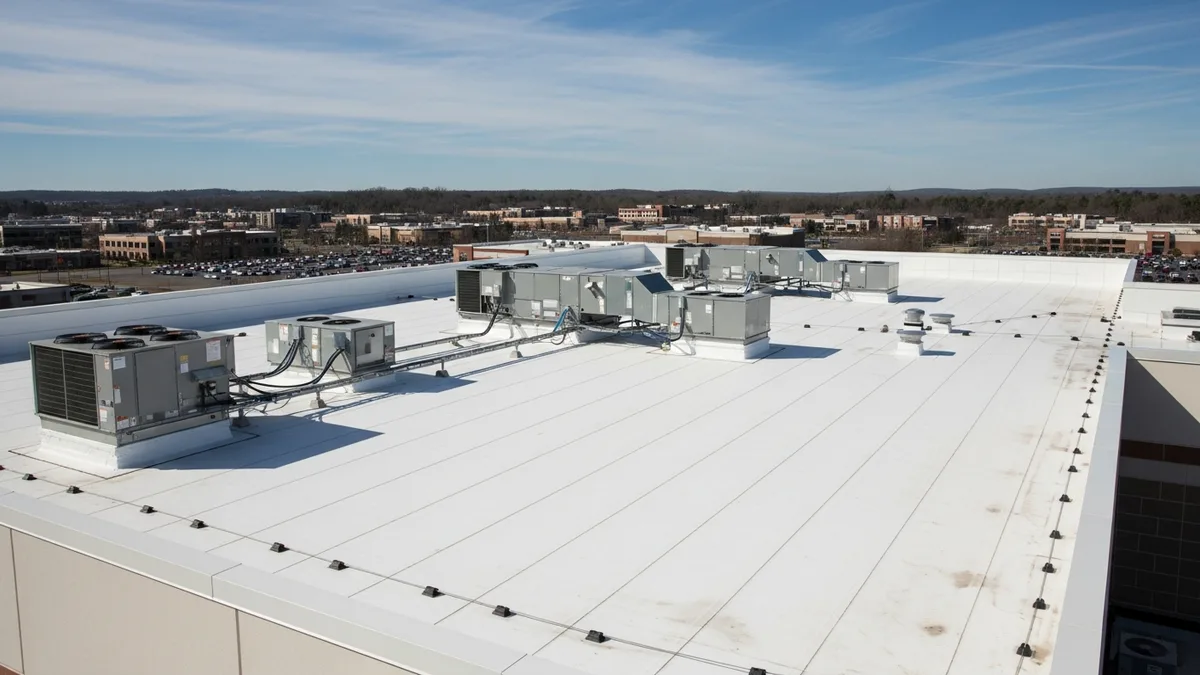
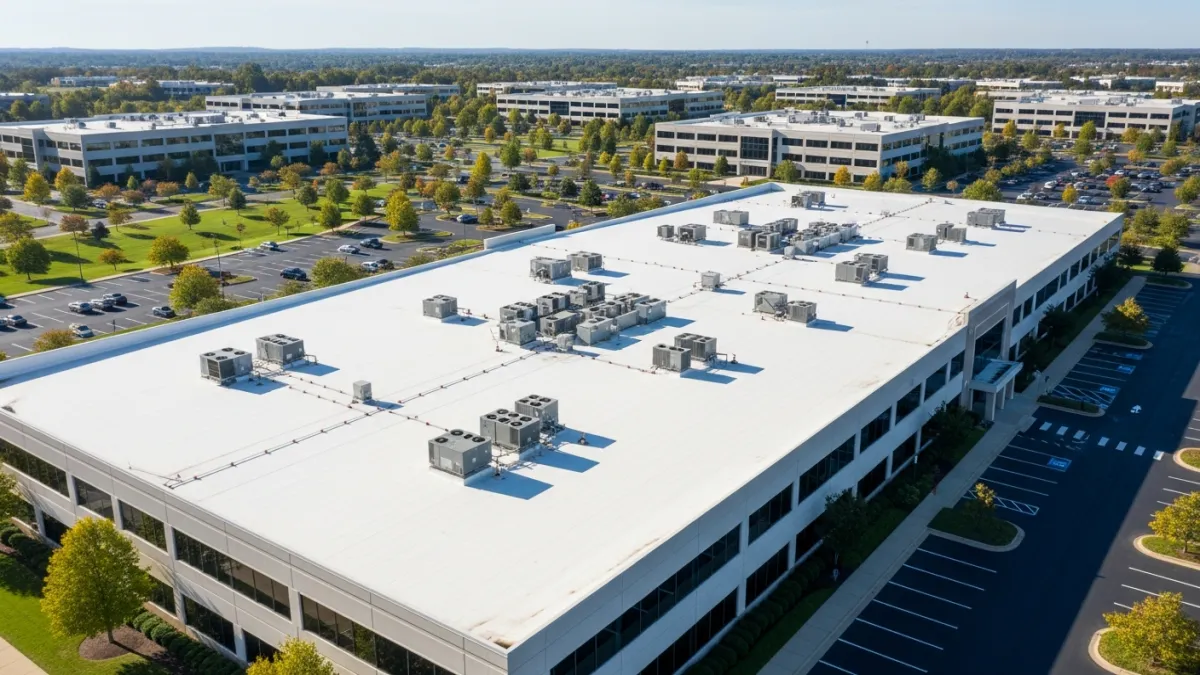
The "flat" versus "low-slope" colloquial distinction within the under-2/12 range is more about appearance than engineering. A roof described as flat is one that looks visually flat from the ground, typically sloped between a quarter inch and one inch per foot — common on commercial buildings, mid-century modern homes, and modern residential additions. A roof described as low-slope is visibly pitched but still under 2/12, typically one to two inches per foot, and shows up most often on sunroom additions, porch conversions, and residential additions where the owner wanted some visible pitch for aesthetics. For practical purposes — membrane choice, drainage strategy, code requirements, and cost — the two are treated nearly identically, and the contractor industry refers to them collectively as low-slope because that is the IBC terminology that drives the project specification.
The Five Membrane Systems Available in Northern Virginia
TPO (Thermoplastic Polyolefin). The dominant residential and small-commercial low-slope membrane in NoVA. Heat-weldable seams (very durable), white reflective surface (reduces summer cooling load), 20–30 year service life. Manufacturer leaders: GAF EverGuard, Carlisle Sure-Weld, Firestone UltraPly, Johns Manville TPO, GenFlex.
EPDM (Ethylene Propylene Diene Monomer / "rubber"). Black rubber sheet membrane, glued or mechanically fastened. Long historical track record (40+ years of installations to evaluate), excellent cold-weather flexibility, 25–35 year service life. The traditional commercial choice and a reasonable residential option for areas where reflectivity isn't a priority. Manufacturer leaders: Firestone, Carlisle, Johns Manville, GenFlex.
PVC (Polyvinyl Chloride). Premium thermoplastic membrane with chemical resistance (restaurants with grease exhaust, industrial facilities). Heat-weldable seams, 25–35 year service life, higher cost than TPO. Manufacturer leaders: Sika Sarnafil (the gold standard, 50+ year track record on some installations), Carlisle Sure-Flex PVC, IB Roof.
Modified Bitumen (Mod-Bit). Asphalt-based membrane with SBS (rubber) or APP (plastic) modifier, applied as 2-ply or 3-ply hot-mopped or torch-applied system. Granule cap sheet provides UV protection. 18–25 year service life. Common on residential additions where matching an existing built-up roof or providing some surface texture is desired. Manufacturer leaders: GAF Liberty (self-adhered), CertainTeed Flintlastic, Soprema, Tremco.
Built-Up Roof (BUR). The traditional "tar and gravel" roof. Multiple plies of asphalt-saturated felt with hot asphalt and gravel surfacing. 20–30 year service life. Largely replaced by single-ply membranes for new construction but still seen on older NoVA commercial buildings. New BUR installation is rare in 2026 except as a like-for-like replacement.
Side-by-Side System Comparison
| System | Service Life | Installed Cost / sq ft | Best For |
|---|---|---|---|
| TPO | 20–30 years | $7.50–$11.50 | Most NoVA residential and small commercial |
| EPDM | 25–35 years | $7.00–$11.00 | Large commercial; areas where reflectivity less important |
| PVC | 25–35 years | $9.50–$14.50 | Restaurants, chemical exposure, premium spec |
| Modified Bitumen | 18–25 years | $8.00–$12.50 | Residential additions; matching existing BUR |
| Built-Up Roof | 20–30 years | $7.50–$12.00 | Like-for-like replacement on older commercial |
Costs are typical 2026 ranges for Northern Virginia. Add $2.50–$4.50/sq ft for R-30 polyiso insulation if not already in place. Add $1.50–$3.50/sq ft for tear-off of existing roof.
Drainage Design and Why It Matters in NoVA
No low-slope roof is truly flat. The IBC requires positive drainage with a minimum slope of 1/4 inch per foot toward drains, scuppers, or eaves, and ponding water must dissipate within 48 hours of the end of a rain event. Northern Virginia's annual rainfall (around 42 inches) and concentrated thunderstorm intensity (1–3 inches in an hour is routine) make drainage design particularly important.
Drainage strategy on a NoVA low-slope roof is built from a combination of tapered insulation, interior drains, scuppers, and crickets, and the right combination depends on the building. Tapered insulation has become the dominant approach for new construction and reroofs alike — polyiso or EPS insulation is factory-cut in tapered shapes that establish positive slope above a flat structural deck, and current Virginia energy code requires an R-30 minimum that tapered systems typically deliver as R-30 to R-40 across the whole roof. Interior drains carry water from low points through the membrane into the building's internal drain piping, with strainers preventing debris blockage; scuppers, which are edge drains that route water through the parapet wall into external downspouts, are more common on smaller commercial buildings and residential additions where running internal piping isn't practical.
A few additional details turn an adequate drainage system into a robust one. Where interior drains are the primary drainage, code requires a through-wall overflow scupper to provide redundancy if the primary drain clogs — a real risk on Prince William commercial roofs that collect leaf debris in the fall. Crickets, which are small triangular framed structures behind chimneys, parapets, and HVAC curbs, divert water around obstructions that would otherwise create chronic ponding zones. When evaluating an existing low-slope roof, persistent ponding more than 48 hours after a rain event is the number-one indicator of a drainage problem, and most older NoVA commercial roofs that need replacement have at least one ponding location somewhere on the roof. A reroof is the right time to add tapered insulation and additional drains or scuppers to correct the underlying issue, and skipping that correction is a common reason newly installed membranes fail at year 12 instead of year 25 — a pattern our commercial inspection guide covers in more depth.
Insulation: Often Half the Cost
The Virginia residential energy code requires R-30 minimum for unvented low-slope roof assemblies, and commercial code typically requires R-25 to R-35 depending on building use. Polyisocyanurate — polyiso — is the dominant insulation choice for NoVA low-slope roofs because it carries an R-6 per inch nominal value (which drops to roughly R-5.5 effective in cold conditions) and is available in a range of thicknesses from 1 inch to 4 inches that can be combined to hit the target R-value. Standard practice is to install polyiso in two layers with staggered seams to break thermal bridges, and a typical R-30 assembly requires about 5.5 inches of total polyiso thickness. Tapered systems use multiple thicknesses cut at the factory to establish the required positive drainage slope above a flat structural deck, and the installed cost generally runs $2.50 to $4.50 per square foot including fasteners, depending on thickness and the complexity of the tapered layout.
A few alternative materials show up in specific applications. EPS (expanded polystyrene) and XPS (extruded polystyrene) are less common than polyiso but appear in some lower-cost residential additions and in projects where polyiso's slight R-value loss in cold weather is a concern. Mineral wool is increasingly used as a fire-resistant top layer in larger commercial applications, particularly where insurance carriers or fire codes require improved flame performance. For a typical NoVA reroof that includes new insulation, the insulation package alone routinely runs 30 to 50 percent of the total project cost — which can be jarring on a $250,000 commercial reroof until you consider that skipping insulation upgrades during the reroof is shortsighted. The cost premium for doing it now is small compared to running it as a standalone project later, the energy savings recover a meaningful payback across the membrane's 25–30 year service life, and the building's tenant comfort and HVAC operating cost both improve from the moment the new roof is in service.
Common Failure Modes by System
TPO failures. First-generation TPO (2002–2010) had widely reported seam delamination and shrinkage issues; current-generation TPO is significantly improved. Common modern TPO failures: punctures from foot traffic, seam separation from poor heat welding at install, edge-strip failure at year 15+, and UV degradation of cheaper Chinese-made membranes.
EPDM failures. Shrinkage at edges and corners after year 15, particularly with mechanically fastened systems. Adhesive failure on glued systems. Pipe boot rubber-to-membrane bond breakdown at year 12–18.
PVC failures. Plasticizer migration over time can make older PVC brittle (current formulations much improved). Yellowing of white surfaces. Generally the longest-lived single-ply membrane.
Modified bitumen failures. Granule loss and cap sheet erosion, blistering from moisture trapped under the cap sheet, and lap-seam adhesion failure on torch-applied systems with poor original installation.
BUR failures. Alligatoring (UV-related cracking), ponding-related membrane breakdown, gravel loss exposing felts to UV, and felt blister failure.
For more on commercial roof inspection and warranty preservation, see our commercial inspection guide and selecting a TPO contractor in Northern Virginia.
Choosing the Right System for Your NoVA Property
Picking the right system for a specific NoVA property is more pattern-recognition than rocket science once you've narrowed by building type. For a residential addition under 800 square feet — sunroom, porch conversion, family room — TPO and EPDM are both reasonable choices; TPO wins when matching a white aesthetic or maximizing reflectivity matters, and EPDM wins when a darker aesthetic is preferred and longest service life is the priority. A mid-century modern home with a full low-slope main roof is also typically a TPO or EPDM project, paired with a tapered insulation system and a full structural slope evaluation, and the choice should coordinate with the home's architectural style rather than be driven purely by cost. Small single-tenant commercial buildings under 5,000 square feet usually default to TPO for cost and reflectivity reasons, with PVC reserved for buildings that have chemical exposure such as restaurant grease exhaust or industrial process emissions.
Mid-size commercial buildings in the 5,000 to 25,000 square foot range can go either TPO or EPDM, with EPDM often cost-favored at the larger end and TPO winning when summer cooling load is meaningful. Large commercial and industrial buildings above 25,000 square feet open up the full menu of TPO, EPDM, and PVC depending on use case, and at that scale insurance carrier requirements become a real input — some carriers specifically mandate FM Global-rated systems for fire and wind exposure. Restaurants and food service properties almost always end up on PVC for chemical resistance to grease and fats from rooftop exhaust, and historic restoration projects either use modified bitumen to match an existing BUR or use TPO/EPDM with carefully designed edge details to preserve the historic appearance — our Occoquan historic home guide walks through how to balance code compliance with period accuracy. For commercial and large residential projects, the practical recommendation is to get quotes for both TPO and EPDM and compare them side-by-side; total installed cost is typically within 5–10 percent between the two for similar specifications, so the actual choice usually comes down to manufacturer warranty terms, aesthetics, and contractor expertise rather than the headline price. Our TPO contractor selection guide and commercial roofing overview are useful follow-up reading once the system choice is narrowed.
Need a Flat or Low-Slope Roof in Northern Virginia?
Woodbridge Roofers installs and repairs TPO, EPDM, PVC, and modified bitumen roofing systems across Prince William, Fairfax, and Loudoun Counties. Free in-home or on-site consultations, transparent quotes with itemized membrane and insulation specs, and access to GAF, Carlisle, Firestone, and Johns Manville warranty programs. Call (571) 570-7930.
Schedule In-Home ConsultationFrequently Asked Questions
Related Articles
- Commercial Roof Inspection in Prince William County
- TPO Roofing Contractor in Northern Virginia
- Commercial Roofing in Woodbridge, VA
- Metal Roofing in Northern Virginia
Conclusion
The choice between system types for a flat or low-slope roof in Northern Virginia comes down to a few factors: roof size, building use, aesthetic preference, and budget. For most NoVA residential additions and small commercial properties, TPO is the default recommendation in 2026 — strong service life, competitive cost, white reflective surface for cooling load reduction, and broad contractor familiarity. EPDM is the strong alternative for larger commercial properties or where reflectivity isn't a priority. PVC is the premium choice for chemical-exposure environments. Modified bitumen and BUR remain in use for specific scenarios.
Whichever membrane you choose, the keys to long service life are correct drainage design (no ponding water beyond 48 hours), code-compliant insulation, manufacturer-certified installation, and a routine inspection program. The membrane itself is only one component of a successful low-slope roof system.
Call Woodbridge Roofers at (571) 570-7930 or book a free consultation to discuss your flat or low-slope roof project, get system recommendations specific to your property, and receive a transparent itemized quote.