Best Roof Underlayment for Virginia's Climate
Best Roof Underlayment for Virginia's Climate
Key Takeaways
- Synthetic underlayment is the modern default — 4–6x stronger than felt, much longer UV tolerance, lighter, lays flatter, and the cost premium is small
- Ice and water shield at all eaves (6 ft up the slope), valleys, around penetrations, and on rake edges is standard NoVA scope even though Virginia is not in the code-required ice barrier zone
- Full ice-and-water-shield coverage is overkill for steep-pitch NoVA roofs — reserved for low-pitch, heavy tree cover, ice dam history, or metal roofing
- Underlayment cost on a typical 2,200 sq ft Northern Virginia replacement runs $1,000–$2,300 in materials, typically rolled into the per-square-foot install price
- Once shingles cover it, quality underlayment typically outlasts the roof above it — investing in the right product the first time pays for itself across the next 25–30 years
Roof underlayment is the part of your roof system between the wood decking and the shingles — and the part that quietly determines how the roof handles wind-driven rain, ice dams, and the gradual moisture intrusion that eventually fails every roof. For Northern Virginia's mixed humid-subtropical climate, the right combination is a high-performance synthetic underlayment across the full field of the roof, plus self-adhered ice and water shield at the vulnerable transitions: eaves, valleys, penetrations, and rake edges. Get the underlayment right and the rest of the roof has a 25–30 year working life. Get it wrong and the shingles above it become the only line of defense against everything below them.
This guide compares the major underlayment options in the Northern Virginia market, walks through Virginia code requirements, prices a typical NoVA install, and addresses the most common scope decisions homeowners face on a roof replacement. We'll also cover the underlayment specifics for metal roofs, low-pitch sections, and the chimney/skylight/valley details that cause most leak callbacks when done poorly.
The Three Categories of Roof Underlayment
1. Asphalt-Saturated Felt (15-lb and 30-lb)
The traditional underlayment, made from organic or fiberglass mat saturated with asphalt. Available in 15-lb (lighter weight) and 30-lb (heavier, more tear-resistant) options. Sold in 36-inch wide rolls covering 2 squares (15-lb) or 4 squares (30-lb). Felt was the standard for decades but has been largely displaced by synthetic underlayments on new installs in Northern Virginia. It still has niche uses on budget reroofs, repair patches, and historical-restoration projects where the original felt material is being matched.
Pros: Cheapest material option, well-understood by all crews, works adequately under shingles when shingles are installed promptly.
Cons: Limited UV exposure tolerance (7–30 days before significant degradation), wrinkles and buckles in heat and humidity, tears easily in wind during install, heavy and slippery underfoot, shorter overall service life if exposed.
2. Synthetic Underlayment
The modern default. Made from woven or non-woven polypropylene or polyethylene fabric, often with a slip-resistant top surface. Sold in wider rolls (typically 48 inches wide, 10 squares per roll) for faster installation. Comes from every major manufacturer: GAF FeltBuster and Tiger Paw, Owens Corning ProArmor and Deck Defense, CertainTeed RoofRunner, IKO Stormtite, Titanium UDL 30/50, Polyglass Polystick. The product names blur together and performance differences between top-tier options are small.
Pros: 4–6x the tear strength of felt, 90–180 days UV tolerance for installation, lays flat without buckling, lighter weight (about 1/3 of felt per square), better walkability for crews, longer service life if exposed during install delay.
Cons: Modestly more expensive at the material level ($0.05–$0.15 per square foot premium over felt), slightly different fastening pattern (manufacturer-specific cap nails or buttons), some products require manufacturer-specific accessories for warranty.
3. Self-Adhered Ice and Water Shield
A peel-and-stick rubberized asphalt membrane with a polyethylene top film and an adhesive bottom. Used at the most leak-prone areas of the roof: eaves (where ice dams form), valleys (where water concentrates), around penetrations (chimneys, skylights, plumbing vents), and on rake edges (where wind-driven rain can blow up under shingles). Major products in the NoVA market: GAF WeatherWatch and StormGuard, Grace Ice & Water Shield, Owens Corning WeatherLock G/Self-Sealing Underlayment, CertainTeed WinterGuard, Titanium PSU30.
Pros: Self-seals around fasteners (any nail through the membrane is sealed by the rubberized asphalt), provides a continuous waterproof layer at vulnerable areas, 30–50 year material life, often outlasts the shingles above it.
Cons: 5–8x the cost of synthetic underlayment per square foot, more labor to install, can soften and become difficult to walk on in extreme summer heat (over 110°F), high-temperature variants required under metal roofing.
Virginia Code: What's Actually Required
Virginia adopts the International Residential Code (IRC) with state amendments, and a handful of sections drive what your contractor is required to install. IRC R905.1.1 mandates underlayment on every asphalt shingle roof per the manufacturer's instructions, and it requires two layers on any low-pitch section under 4:12 — which catches a surprising number of NoVA porch additions and dormer roofs. IRC R905.1.2 covers the ice barrier requirement, which is triggered where the average January temperature drops to 25°F or below; Northern Virginia averages in the low 30s and falls just outside the formally required zone, but most quality NoVA installs include ice barrier anyway because the manufacturer warranty asks for it. IRC Table R905.1.1(1) sets the material standards (ASTM D226 for felt, D4869 for organic felt, D6757 for asphalt-saturated underlayment, or any product carrying an ICC-ES evaluation), and top-tier shingle warranties from GAF, Owens Corning, and CertainTeed all require ice barrier at eaves, valleys, and penetrations regardless of the code minimum.
Underlayment Cost in Northern Virginia
| Product | Material Cost / sq ft | Installed Cost / sq ft | Typical Use |
|---|---|---|---|
| 15-lb felt | $0.05–$0.10 | $0.20–$0.40 | Budget reroofs, patches |
| 30-lb felt | $0.10–$0.18 | $0.30–$0.55 | Older replacements, low-pitch double layer |
| Synthetic (mid-tier) | $0.12–$0.22 | $0.30–$0.55 | Standard NoVA replacement |
| Synthetic (premium, e.g. Tiger Paw, Titanium) | $0.18–$0.32 | $0.40–$0.70 | Top-tier warranty installations |
| Ice and water shield (standard) | $0.55–$0.95 | $1.20–$2.20 | Eaves, valleys, penetrations |
| High-temp ice and water shield | $0.95–$1.65 | $1.85–$3.20 | Under metal roofing, dark roofs |
Prices shown are typical 2026 ranges for Northern Virginia. Underlayment is normally rolled into the per-square-foot replacement price; itemizing it separately is rare on a residential install. Contact us for a free on-site estimate.
For a typical 2,200 sq ft Northern Virginia home, the total underlayment scope (synthetic field + ice and water shield at eaves, valleys, and penetrations) runs $1,000–$2,300 in materials and labor combined. Upgrading from felt to synthetic adds roughly $200–$500. Adding full ice and water shield coverage instead of perimeter-only adds $1,800–$4,500.
Where Ice and Water Shield Actually Matters
There are a handful of locations on a Northern Virginia roof where ice and water shield genuinely changes outcomes, and the standard scope of any quality install includes all of them. The eaves are first — ice and water shield should run six feet up the slope from the gutter line on every eave, which protects against ice dam backup in winter and wind-driven rain backup during summer thunderstorms. Every valley should be covered (full width plus 18 inches each side of the centerline), because valleys concentrate water flow and the membrane there is doing real work even on a routine rain. Every penetration on the roof — chimneys, skylights, plumbing vents, HVAC stacks — should sit on top of an ice-and-water-shield patch as well; the flashing handles most of the day-to-day water management, but the membrane underneath is what saves you when a flashing seal fails ten years later.
A few additional locations have moved from optional to standard over the past decade. Rake edges (the gable ends, running top to bottom) are increasingly covered with ice and water shield because wind-driven rain on lower-slope NoVA roofs routinely blows back up under shingles at the rake. Any low-pitch roof section under 4:12 — common on porches, sunrooms, dormer roofs, and 1980s-era contemporary designs — is required by code to have full coverage rather than perimeter-only. And anything under a metal roof must use the high-temperature variant of ice and water shield, because dark metal panels conduct enough summer heat to soften standard rubberized asphalt and cause adhesion failure within a few summers. Full-coverage ice and water shield across the entire roof is typically reserved for low-pitch designs, homes with chronic ice dam history, properties under heavy tree cover that fills valleys with debris constantly, or metal roofs. For a standard-pitch NoVA home with no specific issues, perimeter coverage at the locations above delivers most of the practical benefit at a fraction of the cost, and the savings can be redirected into a higher-tier shingle product or a longer workmanship warranty.
Underlayment for Metal Roofing
Standing seam metal and exposed-fastener metal roofs have meaningfully different underlayment requirements than asphalt shingles, driven by two facts about how metal panels behave on a Northern Virginia roof. First, high-temperature ice and water shield is required underneath the panels because dark metal routinely reaches surface temperatures of 160 to 180°F in NoVA summers, which softens standard rubberized asphalt membranes and causes adhesion failure within a few cycles; the high-temp variant is engineered for that exposure and stays bonded under the panel for the full life of the roof. Second, slip-resistant synthetic underlayment is strongly preferred over felt because metal panel installation involves significant crew foot traffic across the underlayment surface, and felt becomes dangerously slippery and tears easily under that kind of work.
For a Northern Virginia metal roof install, the standard scope is high-temperature ice and water shield at eaves, valleys, and penetrations (or full coverage on any low-slope sections), paired with a high-tier slip-resistant synthetic underlayment across the field. The total underlayment cost on a metal roof is meaningfully higher than on an asphalt install — roughly $1,800 to $4,200 for a typical 2,200 sq ft home — but the membrane life under metal panels routinely exceeds 40 years, so the cost normalizes well across the roof's useful life. Our NoVA metal roofing guide walks through the panel options that pair with these underlayment choices in more detail.
Common Underlayment Mistakes in NoVA
A handful of underlayment mistakes turn up on the same kinds of NoVA replacement projects year after year, and most of them save the homeowner money on day one and cost them several multiples of that savings within a decade. The most common is skipping ice and water shield entirely to save $300 to $800 in materials and labor; the savings show up on the contract, and the cost shows up two winters later when wind-driven rain finds its way past the shingle layer at the eaves and into the soffit. Almost as common is reusing the existing underlayment during a tear-off — a practice that should be a non-starter, since old underlayment is brittle, peppered with fastener holes from the original shingles, and entirely the wrong base for a new manufacturer warranty registration. Felt left exposed for 30+ days during a delayed install is a third recurring failure mode; UV degrades felt quickly, and by the time the shingles go on, the underlayment is already compromised — synthetic tolerates that exposure window much better and is one reason it has displaced felt on most quality NoVA jobs.
The remaining common mistakes are installation-detail problems that the homeowner can't easily see but that the inspector or the next contractor will spot immediately. Ice and water shield installed without proper course overlap creates direct leak paths at every missed seam, and on a 2,200 sq ft home a single missed overlap can dump several gallons of water into the eave during a heavy storm. Standard ice and water shield used under dark metal roofing causes adhesion failure within one to three summers because the high-temperature variant is required for that application — using the wrong product is a warranty void waiting to happen. Underlayment fastened with the wrong cap nails or staples is a less visible but equally serious problem; many synthetic underlayments require manufacturer-specific plastic cap nails for warranty, and staples or generic roofing nails alone don't qualify. And finally, penetration boots installed without ice and water shield underneath are the single most common source of long-term leak callbacks in NoVA residential roofing — pipe boots are the leak source, and the membrane underneath is the secondary defense, so skipping it eliminates the only backup the homeowner has when the boot inevitably fails at the 10–14 year mark.
Underlayment Choices That Match the NoVA Climate
Northern Virginia sits at the intersection of three climate stressors that all push specific underlayment choices. The first is the freeze-thaw cycle: Prince William, Fairfax, and Loudoun Counties typically log 60 to 90 freeze-thaw events per winter, and each cycle drives small amounts of moisture into the roof system that can refreeze and expand. Synthetic underlayment with a slip-resistant top surface and proper cap-nail fastening prevents that moisture from reaching the deck, and ice and water shield at eaves and valleys absorbs the brunt of any backup that does occur during ice dam events. The second is summer humidity and heat: surface temperatures on a dark NoVA roof routinely exceed 150°F on July afternoons, and the underlayment underneath is what protects the deck during the long stretches when the shingle layer is heat-cycling and gradually losing granules. Synthetic underlayments tolerate that thermal load far better than asphalt-saturated felt, which softens, wrinkles, and loses tear strength under sustained summer heat.
The third stressor is severe weather. NoVA gets one to three measurable hail events per year and a small number of high-wind storms each summer, and the 2012 derecho remains the regional benchmark for what a worst-case wind event looks like. After hail or high-wind damage, the shingle layer often shows visible damage that triggers an insurance claim, but the underlayment underneath is what determines whether the deck stayed dry through the event and whether the post-storm repair becomes a partial repair or a full reroof. A robust underlayment scope — synthetic field plus ice and water shield at all eaves, valleys, penetrations, and rake edges — is what gives a NoVA roof the best chance of surviving a storm intact and the best chance of converting any storm damage into a clean, well-documented insurance claim per our claims filing guide.
Putting It All Together: Typical NoVA Replacement Scope
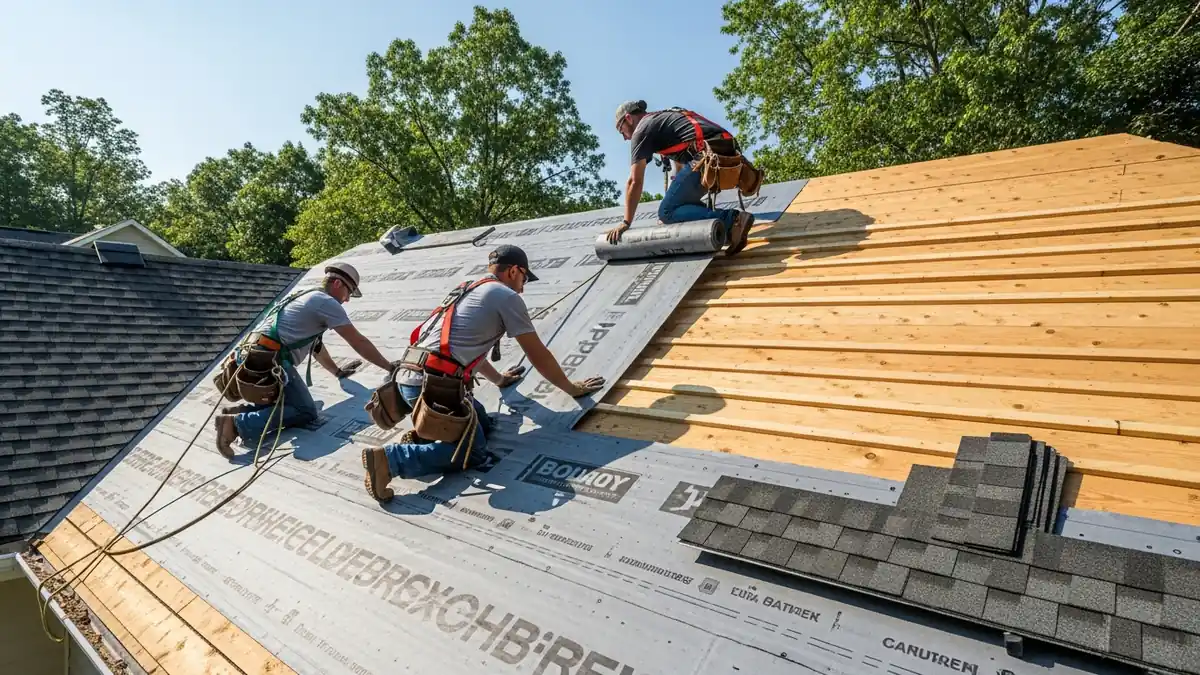
For a standard 2,200 sq ft Northern Virginia home with architectural asphalt shingles and a 6:12 pitch, the recommended underlayment scope reads as a single coherent package. The job starts with a full tear-off to bare deck and a careful decking inspection, replacing any rotted or compromised sheets before anything else goes down — skipping deck inspection in favor of "lay over the existing" is one of the cheapest decisions a contractor can make and one of the most expensive ones the homeowner ends up paying for later. Once the deck is sound, the field gets a mid-tier or premium synthetic underlayment fastened per the manufacturer's specific cap-nail pattern, and the vulnerable areas get ice and water shield: six feet up the slope from the gutter line at every eave, full width plus 18 inches each side of the centerline in every valley, around every penetration on the roof, and on every rake edge from top to bottom of the gable. Drip edge metal goes on at all eaves and rakes, and the ridge vent integrates with the underlayment system per the manufacturer's spec rather than being cut in as an afterthought.
This scope qualifies for the highest manufacturer warranty tier on most asphalt shingle systems and provides the moisture protection that Northern Virginia's wet-dry-freeze cycles demand. For a deeper dive on pairing this with the right shingle, see our guides on best roofing shingles for Virginia and roof ventilation for Northern Virginia homes.
See Exactly What's Going Under Your Shingles
When Woodbridge Roofers quotes a Northern Virginia roof, we spell out the underlayment products, the ice and water shield coverage, and the manufacturer warranty tier on a single page so you can compare apples to apples. Free in-home consultation, no pressure. Call (571) 570-7930 or book online.
Schedule In-Home ConsultationFrequently Asked Questions
Related Articles
- Roof Ventilation Guide for Northern Virginia Homes
- Best Roofing Shingles for Virginia
- Best Roofing Shingles for Virginia's Humid Climate
- Roof Replacement Cost in Northern Virginia
Conclusion
Roof underlayment is the silent half of a Virginia roof system. Get it right and you'll never think about it again for 25–30 years. Get it wrong and the shingles above it become the only thing standing between your living room and the next storm. The current standard for Northern Virginia is straightforward: high-quality synthetic underlayment across the full field, plus self-adhered ice and water shield at eaves, valleys, around penetrations, and on rake edges. Felt and skipped ice barrier are increasingly limited to budget reroofs and short-term repairs.
When you're comparing roof replacement quotes in Woodbridge, Lake Ridge, Dale City, Lorton, Manassas, or Stafford, ask each contractor specifically what underlayment products they're proposing, what the ice and water shield coverage scope is, and whether the proposed scope qualifies for the highest manufacturer warranty tier. Differences in underlayment scope often explain why one quote is hundreds or thousands lower than another for what looks like the same shingle.
Call Woodbridge Roofers at (571) 570-7930 or book a free in-home consultation. We'll spell out the underlayment products, the ice barrier coverage, and the warranty tier on a single page so you can compare apples to apples.