How to Compare Roofing Quotes in Virginia: A Line-by-Line Checklist
How to Compare Roofing Quotes in Virginia: A Line-by-Line Checklist

Key Takeaways
- Get three quotes; not one, not five — three balances information vs decision-making time
- Compare line-item by line-item, not just totals — the lowest quote is often missing scope the others included
- Verify Virginia DPOR license, current liability insurance, and workers comp for every contractor before signing
- The biggest sources of price variation: shingle product line, decking allowance, ice & water shield coverage, ventilation scope, and warranty tier
- Major red flags: large upfront deposit, "today only" pricing, deductible-eating offers (illegal in VA), no written quote, no license verification
For most Northern Virginia homeowners, a roof replacement is a $11,500–$20,000 decision and the second or third largest discretionary expense in a typical year. The market has dozens of contractors operating across Prince William, Fairfax, and Loudoun Counties, ranging from established multi-decade firms to one-truck operators to out-of-state storm chasers who follow weather events into the DMV. Quote prices for what sounds like the same job often vary by 40% or more between bidders, and the variation is almost never random — it reflects real differences in scope, materials, warranty, and contractor quality. This guide gives Virginia homeowners a structured way to compare quotes that exposes those differences and lets you make a price decision based on apples-to-apples comparison.
The single most important takeaway: do not compare totals; compare scope. The lowest total is almost always the lowest because something is missing.
Step 1: Verify the Contractor Before You Even Read the Number
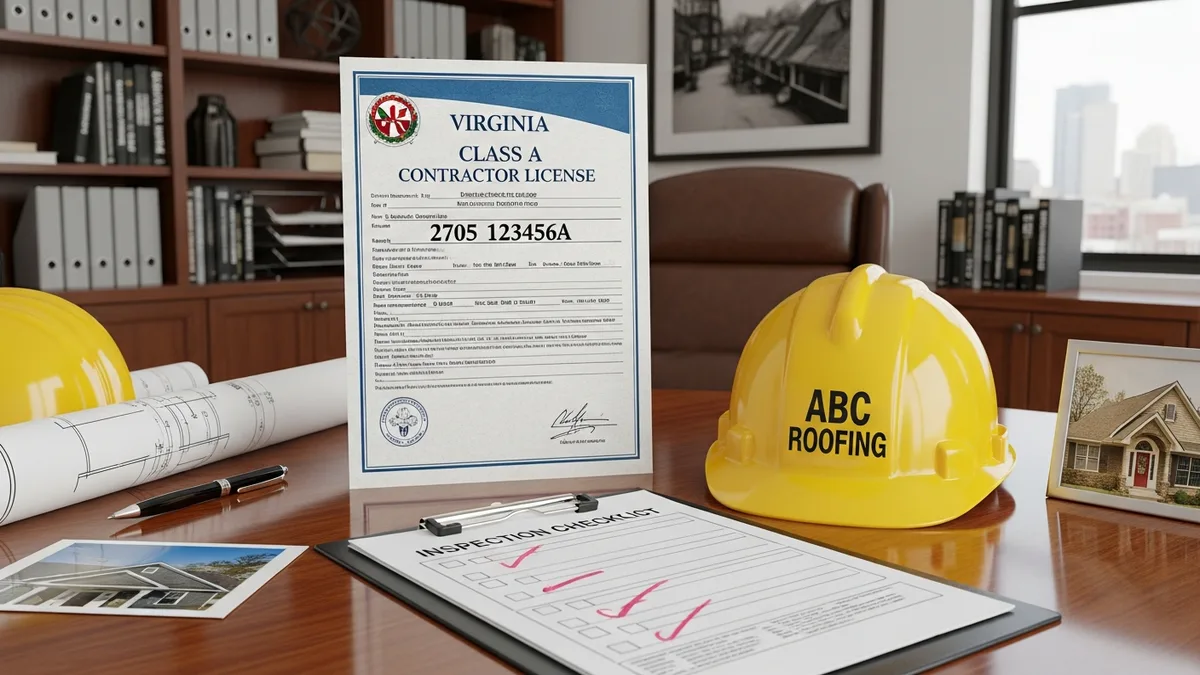
Before you compare quote totals, eliminate any contractor who can't pass basic verification. The starting point is the Virginia DPOR license — check the license number at dpor.virginia.gov and confirm both the class and the specialty. Class A is unlimited, Class B carries a $120K monetary limit, and Class C is capped at $10K and is not appropriate for a full residential replacement. The specialty matters too: an RBC (Residential Building Contractor) or RAC (Residential Accessory Contractor) designation is what you want for a roofing project. Pair that license check with a current Certificate of Insurance showing general liability of at least $1 million per occurrence; the COI should be issued to your project address and ideally name you as an additional insured. Workers compensation insurance is required by Virginia law for any contractor with employees, and without it you could be on the hook if a crew member is injured on your property — our licensed contractor guide walks through how to verify both DPOR and insurance in a few minutes.
Beyond the legal documents, look for the markers of a real local business. A physical office address in Northern Virginia (not a P.O. box) and a trackable phone number that reaches a local office rather than a call center are basic table stakes. Ask for three to five references from jobs completed in the past 12 months in Prince William, Fairfax, or Loudoun and call at least two of them — references that come from your own county and your own decade are far more useful than national platform reviews alone. Then layer in the public reviews on Google, BBB, Angi, and Yelp, focusing on patterns over individual posts; a contractor with 50+ reviews averaging 4.5 or above is a strong signal, and reviews that mention exactly the issues you care about (responsiveness, scope creep, cleanup) are more useful than generic praise. Any contractor who can't or won't produce these items within 24 hours is not a serious bidder, and you'll save yourself considerable time by dropping them and moving on rather than continuing to chase the rest of their quote.
Step 2: The Line-Item Scope Checklist
Build a side-by-side spreadsheet with each contractor as a column and each line item as a row. The line items that matter:
| Line Item | What to Look For | Why It Matters |
|---|---|---|
| Shingle product | Manufacturer + product line + color | $3K–$8K spread between basic and premium |
| Underlayment | Synthetic preferred; product brand | Synthetic outlasts felt; $200–$500 cost diff |
| Ice & water shield | Eaves, valleys, penetrations specified | Code-required at eaves in VA; valley coverage varies |
| Decking replacement allowance | N sheets included + per-sheet rate beyond | $60–$120 per sheet adds up fast |
| Ventilation scope | Ridge / soffit / box / gable / power, brand | Affects warranty and lifespan |
| Flashing scope | All replaced vs reused; pipe boots, step, valley | Reused flashing is the #1 leak source |
| Drip edge | Color-matched aluminum, gauge | Code-required; cheap installs skip color match |
| Ridge cap | Manufacturer-matched cap product | Cut-shingle ridges void warranties |
| Permit inclusion | Pulled by contractor, included in price | $120–$350 in NoVA jurisdictions |
| Dumpster + debris removal | Included; magnetic nail sweep after | $400–$700 if added later |
| Workmanship warranty | Years specified, written, transferable | 5–25 yr range; major quality signal |
| Manufacturer warranty tier | Standard / Silver / Golden Pledge / Platinum | $0–$1,500 cost diff, big coverage diff |
| Payment schedule | Deposit, progress, final breakdown | Large upfront = red flag |
| Start date and duration | Estimated start, expected days on site | Schedule certainty matters in NoVA weather |
If a quote is silent on any of these line items, ask the contractor in writing what they're including. Get the answer in writing too. Verbal additions don't count.
Step 3: Normalize the Scope, Then Compare Prices
Once you have all three quotes with their line items, normalize them to an apples-to-apples scope. The cleanest method is to pick the most complete quote as your baseline scope and then evaluate every other quote against it: identify the scope items in the baseline that are missing or different in the quote you're evaluating, ask the contractor what they would add or charge to bring the quote up to that baseline, identify anything in the quote that is actually better than the baseline (a higher shingle product line, a longer workmanship warranty, ice and water shield extended into the valleys), and only then arrive at the quote's true comparable price after normalization. The point of the exercise is not to find the cheapest contractor; it is to compare three contractors offering the same product so the decision is about quality and trust rather than which one quietly stripped out the most line items.
A common pattern in NoVA looks like this: three quotes come in at $13,800, $16,500, and $18,200. The $13,800 quote uses Owens Corning Supreme (a 3-tab product covered in our 3-tab versus architectural breakdown), 15-lb felt underlayment, no ice and water shield in valleys, and a 2-year workmanship warranty. Once normalized to GAF Timberline HDZ architectural shingle, synthetic underlayment, ice and water shield in eaves and valleys, and a 10-year workmanship warranty, that quote comes up to roughly $16,200 — making it the middle of the three rather than the headline cheapest. The $18,200 quote is for a Class 4 impact-resistant upgrade with a 25-year transferable workmanship warranty (GAF Golden Pledge), which is a meaningful upgrade discussed at length in our Class 4 IR shingle guide. After normalization, the price differences usually shrink dramatically and the actual decision becomes clearer — typically a choice between the two reputable mid-and-premium quotes rather than between three apparently different price points.
Step 4: Watch For These Specific Red Flags
A handful of patterns in a quote or in a contractor's behavior should make you skeptical, and most of them surface during the first conversation. A large upfront deposit is the loudest one — anything over 25 percent before materials are on site is outside industry norms, and the reasonable schedule is a small deposit of 10–25 percent, a progress payment when materials arrive on the property, and the balance on completion. Tied closely to that is "today only" pricing pressure: reputable contractors honor a written quote for 30 to 60 days, and high-pressure same-day signing tactics are the calling card of door-to-door storm chasers who don't plan to be in your area when something goes wrong in year two. The classic out-of-state storm-chaser pattern, with no physical Northern Virginia office and a phone number that routes through a national call center, almost always shows up alongside one of these other red flags.
An offer to "eat" or "absorb" your insurance deductible is another bright-line warning. That practice is illegal in Virginia under Va. Code §38.2-218, and a contractor who proposes it is asking you to participate in insurance fraud — and signaling they'll cut other corners later. Our supplement guide and claims walkthrough explain how legitimate insurance restoration is supposed to work. Be similarly skeptical of any pressure to file an insurance claim when you don't see clear damage; some contractors push speculative claims to drive up project size, which routinely results in a denied claim — or worse, a non-renewal — that our claim denial guide walks through. A verbal-only quote with no signed written scope document leaves you with zero recourse for scope changes or quality disputes, and a workmanship warranty under five years for an architectural shingle replacement signals a contractor who doesn't expect to be around to honor it. Finally, watch for the absence of any mention of a building permit or final inspection — most NoVA jurisdictions require both, and a contractor who plans to skip them is exposing you to code violations at resale — and watch for any pushback on manufacturer-certified installation methods, which are the prerequisite to warranty registration. A contractor who resists certified methods isn't planning to register your warranty in the first place.
Step 5: Demand These Items in Writing Before Signing
A complete signed contract pulls together every line item from the comparison table above into one document. At minimum, it should specify every product by manufacturer, product line, model number, and color — generic language like "30-year architectural shingle" is not specific enough to defend later if a substitution happens during installation. The workmanship warranty terms should be spelled out in full, including the warranty length, whether coverage is transferable to a future buyer, and exactly what is and isn't covered. The contract should also identify the manufacturer warranty tier the contractor commits to registering on your behalf — Standard, Silver, Golden Pledge, Platinum, or whatever the manufacturer's labeling is — because the gap between basic material coverage and a full system warranty can be 20+ years of effective protection.
From there, the operational details matter just as much. The payment schedule should define each milestone clearly (deposit, materials delivery, completion), and a lien waiver from the contractor at final payment — plus from any subs or material suppliers where applicable — protects you from third-party claims after the work is done. Cleanup commitments should be explicit: magnetic nail sweep at the end of the project, dumpster removal within a defined window, and a damage policy covering landscaping, gutters, the AC condenser, and vehicles in the driveway. The change order process should require written approval for any scope additions so that mid-project surprises don't translate into surprise bills. Permit pull and final inspection responsibility should be assigned in writing (most reputable NoVA contractors handle both), and the contract should include an estimated start date with a clear weather-related rescheduling policy so winter and storm-season jobs don't slip into ambiguity. Finally, the contractor's Virginia DPOR license number, business address, phone, and a current insurance certificate copy should all be attached or referenced. Anything not in writing will not be in scope when problems emerge mid-project, and the documents you sign before work begins are the only documents that actually matter once the dispute starts.
Special Case: Insurance Restoration Quotes
When the project is funded by an insurance claim, the dynamics shift in important ways and the comparison process changes accordingly. The carrier's adjuster scope — almost always documented in Xactimate — becomes the real baseline, not the contractor's quote sheet, so you should compare contractor quotes against the adjuster's line items rather than against each other directly. The contractor should bill the carrier directly to the adjuster's scope, leaving you to pay only the deductible at completion. If a contractor wants to "supplement" the claim by requesting additional payment for items the adjuster missed during the original inspection, confirm that they handle the supplement directly with the carrier and that any supplement is documented in writing on the carrier's letterhead. Avoid contractors who promise the entire job will cost you "only your deductible" without showing you the carrier's full payment breakdown — that promise is sometimes a precursor to inflated billing or to the illegal deductible-eating practice flagged earlier. The full mechanics of insurance-funded roofing in Virginia are covered in our claims filing guide, our supplement guide, and our insurance and replacement overview, and they're worth reading start-to-finish before signing any insurance-funded contract.
A Realistic NoVA Quote Comparison Example
Consider three quotes for a 2,200 sq ft Lake Ridge home, presented as the homeowner first received them. Quote A came in at $12,400 total with the entire scope summarized as "replace shingles with architectural; haul away debris." Quote B was $16,800 and listed the full installation: GAF Timberline HDZ in Pewter Gray, GAF FeltBuster synthetic underlayment, GAF WeatherWatch ice and water shield at eaves and valleys, all flashing replaced, ridge vent and soffit vent inspection included, a 10-year workmanship warranty, the GAF Silver Pledge manufacturer warranty registered on the homeowner's behalf, permit pulled, dumpster and magnetic nail sweep included, and a 5-sheet decking allowance with $85 per additional sheet. Quote C came in at $19,400 with the same scope as B but upgraded to Class 4 GAF Timberline HDZ AS II shingles, a 25-year transferable workmanship warranty, and the GAF Golden Pledge manufacturer warranty.
After normalization the picture changes completely. Quote A as written excludes ice and water shield, uses a lower-grade shingle, offers only a 2-year workmanship warranty, and reuses existing flashing — the single biggest leak-source category in any roof replacement, as covered in our leak repair guide. Bringing Quote A up to Quote B's scope adds approximately $3,800 to $4,500, which puts the real apples-to-apples price at $16,200 to $16,900 — essentially identical to Quote B. Quote C is a genuine premium upgrade at $2,600 more than B, buying Class 4 impact resistance plus the longer transferable Golden Pledge warranty, which may or may not be worth it depending on the homeowner's storm-risk profile and resale timeline. The right answer for most NoVA homeowners in this scenario is either B (transparent mid-tier scope from a reputable contractor) or C (the genuine upgrade if Class 4 and the longer warranty fit the home and the budget). Quote A is not actually the cheapest; it just looks that way on first read, and that gap between apparent and real price is exactly what the normalization process exists to expose.
Need a Transparent, Itemized Roofing Quote in Northern Virginia?
Woodbridge Roofers provides fully itemized written estimates with manufacturer products specified by line and model, transparent decking allowances, all flashings replaced as standard, and 10-year workmanship warranties on architectural shingle replacements. Free in-home consultation throughout Prince William, Fairfax, and Loudoun Counties. Call (571) 570-7930.
Schedule In-Home ConsultationFrequently Asked Questions
Related Articles
- Roof Replacement Cost in Northern Virginia
- Licensed Roofing Contractor in Prince William County
- How to File a Roof Insurance Claim in Virginia
- Roofing Financing in Northern Virginia
Conclusion
Comparing roofing quotes in Northern Virginia well requires only two disciplines: verify every contractor's license, insurance, and references before considering their quote, and compare line-item scope rather than totals. The cheapest quote is almost never the cheapest job once you normalize scope, and the patient hour you spend building a side-by-side scope comparison is the highest-leverage hour of the entire project.
If you'd like to see what a fully itemized Northern Virginia roofing quote looks like as a reference, call us at (571) 570-7930 or book a free in-home consultation. We'll provide a transparent line-item estimate you can use to compare against any other quotes in your file.